				
Enrico Zoffoli
Magistery of the Pope
And catéchèses of Kiko :
A comparison
About the Path Néocatéchuménal
		
Edizioni Segno S.r.l.
Via E. Fermi, 80,
33010 Tavagnaccos, Udine, Italia,
Tel. +39 0432 575179
Fax +39 0432 575589
E-mail: info@edizionisegno.it
PREFACE OF THE TRANSLATOR
Is the Path Néocatéchuménal a sect? A Parallel Church? A Church in the church?
While translating this book of the Father Enrico Zoffoli, our desire is that a French public has access to this Italian document importing that fact only to confirm that in very Rome, this movement is contested. He/it is besides all over the world. Few movements caused as many pastoral notes of bishops, of Episcopal conferences. The Pope, while pushing it of his/her/its authority and his/her/its encouragements, also exhorted it more of once of attitudes to avoid. Of the priests himself are opposed of it also. Some Internet sites in the world coalesce faith of the oppositions that he/it creates. Finally some laymen had strong to debate with the members of the Path NC, all this often leading to painful divisions to the human and parochial plans. Besides, it is another source of incentive, that wants to say, the big number of victims, silent for most, that don't have a voice to defend them and to sustain them.
Few documents are precisely about the source of all these problems, that, we sincerely believe it, meet in the founder's teaching. The Father Zoffoli dedicated itself to the analysis of this teaching that is stayed a long time secret, even of members that walked for years in the movement and that ignored the existence of it. The reader will be invited therefore to wonder about the human and pastoral attitudes that can derive such a teaching.
All notes of footing are the translator (as well as a preface and a conclusion) and don't hire the author, although to our opinion, they don't contradict it. We didn't remove anything or added to the translation of the book. For the reader who would find the too trying more theological shutter, we suggest to begin to the page 101.
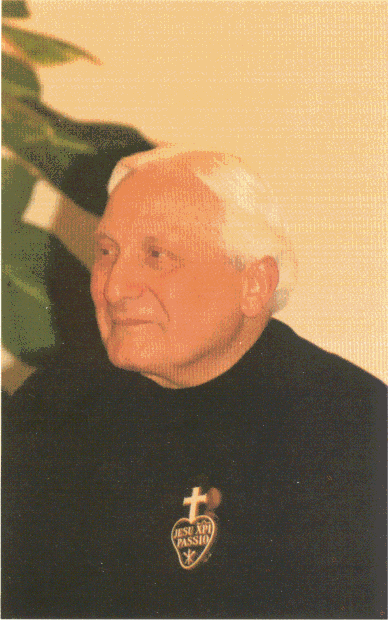
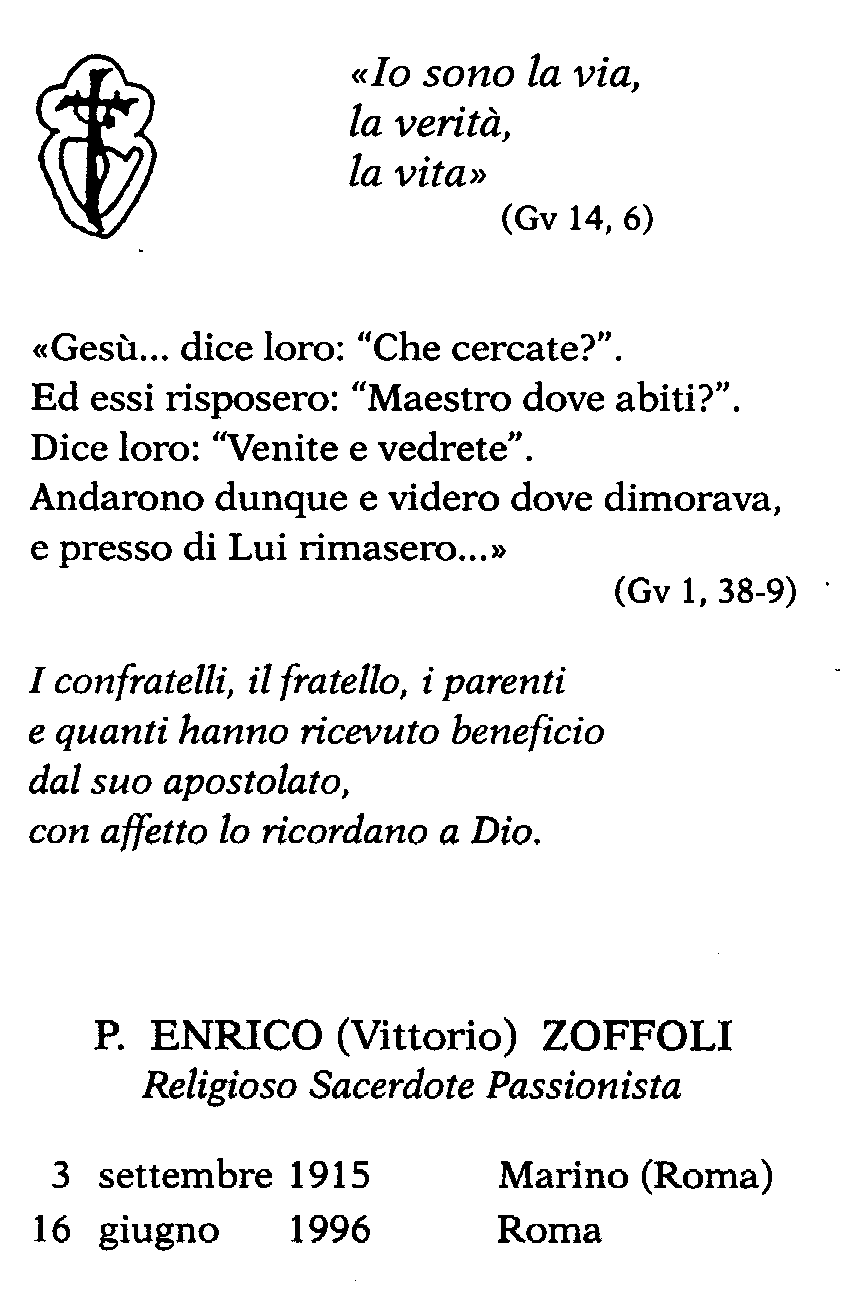
We are anxious to thank the Rome-South association (c/o Fermo Posta, Roma Ostiense, 00154, Rome, Italy) that put to our disposition this biographic note, completed of a bibliography of them. uvres of the Father Zoffoli as well as a photo. Since, to our knowledge, no of his/her/its. uvres is not translated in French, we let the bibliography in his/her/its Italian language. Finally, thank you to the Segno editions, that gave us the authorization for the publication of the translation in French on Internet.
Gone frontal of the memory of the Father Zoffoli		 posterior Part of the memory of the Father Zoffoli
Biography
He/it was born in Marino, small city of the Collar Albainses, September 3, 1915 and all young man felt the Vocation to the "consecration to God" and in order to achieve it, he/it chooses the Community of the Passionisteses, founded by S., Paul of the Cross.
He/it browsed the rules itineraries formatives, while always showing evidence of maturity and devotion. His/her/its superior having discovered at the young a sharp and strong intelligence, they sent it to accomplish his/her/its philosophical and theological studies in the papal universities of Rome and Louvain in Belgium, where he/it dismissed himself/itself in philosophy.
The first destination of the young was therefore the teaching inside his/her/its Community and subsequently to the theological institute for laymen of Co. Cross of Florence for 4 years.
For one decade he/it was then a professor in the university Papal Latran of Rome (1959-69).
Finished the official didactic activity once, he/it dedicated himself/itself to the two functions most important for God's Kingdom: the predication of the spiritual Exercises and the writing of books, some large-scale and value, and of smaller span others, but touching the most present problems. In this activity of writing venerated it father reflects his/her/its interior adherence to the Faith, and to the orthodoxy that must envelop it, and a visceral love of the church, sacrament of salute.
Without no tip of pomposity, one can say that the activity of edition of the P. Zoffoli was "stupendous", as the list of his/her/its publications demonstrates it (cfr. Bibliography).
A special aid of the mind Saint... a happy capacity of synthesis.., a sure and clear theological basis. . .the stern use of his/her/its time... such are the elements that explain the aforementioned stupendous activity.
The Community of the Passionisteses is vastly thankful to him for his/her/its studies on S. Paul of the Cross (until now unequaled) and on Co. Gemma Galgani, and for other booklets on the Passion.
His/her/its disciples and his/her/its supporters will be above all mainly thankful to him for his/her/its different development theological, ascetic and sometimes apologetic on the a lot of Holy Eucharist.
He/it is obvious enough that his/her/its writings drive their roots in the author's personal life that lived his/her/its priesthood and his/her/its mercy eucharistique in the clarity of the Faith and in the mercy of the seraphs.
His/her/its death was as his/her/its life: serene and fervid.
He/it knew some that he/it had believed and hoped.
He/it fell asleep in the Christ like a child who knows that he/it can count on God's love! (16/06/1996).
He/it has been buried in family's vault to the cemetery of Marino (Rome).
Bibliography
Philosophy :
Itinerario went fìlosofia,
Ed., Fiorentina Firenze, 1948, pp. 128.Him male, Lecce, 1951, pp. 116 (ed. Privata).
Problema e male mistero, Marietti, Torino, 1960, pp,. 440.
Ed io che sound system?, Him Crivello, Cittadella Padova di, 1972, pp. 200.
Aborto giudicato tiled ragione, Ed., Grafischena, Fasano (Br), 1975, pp. 80.
The verità, Ed., Grafischena, Fasano (Br), 1975, pp. 40.
Origin del mondo, Ed., Grafischena, Fasano (Br), 1978, pp. 76.
Flags excelled nebulosa all'uomo, Ed., Grafischena, Fasano (Br), 1979, pp. 58.
Esistenza dello spirito e dignità della persona, Ed., Grafischena, Fasano (Br), 1979, pp. 104.
The persona non muore, Ed., Grafischena, Fasano (Br), 1979, pp. 106.
Valore dell'esistenza, Ed., Rogate, Roma, 1980, pp. 262.
Pena di dead e Chiesa cattolica, Ed., Settimo Sigillo, V.S. Veniero, 74, 00192 Romas, 1981, pp,. 134.
Tomismo e cattolicesimo, Ist. Padano A.G di., Rovigo, 1978, pp. 28 (estr. Palestra da Clero del, nn. 20-21, 1978).
Origin delle e idea astrazione dell'intelletto agente in Tommaso san, pp. 50 (estr. Atti dagli Congr dell'VIII. Tomist. Intern., flight. VII, 1982).
The dignità del corpo umano nella dottrina di Tommaso san, pp. 10 (estr. Atti dagli del IX Congr. Tomist. Intern., flight. III, 1991).
Him fundamental tomismo GaliIeo di, pp. 20 (estr. da Doctor Communis, XLIV - 1991, pp. 130-147).
Principi di filosofìa, Ed., Fonti Vive, Roma 1988, pp. 936. Idiot letture di storia del western pensiero.
Apologetic
:Itinerario went fede
, Ed., Grafíschena, Fasano (Br), 1978, pp. 48.Perched creed, Ed., Him Crivello, Cittadella Padova di, 1970, p. 204.
Galileo, Fede nella ragione e ragioni della fede, Ed., Domenicano studio, Bologna, 1990, pp. 180.
Comunione sulla mano? - Him vero pensiero della Chiesa secondo the vera storia del nuovo rito. V ed. riveduta ed ampliata - Roma, 1990, pp. 132.
The confessione ancora necessaria? - Roma, 1990, pp. 222.
The Chiesa vera Cristo di! - Roma, 1990, pp. 316.
The messa è tutto. Catechismo - Roma, 1991, pp. 68.
Eresie del movimento neotecumenale - V ed. migliorata, arricchita di nuove sconcertanti testimonianze. Saggio critico, Edizioni Segno, Udine, 1992, pp,. 168.
Congiura contro the e eucaristia him sacerdozio - Roma, 1991, pp. 174.
The Messa unico e tesoro sweat it concelebrazione - Roma, 1991, pp. 58.
Dio perdona, himself... Dialogo Sacramento sul della penitenza - Roma, 1991, pp. 48.
Magistero del Dad e catechesi Kiko di. Confronto, TO proposito del "Cammino neocatecumenale", Edizioni Segno, Udine, 1992, pp,. 150.
Eucaristia Ecumenismo ed. Dialogo. - Ed. Comitato Medjugorje - Milano, 1992 (V. Cordusio, 4). pp. 134.
Catechesi neocatecumenale e ortodossia del Dad. Ed. Segno, Udine, 1995, pp. 80.
Theology and spirituality
:The obbligo di corrispondere went vocazione,
Ed., Fiorentina, Firenze, 1949, pp. 44 (estr. da Vita Cristiana, fasc. IV-V.Him e mio vostro sacrificio. Lineamenti di una teologia del Sacriftcio eucaristico per laici, Lucca, the 955, pp. 64.
The passione mistero di salvezza, Vicenza, 1966, pp. 248 (successive ediz. italiane nel 1971, 1984,; una e spagnola un'altra portoghese Brasile in).
Done perch the Messa?, Ed. Him Crivello, Cittadella Padova di, 1970, pp. 106.
The dead. E poi?..., Ed. Grafischena, Fasano, 1975, pp. 312.
The passione Cristo di Bibbia nella, Ed., "Him Crivello", Cittadella Padova di, 1971, pp. 310.
Mistero della sofferenza Dio di? - Him pensiero S. di Tommaso. Pontif. Accad. S. di Tommaso, Libr. Ed. Vaticana, n. 34 della coll. "Studi Tomistici", Roma, 1988, pp. 88.
To colloquio Dio idiot, Ed., Rogate, Roma, 1991, pp. 108.
The Messa è tutto. Teologia has servizio della fede, Ed., Cipi, Roma, pp. 242.
Carismi e carismatici Chiesa nella - Ed. Dehoniane, Roma, 1991, pp. 180.
Incontro Mistero al. Elevazioni. Ed. Segno, Udine, 1992, pp. 280.
Catechismo della fede cattolica f.to 11x19, pp. 442, ed., Segno, Udine - 1993.
Him neocatecumenato della Chiesa cattolica. Lettera aperta al clero italiano - f.to 10,5x21, pp. 34, ed., Segno, Udine -1993.
The confessione ancora necessaria? F.to 11x19, pp. 70, ed., Segno, Udine - 1993/24 ed.
Cristianesimo. Float di teologia cattolica - f.to 12x24,5, pp. 1380, ed., Segno, Udine - 1994.
Eucaristia oh nulla f.to 11x19, pp. 132, ed., Segno, Udine - 1994.
Him male. Itinerario della speranza f.to 11x19, pp. 232, ed., Segno, Udine - 1994.
Questa è the Messa. Non altro. Ed. Segno, Udine, 1994, pp. 120.
Chiesa e uomini Chiesa di. Apologia has rovescio, Ed., Segno, Udine, 1994, pp. 56.
Dio. Dov'è Dio questo? - Bridge. Accademia S. di Tommaso, Libr. Ed. Vaticana, Roma, 1994, pp. 380.
Ecumenismo e umanesimo di Giovanni Paolo Him, Bridge. Accademia S. di Tommaso, Libr, Ed., Vaticana, Roma, 1995, pp. 108.
Catechesi neocatecumenale e ortodossia del Dad, Edizioni Segno, Udine, 1995, pp,. 80.
Vita futura e verità sul purgatorio, Edizioni Segno, Udine, 1995, pp.208,.
Hagiography
:The Gemma povera.
Saggi critici storico-teologici. Ed. "Him Crocifisso", Roma, idiot 158 illustr.S. Paolo Croce della. Storia critica. To cleaned Congr della. PP dei. Passsionisti, Roma, 1963-1968.
flight. I, Bibliografia, pp. 1616, idiot e indici 180 illustr. fuori testo;
flight. II, The e uomo him Santo, pp. 1755, idiot e indici 73 illustr. f.to.;
flight. I, Maestro Spirito di, missionario e fondatore, pp. 2512, idiot e indici 77 illustr. F.to.
S. Paolo Croce della. Diario spirituale. Testo critico, introd., note e indici. To cleaned PP dei. Passionisti. Roma, 1964, pp. 102.
S. Paolo Croce della. Profilo. Vicenza, 1967, pp. 102.
S. Paolo della Croce e the Suore Passioniste di Signed, Roma, 1967, pp. 64.
S. Paolo Croce della (compendio big dell'opera, has cleaned PP dei. Passionisti di Puglia e Calabria). Manduria (Taranto), 1975, pp. 338.
Tempo ed eternità. Nella vita summoned S. di Teresa Lisieux di, Ed., O.C.D., Roma, pp. 454.
History
:I Passionisti.
Spiritualità e apostolato. Ed. del "Him Crocifisso", Roma, 1955, pp. XV-404.The monache passioniste, Ed., "Him Crivello", Cittadella Padova di, 1970, pp. 700, idiot 55 illustr. f.to.
Varied publications
:Places di preghiera, non spelonca di ladri,
Roma, 1980, pp. 43.Lettera aperta di a gruppo di laici al clero italiano, Roma, 1986, pp. 38.
Dizionario Cristianesimo del, Ed., Segno, Udine, 1992, pp. 588.
|
Leaves scoperta Gesù di, Maurizio Minchella Editore, Milano, 1996, pp,. 48 |
_____________
- The present bibliographic report doesn't consist of many small and big unpublished writings, nor the articles appeared in magazines and dictionaries.
MAGISTERY OF THE POPE AND
		CATÉCHÈSES OF KIKO :
		UNE COMPARISON
About the Path Néocatéchuménal
In His/her/its Holiness Jean Paul II
Infallible Master of truth
to refute the accusations
of a lot of Néocatéchumèneses
of which I expose the blindness
and the behavior and
who didn't understand
the more orthodox sense of their" path "
PREAMBLE
Whereas exhausts itself the last edition of my booklet Heresies of the Movement Néocatéchuménal, I have been encouraged by the reverend grant Gino Conti to undertake this work, to which my friend collaborated efficiently with an ample and scholarly compilation of drawn texts of the Pope's Magistery, intended to be opposed to other catéchèses of Kiko Arguëllo. We could not adopt a better method to satisfy a public always vast, anxious to know the real reports of the thought of Kiko with the doctrine taught throughout by Jean Paul II and rise in the water level good" Catholic ".
The goal of the present test is to answer - with data to the hand - to all Néocatéchumèneses and sympathizers, whom stops objecting to my accusation of "heresy" makes it that - as they say - the Pope knows all, the Pope is with them, the Pope approved the charisma of it, the Pope blessed some and encouraged several times l'. uvre in the fields liturgical, pastoral, missionary...
I sustained that the Pontiff is only informed in part of the" Path ", especially ignoring the dogmatic premises... But, in the hypothesis that he/it was informed of all, I would not dare to discuss ever on the reasons of his/her/its silence and his/her/its attitude in favor of the Movement: tomorrow history will be able all to reveal, us while handing to God's judgment at present.
In spite of it I feel the duty not to stop denouncing the mistakes overtly against the faith contained in the famous text of the catéchèses of Kiko, that I already criticized: Orientations for the Teams of catechists for the phase of conversion (Madrid, February 1972).
The typed copy that I examined goes back up to March 1982. Now, that this one is authentic, it is demonstrated, over it all, because she/it has been corrected by the Center Néocatéchuménal" Servant of Jahvè in the San Salvador ", Piazza S. Salvador Campo in, Rome. But, as he/it has not without reason been observed, Kiko, after some years of new experiences and reflections, have touched up it and corrected maybe also in the incriminated points...
Not wanting to run the risk to take me against the" windmills ", I obtained of other more recent writings of the author (or better, of his/her/its registered speeches) of which I introduce the list, at least of those that I succeeded in having. Will be presented you two writings that, even while being previous to those of 1982, don't defer the quoted Orientations, which amplify however and confirm the idea :
1 - orientations to the Teams of Catechists for the "Shemà" (Notes valued from the ribbons of the Shemàs made by Kiko and Carmen in some communities of Rome and Madrid in 1974) pp. 110.
2 - as preamble to the whole cycle of the Catéchèseses of the announcement we put the translation (drawn of the registered ribbons) of everything that has been said by Kiko in a meeting made to the Center Néocatéchuménal of Madrid October 22, 1981, to orient the available catechists in order to make some catéchèses in new parishes, pp. XVI.
3 - orientations to the Teams of Catechists for the Convivence of the Renovation of the first baptismal Vote (drawn Notes of the catéchèse given by Kiko and Carmen in Madrid in 1972, with additions of 1986, pp. 14.
4 - announcement of the Lent - March 1, 1987 - Crypt of the Martyrs Canadians, pp. 14.
5 - announcement of the Advent - Crypt of the martyrs Canadians - November 25, 1987, pp. 31.
6 - drawn notes of the Catéchèseses of Kiko in the Convivence of Arcinazzo of September 22-25, 1988 (to help the teams who participated in the convivences of the catechists or persons responsible in order to return the experience in their own communities, pp. 18 consistent by two letters of Kiko).
7 - announcement of Easter - Crypt of the Martyrs Canadians, March 25, 1988, pp. 21.
Having read these writings attentively, I didn't find anything considerable that makes suppose turning around or a recantation of those that are known more and more elaborate, that I presented in the booklet Heresies of the Movement Néocatéchuménal.
It allowed me one comparison more objective of the catéchèses of Kiko with the Pope's doctrine.
The author
Rome, January 28, feast of S., Thomas of Aquin
FIRST PART
		 COMPARATIVE
ANALYSES
					 I	
		
		
the Catholic church: the unique enclosure
THE POPE
" That resounds always living in our ears the mandate of the Divine Mr.: "Go therefore and teach all nations, their teacher to observe everything that I ordered" you (Mt 28,19s) Conscious of an as big responsibility, you must make yours the apostolic anxiety of S. Paul when he/it exclaimed: "misfortune to me if I don't evangelize (1 horn 9, 16). And, as the same Apostle recommends it, you must preach the speech" in all opportunities, in time and to against time" (2 Tms 4, 1s), completely convinced of the inherent strength in the truth that the church professes since two thousand years. Every action of evangelism moves therefore to make that every person and every community open up completely to "God's Speech (Montevideo, To the religious, 31.3.1987).
" In light of the new Epiphany God is revealed in Christ to all peoples and to all nations of the earth. To all is destined the divine light that penetrates in the obscurity of the human existence. " (For the ordination of 10 bishops, 6.1.1988).
"Even though the times and mentalities change, Jesus' Words to the Apostles remains always valid and present: "I have other sheep who are not of this enclosure; and those as, it is necessary that I lead them; they will listen to my voice and there will be only one herd and only one shepherd" (Jn 10,16). " As the Father sent to me, me also I send" you (Jn 20,21) "Go therefore: of all nations made of the disciples, baptizing them in the name of the Father and the Son and the Holy Mind, their learner to keep everything that I prescribed" you (Mt 28,19). It is the will certain of God expressed by the Christ's command that adds: Don't fear (.). I am with you until the end of the world" (Mt 28,20). ( cf. : XVIe Council of Tolède, D-S 575,; III innocent, 792,; IVe Council of the Latran, 802,; Boniface VIIII, 870,; Council of Constancy, 1191,; Council of Florence, 1351,; Léon XII, 2720,; Grégoire XVI, 2730,; IX magpie, 2785, 2865, 2917ss,; Léon XIII, 3304,; XII magpie, 3821s, 3866-73, )
KIKO
About the nature, the mission and the destiny of the church, Kiko doesn't get lost in subtlety: it would not be necessary more of them to believe it heretical.
" Let's think ourselves maybe that the mission of the church is to take all people who are outside of the church and to bring them inside (.). If it was the truth, we could say that Jesus Christ failed after 2000 years because today, those that are really in the church are very few. If the mission of the church is that all people enter there, how God can it permit that there is so little people today in the church? ( Orientations to the Teams of Catechists for the phase of conversion. . Notes from the ribbons of the meetings held by Kiko and Carmen to orient the teams of catechists of Madrid in February 1972. Publications to the care of the Center Néocatéchuménal " Serviteur of Yahvé" in San Salvador, Place S., Salvadore Campo in, 00186. Tel. 6541589. March 1982, p. 78).
" The mission of the church is not to make that all men enter there to make part juridically of it, but that the men are illuminated by the church and arrive to the Father". p. 81
" Of salute dawns out of the church (.). In this sentence, included juridically, reflect himself the whole mentality of people that will listen you. She/it is to the basis of all our mentality on the church. From there come all extreme unctions to all patients, the confessions at the last moment, and the baptisms as quickly as possible to the children hardly born. Because if the church is the unique board of salute and if the one that doesn't belong to him juridically condemns itself, this is how it is necessary to make". (id., p. 82. Cf. id., pp. 83, 84, 86).
" The church is an event, it is a history, it is a fact". p. 87
But how all this can he/it be, if she/it is not before a whole "society" with his/her/its clean energies, his/her/its message? Kiko manages to say that she is not either" a religion ". ( id. ).
" The primitive church never considered itself as the unique board of salute, but as having a mission inside history. " (id., p. 81s).
Therefore: ". This is how we think the church; without triomphalisme, nor proselytism, without wanting to carry Jesus Christ I don't know where, or that all enter in the church" (p. 86).
Therefore, it is indifferent to belong or no to the Catholic church, or to the hierarchical church, the one that is visible, that kiko calls" legal ", but that is definitely the only one founded by the Christ and whose pastor is Jean Paul II... He/it follows than always according to the charismatic chief of the néocatéchumènes :
- the" other sheep" that at present is not of its "sheepfold" don't belong to the Christ nor are not held to enter even to form one herd only...
				
II	 Speech
of God and ecclesiastical Magistery
THE POPE
" The supporters are called to serve God's revelation, rather than to use the speech to assist their ideas, just as elevated that they can be. One cannot forget that the Speech is confided to the church (Council Vatican II, Dei Verbum, 10) and that the service of the Magistery of the church has the responsibility of the authentic interpretation of his/her/its message" (TO the federation for the biblical apostolate, 6.8.1984).
"This duty (to interpret God's Speech authentically) has been confided to the only living Magistery of the church, whose authority exercises itself in the name of Jesus Christ (Dei Verbum 10). has a new characteristic of the faith therefore: to believe Christian manner means to accept the truth revealed by God also as the badge of the church ". ( General audience 24.4.1985. Cf. Community for the Doctrine of the faith, Instruction on the theologian's ecclesiastic vocation, 24.5.1990, )
( Cf. : Council of Thirty, D-S 150,; IV magpie, id. 1863; Alexander VIII, id. 2284; Benoît XIV, id. 2538; Council Vatican I, id. 3007; Léon XIII, id. 3281; X magpie, id. 3401-8, 3546,; XII magpie, id. 3887).
KIKO
" In this path, we want that people meet the books of the Bible directly. It is useless that people read the Bible home, because since the fourth day they get tired. The Bible is interpreted of her even through the parallelisms". (id., p. 372 )
In his/her/its Orientations, Kiko rarely mentions the multiple documents of the Magistery of the Popes to illustrate some and to verify the thought of it; so of those that protected it a lot and encouraged, Paul VI and especially Jean Paul II.
In his/her/its Orientations he/it speaks only only of two of the twenty-one Councils. cuméniques celebrated by the church: the Council of Thirty and the Council Vatican II, but only to oppose them one towards the other.
The Council of Thirty, mainly famous against the mistakes of the Protestantism, that are blamed toughly,: "With the Council of Thirty, and of the XVIe in the XXe century, all blocked rest". (id., p. 174 )
" But to Thirty one put all the accent on gas, on the efficiency, and one lost of view the sacramental value of the sign". (id., p. 175 )
". With the Council of Thirty in the XVIe century, all is fixed rigidly, while imposing radical manner the Roman ritual. With this imposition he/it is not henceforth more possible to remove or to add whatever it is at the Mass. This is how the Mass arrived until us. This fixisme lasted such a long time that when one has for the first time changed the liturgy, we were shocked because it seemed unchangeable to us. It is a mistake". (ibid. p. 325) - after Thirty, we remained with gas and the efficiency while underestimating the value of the signs". (ibid. p. 327 )
But Jean Paul II, in agreement with all his/her/its predecessors, mentioned and approved several times the Council of Thirty, as having a definitive dogmatic value. ( cf. General audience 8.1.1986; 8.10.1986 )
To the condemnation of the Council of Thirty, by Kiko, answers the respectful panegyric of Vatican II, thanks to which" we nearly came out of the permanence total" (id., p. 73. Cf. id., p. 67ss, 81, 316, 327, 332, 334, 335, 348, 349, 350, 351).
Not a sign of the theologians, small and big - including S. Thomas - that had the merit to prepare, to develop and to defend the official Magistery of the church; but on the contrary distrust and contempt towards tous.Kiko satirize on their proceedings about the dogma eucharistique and in general of their treaties (cf. id., pp. 74, 251, 264, 325, 326, 329).
Answering one present topics of biblical exegesis, Kiko teaches: "You cannot give an interpretation to your manner of this Speech, because there is an interpretation that is the one that gives the church (ibid. p. 239). Exact: the survey of the parallel passages is not sufficient, it is necessary to come out of the text and to call on the authority of the ecclesiastical Magistery. Kiko gives lessons of orthodoxy. But he/it often contradicts himself/itself, because some of his/her/its interpretations of God's Speech contrast with the Magistery. Thus, his/her/its relative exegesis to the sale of goods is completely personal and aberrant (Mt 19, 16-19,; Lc 18, 18-30); to the community of goods (Ac 5, 1-4). And they don't count themselves the diametrically opposite biblical passages to the exegesis kikienne around the redemption, of the Christ's sacrificial mediation, Victim of the sins of the world.
Unfortunately, the catechists of the path hold for" possessed by the demon" whoever defers the speech of Kiko, imposed like indisputable.
					 III
	 HIERARCHICAL STRUCTURE OF THE CHURCH
THE POPE
" It is here, to the altar, that the church is revealed in its most intimate nature as hierarchical communion of faith, hope and charity (To the American Prelates, 2.3.1989, )
The" sense of our Episcopal ministry (...) includes duties mainly to teach, to sanctify and to govern. These duties are exercised in the hierarchical communion with the head of the college of the bishops and with the members of this college...( To the Episcopal conference of Canada, 20.9.1984, )
"To the basis of the communion, that in a some sense holds all the church together, explain himself and achieves itself also the hierarchical structure of the church, endowed by the Lord of collegiate nature and at the same time primatiale when it constituted the Apostles to the manner of a College or a steady class, to the head of which it put Pierre, chooses the middle of them... ". " To use words of the Council Vatican II", the bishops, again therefore, assume the ministry of the community with their collaborators priests and deacons, while presiding the herd of which they are the Pastors, as Masters of the doctrine, priests of the sacred cult, ministers of the government". (Apostolic Constitution., Good Pasteur, 28.6.1988. - cf. General audience., 22.6.1988; to the representatives. cuméniques, 26.6.1988; to the bishops of New Zealand, 9.4.1988, to that, he/it has between recalled other: "The ecclesiastic significance of your visit is a hierarchical communion.")
(cf. : Clement of Rome., D-S 101; Council of Florence, 1318,; Council of Thirty, 1768,; Council Vatican I, 3061,; IX magpie, 2919,; Léon XIII, 3167,3171; Magpie IX, 3685,; XII magpie, 3804,; Council Vatican II, Holy Liturgy. 26; The church, 4, 8, 10, 18, 20,; The ministry and the life of the priests., 5).
KIKO
" . The church is not a legal reality but sacramental". (id., p. 167) the primitive church, with the penitential discipline, acquired" a legal dimension" (id. ). Kiko rejects" a legal vision of the church" (id. ). " Where is the church then? Where is the mind Saint, Jesus' bracing mind resuscitated Christ, there be the new man of the sermon on the mountain. Where there is it, there be the church. (p. 88). Therefore, the non hierarchical church. Bishops, priests and deacons don't represent as essential elements of the church that illuminate, sanctify, guidance.
Shortly before indeed (p. 88) he/it had said that the parish, the vicar and the priests don't make the church; didn't please the fact that there are a community and a priest; that one celebrates the Mass, that one gives a catéchèse and that one believes in revealed truths... The church, according to it, is constituted other things by far, and precisely of supporters that, animate by the mind Saint, live in God's grace, according to the mind and the letter of the" sermon on the mountain" of which is not formed a visible, composed society also of sinners...
Kiko recalls the theses therefore the more condemned of the Magistery. It would be sufficient to recall the position of Montan, disciples Béguards of the Middle Ages (D-S 893), of the Brothers (D-S 910-912), and then of Jean Wyclif (D-S 1187), Jean Hus (D-S 1201-1206), Luther (D-S 1465ss), P. Quesnel (d-S 2474ss), the Jansenists of the Synod of Pistoia (D-D 2615. cf Magpie XII, Mystici corporis, D-S 3803).
				 & #9;
IV&#
9;		SACERDOCE MINISTERIAL AND&#
9;		SACERDOCE COMMON
THE POPE
"The Council Vatican II recalled us this splendid truth" on the universal priesthood of God's whole people, that drifts of the involvement to the unique ministration of Jesus Christ ". Our "ministerial" ministration, deep-rooted in the sacrament of the order, essentially differentiates itself of the universal priesthood of the supporters (.). The Sacrament reaches this goal (to illuminate the supporters) through the ministry of the speech and sacraments, that is clean to him, and especially through the Sacrifice Eucharistique, for which only it is allowed ". ( To the clergy of Rome, 9.11.1978).
" The ministration to which we participate by the sacrament of the order, that has been engraved forever in our souls by means of God's special sign, that means the" character ", home in explicit relation with the common ministration of the supporters, that means of all baptized and, at the same time, essentially defer him" and not only in degree" (Lumen Gentium, 10). If they not only differ between them in degree, but in gas, it is the fruit of a special wealth of the Christ's very ministration, that is the unique center and the unique source is of this involvement that is the essence of all baptized, either of the other involvement to which one arrives by means of a distinct sacrament, that is precisely the one of the order..."
" Our sacramental ministration, therefore, is at the same time hierarchical and ministerial ministration - constituent a special ministry - that means that he/it is a service with regard to the community of the believers. He/it doesn't pull his/its step origin however from this community, as if it was hers to call or to delegate. It is rather a grant for this community and he/it comes of the Christ himself, in the fullness of his/her/its ministration. Such a fullness finds its expression in the fact that the Christ, while making us all capable to offer the spiritual sacrifice, call some of it and it makes them capable to be ministers of his/her/its same sacramental sacrifice: The Eucharist to which oblation contributes all supporters and in which are inserted the spiritual sacrifices of God's People.
"Conscious of this reality, we understand what manner our ministration is hierarchical, that means related with the power to form and to sustain the ministerial people (Lumen Gentium, 10) and, indeed for it, ministerial... " ( To all priests, 8.4.1979; (cf. Ordination of the priests of Rio de Janeiro, 2.7.1980); To the priesthood of Parigi, 30.5.1980; To the priests, holy Thursday, 16.3.1989; Exhortation apostolic Christifideles, 30.1.1988,22; Angelus, 8.3.1987).
( Cf. : III innocent, D-S 794, 802,; Clement VI, id. 1084; Council of Florence, id. 1321; Council Vatican II, Lumen Gentium, 10, 21, 25, 26, 41,,; Christus Dominus., 15; Xii magpie, Plectrum Dei, 68-69).
D OH N C :
The priest is placed to centers it even of the Christ's mystery (..). He/it acts" in the "Christ's person particularly when he/it celebrates the Eucharist: by his/her/its ministry the Christ continues to exercise in the world his/her/its. uvre of salute ".
" I know good that the Catholic laïcat of Honduras has more and more took conscience of his/her/its responsibility inside the church and that it is contributing in charge of to spill the evangelical message. This one must not have the irreplaceable and particular place however forgotten that, for the sanctification of God's people comes back to the priests, wanted by the Lord so that" in the society of the supporters they had the power consecrated of the order to offer the Sacrifice and to forgive the sins, and that to the Christ's name they exercise for the men in an official shape the ministerial function ".." ( The Ministry and the life of the clergyman, 2. - To the Bishops of Honduras, 23.11.1978).
KIKO
We don't have either of priest to a person's sense that we would separate of all other because in our name she/it would take contact with the divinity. Because our Priest, the one that intercedes for us, it is the Christ. And since we are his/her/its Body, we are all priests.
All the church is ministerial to the sense that it intercedes for everybody. It is true that this ministration makes visible in a service and that there are some brothers who are servants of this ministration, ministers of the ministration. In the New Will, the word "priest" is never used otherwise that in reference to the Christ; to part it, one speaks of ministers or presbytres". (id., p. 56 )
Kiko doesn't think however (or doesn't believe) that the Catholic priest is minister of the ministration because in him the Christ lives with the power of his/her/its mediation by the Father; for it in him only (and no the supporters or the community of the supporters) conjugates itself in first the person of the verb who expresses the exercise of the powers exclusively clean to the Christ.
Unfortunately, some unanimous and influential testimonies confirm that in the Communities Neo Catéchuménales it is not the "priest" (= presbytre), but rather the "catechist" (= layman) that presides as soul and animator, feeling all and commander to all... However, exactly to the priests the Pope, December 9, 1985, grown necessary to express itself/themselves in the following terms: "... In this l path'. uvre of the priests remained fundamental ". They are "the guides of the community"; for which" the requirement first that imposes itself is to know how to maintain the faith in your ministerial identity.
" According to the sacred ordination, you have been marked with a special character that configures you to the Christ priest, in order to be able to act in his/her/its name. The sacred Minister should be welcomed therefore not only like f r è r e that shares the path of the very community, but especially as the one that, while acting "in the Christ's person ", door in itself the irreplaceable responsibility of Mr., Sanctifier and Guide of the souls, responsibility to which he cannot renounce in any way (...) It would be an illusion to believe that to serve the gospel dilutes your charisma in a false sense of humility or a demonstration badly interpreted of f r has t e r n i t é (...).
Don't let deceive you! The church wants you priests and the laymen that you meet want
you priests and anything else that priests. The confusion of the charismas impoverishes the church, it doesn't enrich it (Speech of the 9.12.1985 )That is not sufficient. Exactly as addressing in the Néocatéchumèneses, the Pope, the 10 fév.1983 had warned: "Follow the methods, the indications, the itineraries, the texts offered by the Episcopates, exercise the ministry of the catéchèse also in the communion and in the ecclesiastic discipline, while respecting the ministry founded of the bishop and priests who are associated to him, it will be a precious help for your catéchèse to all levels..."
On the contrary, The néocatéchumènes has their "catéchèses", conceived and organized to their manner, in following neither the indications nor the methods of the Bishops. The "priest", in the Communities, is only a president for the ritual and the sacramental: presidency, his, that includes no authority magistérielle. The community is directed by a responsible layman: "The big danger of the communities - according to Kiko - it is that the priests kill them without wanting it. In this path the community will have a responsible layman". (id., p 371s). Therefore: "This community won't walk alone, as good seems you, while making each what pleases him, this community it is we that direct it in the name of the bishop. We have the mission to drive you to the adult faith, to the baptism. It is why doesn't have a catéchuménat without obedience to the authority of the catechists". He/it follows that the vicar must limit himself/itself to preside" the local community" (id., p. 370), that is well something else that the "community."
The one that is elected "catechist" must consider itself full by this same Mind Saint, and from this moment his/her/its instructions and sentences are indisputable, infallible... He/it has" the charisma of the discernment of the minds" (id., p 188). In short" if there is not an obedience towards the catechists, there is not a path". (id., p. 353).
But, nor the bishop nor the Vicar don't choose the catechist. To them is confided the duty only to confer "the mandate" in a solemn ceremony; who is adjusted by a ritual conceived by the Movement and he/it consists in the imposition of the hands on behalf of these last... The result is an ecclesiastic structure of parallel service that one founded on the sacrament of the order... But, Jean Paul II, also while recognizing to the Shepherds the authority to confer some tasks to the laymen, warns that" the exercise of these duties made not of the faithful layman a shepherd: actually it is not his/her/its duty to constitute the ministry, but rather the sacramental ordination..."
Unfortunately, "the catechist" in the community catéchuménale assumes a power that exceeds all limits of his/her/its condition... The complaints and the protests on behalf of the supporters fallen in its net are very big, frequent.
					 V
THE SIN
THE POPE
" While sinning, the man" is facing God's exclusion by the opposition in the face to one his/her/its commands, by a gesture of rivalry to his/her/its consideration, by the pretension misleading to be "as Him" (.). In the case of the Eden appears in all his/her/its gravity and his/her/its intensity what constitutes gas the most intimate and most obscure of the péché : the disobedience to God, to his/her/its law, to the moral rule that he/it gave to the man (.). Exclusion of God, rupture with God, disobedience to God: all along the human history this one was and was, under different shapes, the sin that can arrive until the negation of God and his/her/its existence,: it is the phenomenon named atheism (.). Disobedience of the man that, with an act of his/her/its liberty, doesn't recognize God's domination on his/her/its life". (Reconciliation and penitence, 14. Cf. 15).
" Why and in what measure is the sin engraves in the offense that is made to God and in his/her/its repercussion on the man? The church has its doctrine to this topic and it reaffirms it in his/her/its essential elements". (id., 17).
"... The man feels that this disobedience truncates its relation to God in his/her/its vital principle: it is a deadly sin, that means an act that offends God seriously and finishes by turning against the man himself with an obscure strength and a power of destruction... " ( id., 17).
" Then it is vain to hope that takes consistence a sense of the sin opposite the man and the human securities, if he/it misses the sense of the offense committed against God, that means the sense truly of the sin" (id., 18).
"God is always the main oh f f e n s é by the sin - "tibi soli peccavi! " - and only God can forgive..." ( id., 31/III).
"Those that approach of the sacrament of the penitence receive God's mercy the forgiveness of the offenses that is made to Him and, at the same time, the reconciliation with the church... " ( id., 30, where are mentioned the Council of Thirty, D-S 1668-70, 1701, and the Vatican II, The church, 11).
In the beginning of the Lent of 82 Jean Paul II spoke of the love of a "jealous" God, oh f f e n s é by the man, guilty to have erased in him his/her/its picture, while sinning.
In the encyclic Dominum and vivificantem the Pope comes back on the sin as oh f f e n s e to God, as far as being going to suppose that he really suffers (id., 39).
( Cf. : Council of Thirty, D-S 1525, 1528,; Decree of the S.Office., id. 2291; XI magpie, Miserentiss Redemptor,; XII magpie, iv. 3891; Council Vatican II, The church, 11,; The church in the world of this time, 13, 22, 41).
KIKO
" One wonders if it is possible to offend God solely. The question is asked thus because we have a vertical conception of the sin, individualist,: that it is we that offended God in a certain manner, as if the sin was an offense God's in the sense that one can steal from him his/her/its glory. We believe that we can make a damage to God. The first thing that we must think that is that it is not possible to make a damage to God. God is invulnerable. One cannot pull him his/her/its glory of no manner."
" In what sense can one speak about offending God? In the sense that the sin breaks God's plan. What is God's plan, God's intention on the man? The love. The sin is always a rupture of love. " (id., p. 182).
It is necessary to get along:
a) It is certain that the sin doesn't offend God solely; But it is also incontestable that he/it is mainly "offense God's": the true conception of the sin is essentially "vertical", because as offense to God the sin makes the wrong to that commits it only and to his/her/its neighbor. And, in spite of what Kiko thinks some, the very conception of this sin is as "personal" because it consumes himself/itself in an immediate report of altérité between the unique human person (conscious and free) and God. It is not the "community" that sins, but each of the members that composes it, for which each is the first to answer for his/her/its action.;
b) No one can suppose that the sin removes something to God, him whose beatitude remains immutable, in spite of all human iniquities.;
c) The sin however offense really God in this sense that the man refuses Him the love that he deserves, as refusing to recognize the absolute character of his/her/its pre-eminence, the truth of his/her/its infinite perfection, the clean required to Really depend on Him the Sovereign, eternal Law, sovereign Providence. But, this lack of recognition is the worse of the injustices, because the man doesn't assign to God what belongs to Him objectively; and exactly for it he/it offends it, even though he/it only harms himself/itself to himself, while refusing to adhere to his/her/its unique Good.
In short: Kiko only conceives the plan of God's love for the man, without thinking that the man can be only happy to the condition to like God in first and over it all, because his/her/its true good depends solely on such a love.
As we will see, the man, who doesn't offend God, is not held to some such atonement the mind of "sacrifice" that Kiko repulses logically.
						 VI
POSSIBILITY OF THE SIN
THE POPE
" As writing the apostle holy Jean", if we say that we are without sin, we are mistaken ourselves and the truth is not in us. If we recognize our sins, Him, is faithful and just, he/it will forgive our sins" These inspired words written just before the church orient this speech better than any other human expression on the sin that is closely unites with the one on the reconciliation (...). To recognize the sin indeed, or better - while going more again truly to the bottom in the consideration of the personality - to recognize the sinner, capable of sin and carried to the sin, is the beginning indispensable of the return God's". (Reconciliation and penitence., 13).
The expression" mystery of the sin" tempts to make us discern what of dark has and of elusive that hides in the sin. This one is l'. uvre of the man's l i b e r t é undoubtedly..." ( ib., 14 )
" The sin, in a real sense, is always the person's act, because it is an act of l i b e r t é of only one man, and no mainly of a group or a community. This man can be conditioned, hurried, advanced in more of a case by light external factors, as also he can be subject to tendencies, of the flaws, of the habits inherited of his/her/its personal condition. In more of a case of such external or internal factors can attenuate in more or less big measure his/her/its liberty and, then, his/her/its responsibility and his/her/its guilt. But it is a truth of faith, confirmed by our experience and by our reason, that the human person is l i b r e. One cannot ignore this truth, to unload on the external reality - the structure, the systems, the other - the sin of each. Over it all it be annul the liberty and the person's dignity, that also reveal - although in this case in a negative and disastrous way - the responsibility for the sin committed. It is why, in every man doesn't have anything more personal and untransferable that the merit of the virtue or the responsibility of the mistake". (id., 16).
" The sense of the sin (.) is bound closely with the moral conscience, with the research of the truth, with will to make an use responsible for the l i b e r t é". (id., 18 )
( Cf. : Council of Arles, D-S 331, 336, 339,; Léon X, id. 1486; Council of Thirty, id. 1555; Léon XIII, id. 3285).
KIKO
" The man cannot make the good because he parted with God, because he sinned and that he remained radically impotent and incapable, to the power of the demons, he remains slave of the Shrewd. The Shrewd is his/her/its Lord. It is why the advice and the demanding sermons are not worth anything. The man cannot make the good (.) You cannot accomplish the law because she tells you to like, not to resist the pain that one makes to you, but you you are not able to: you, you make what the shrewd" wants (id., p. 130. Cf., p 135).
The man" is fundamentally tare. He/it is carnal. He/it cannot make otherwise that to steal, to argue, to be jealous, to envy, etc. He/it cannot make otherwise and he/it is not offending" of it. (id., p 138 )
For it the speeches don't serve exactly" to anything. He/it doesn't serve to anything to say: sacrifice yourselves, like yourselves! And if someone tries, he/it will become the biggest pharisien of the world because he/it will make all for his/her/its personal perfection". (id., p 136). Strange, irritating way to reason!.
Therefore, the personal perfection wanted by God (Mt 5,48; Ep 4, 13,; Jc 1,4; 3,2) would not a duty be? And reason would a "pharisien" be the one that worries to incite and to stimulate the other to make some as much?. - does Kiko show that he doesn't know this that he says, of the less according to the biblical language, business of the church and all Holy.
Family's mother wrote to me, in other,: "I had to face the Néocatéchumèneses and their priests with discussions on the confession and the sin. Confession or no, we are always in the sin; one has the impression that the Grace doesn't exist; but of the rest she/it doesn't serve to anything, because the one that hopes to enjoy is a presumptuous of it, because he/it wants to become like God, and he/it is in Satan's hands because he/it doesn't accept himself/itself as he/it is (God doesn't want us so different, because he likes us really thus); is worth as much to continue better to sin..."
Is this the drank to which stretches" the Path Néocatéchuménal?"
					 & #9; VII
			 & #9
; THE CONVERSION
THE POPE
The biblical message" underlines in the penitence before all his/her/its conversion value, term with which one tries to translate the word of the text Greek metànoia, that means to let return the mind literally to make turn it toward God. These are the rest the two fundamental elements emerging the parabola of the lost son and regained: to bring it" in itself" in, and the decision to come back to the father. He/it cannot have a reconciliation there without these attitudes primordial of the c oh n v e r s i oh n..." ( Reconciliation and penitence., 26 )
To "make penitence wants to say, beyond all, to re-establish the balance and the harmony broken by the sin, to change direction, even to the cost of sacrifices... " ( id., 26).
" The essential act of the penitence, on behalf of the penitent, it is contrition, that is to say a clear and resolute repudiation of the sin committed together with the intention not to return to commit it (Cf. D-S 1676-7) for the love that he/it carries to God and that is born again with the repentance. It being agreed, contrition is therefore the beginning and the soul of the conversion, of this evangelical metànoia that brings back the man to God as the son lavishes that comes back to the father". (id. 31/III).
( Cf. : Council of Thirty, D-S 1457, 1526s,; 1669).
KIKO
"The conversion is never the fruit of the man's effort... " She/it is" God's grant, God's call, "God's initiative. (id.., p. 163).
Initiative of God, pre-eminence of his/her/its grace, etc.: doesn't have doubt, against every tendency pélagienne,; but Christianity repulses as every behavior quiétiste, while reminding to all that it is necessary" to tighten the teeth" and to make all our "efforts" to disown itself/themselves, to take his/her/its own cross every day, to prefer the Christ to his/her/its own goods and to the dearest people, to sacrifice his/her/its own life... ( Mt 10,37-39; 13,44; 16, 24-25,; Mc 8,34-37; Lc 9,23-27; 12,33; 14,26-27; Jn 12,24-25).
Kiko seems to forget that" our struggle is not against creatures made of flesh and blood, but against the Principalities and the Powers, against the domineering of this world of darkness, against the minds of the pain..."; he/it doesn't think that the believer must take" "God's armor to resist" in the bad days and to remain standing after have support all tests ". For it he/it must really remain firm, to gird on itself/themselves the hips with the truth, to don the breastplate of the justice...", while holding hand-held the shield of the faith with which he/it can extinguish all arrows inflamed of the shrewd... " ( Ep 6,10-17).
Jesus didn't come to carry the peace but the sword..." ( Mt 10,34). Timothy must fight the good fight (1 Tm 1,18), using the weapons capable to knock every fortress and rampart that rise against God's knowledge down (2 Co 10,3-5). In short, it is impossible not to tighten the teeth" and to abstain of all "effort" when one has the duty to fight against the" carnal desires that make the war to the soul" (1 Pi. 2,11).
Kiko didn't evidently consist of the essence of the Christian life: while being mistaken himself and the other, he/it betrayed the evangelical message consisting in the knowledge of the cross (1 Co 1,18-26). Him - as we will confirm - didn't understand that the believer must limit himself/itself to honor the Christ's Cross, while supposing that he now dispensed it to carry his and to let die on this one" his/her/its passions and his/her/its desires" (Ga 5,24).
Kiko however, imperturbable, pursues: "... To call to the conversion that is not require, but rather to give the possibility, the opportunity of the conversion (.). The conversion is God's enormous grant, fruit of the resurrection of Jesus Christ (.). The conversion is a. uvre of God, and not one effort volontariste of the man. " (id., p 164).
" The conversion never has a sense moralist or volontariste; but she/it is on the contrary essentially a change of mentality, a change of direction". (id., p 165).
" Because the conversion is not repent of the past, but to get on the way forward, toward the future". (ib., p 166-167 )
What future? Evidently the one realized by an inversion of road, that hires the convert's strengths, prejudiced and sustained by the Grace. But Kiko thinks it differently.
According to him, the" métanoia ", as change of mentality, consist in an interior illumination, by which the man recognizes his own sin and accept, that is to say believes that he has been forgiven in Jesus Christ: "When we say: all sins are forgiven in Jesus Christ, we say the truth, but roaches present that to be able to receive this forgiveness, it is necessary to be first in a mind of conversion, to have this illumination,: that you are in the sin. It is why the conversion leaves from God's initiative, that makes you see that you are in the sin". (id., p 164).
But it is little. According to the faith, God, in addition to illuminate the sinner's conscience, so that he/it recognizes his/its own mistakes, also give the necessary grace so that he/it repents and intend to correct itself/themselves. What Kiko ignores or don't accept, distorting one of the most fundamental truth around the grace and his/her/its reports with the human will...
It is not all. " It is a big truth that God forgave all sins in his/her/its Son Jesus Christ; but it is as true as you must accept this forgiveness of the sins. And to accept this forgiveness, the first thing that you must make that is to recognize you sinner, extremely difficult thing. It is why God comes to your help while calling you to the conversion (id., p165).
Attention :
-	Dieu only forgave the sins in this sense that, in the Christ, he/it offers the grace to be able to repent and to make up with Him;
-	Il are improper to say that we must accept" the forgiveness of the sins: we must deserve it while preparing us to receive it with the possible returned contrition by the Christ's grace, that invites us to participate - by her - to his/her/its expiatory Passion;
-	Dieu call to the conversion not only while making us recognize the sin, but while also inspiring remorse with the intention to defeat him and a more and more radical life change.
But it is not sufficient.
Therefore", You will return glory to God if you believe that God can make you that are a sinner, a lustful, an egoist, attached to money, God's son who likes like Jesus Christ,. Do you believe it? It is God who will make it, not you. It is why Christianity is a good news for the poor people and the poor wretches. Christianity doesn't require anything of no one, it gives all in gift". (id., p 222-223 )
Let's remain with Kiko, let's note that the confidence in the virtue of the Christ's resurrection destroys the past guilty of the man, that therefore comes back to live some Him, dead and resuscitated,: "If we have been created to the picture and God's resemblance, if died Him for our sins, us also we died for our sins (.). If occupied Him your place and mine, if he/it has been put in the pit to our place and if the Father revived it, he also revived us us. Because he/it revived it like pledge, as guarantee that your sins are forgiven, that we have access to God's life, that now we can be born in God. (id., p 141 )
" The death and the sin have been defeated in the death and the resurrection of Jesus Christ that, in his/her/its flesh, buried and destroyed the body of sin (.). If a man has been revived of the death, it means that the sin has been forgiven (.). Is revived him like beginning, to show to all men that the death has been forgiven to all, because the sin has been forgiven". (id., p. 143-144 )
In short", in Christ Dieu inaugurates a new creation, makes a new humanity" (id., p 144 )
The contrast with the i d é e of "conversion" expressed by the pope and the one sustained by Kiko is squeaky. Against the current pélagien, he/it is of faith that the initiative of the whole process of conversion belongs to God, who hears to make up the man sinner...; but, against the Lutheran current, he/it is not less certain than the conversion is enlivened necessarily by the "contrition" that regrets to have offended God and has the intention to correct itself/themselves... Contrition deriving a such love-innate that determines it in an indispensable and vital manner... It is why, Kiko only assigns the "conversion" to the faith in the forgiveness that God hears to grant to the sinner, abstraction made of "contrition" and dispensing the man of the effort to correct itself/themselves, possible returned article by the grace.
In other words, Kiko, as Luther, deny the human liberty, while exaggerating the efficiency of the grace as far as distorting the deep nature of it. She/it is a grant of God's mercy, no because she/it makes all without the human will, but rather because she/it confers to the human will the possibility to make all by her and with her, it as to be responsible for his/her/its own action in good, if he/it encourages the grace, and in pain if he/it refuses it.
In short, God operates in the man, while respecting his/her/its dignity of no one, essentially capable to accomplish his/her/its own choices in an autonomous, responsible manner. It is the faith professed by the church in l'. uvre of the Redemption. uvre of a necessarily just Mercy. ( Cf. Chapter pseudo clémentin, D-S 243-245, 248,; Council of Arles, id. 1525 s, 1529, 1541, 1554,: Alexander VIII, id., 2305s; Clement XI, id. 2401-2425, 2430s,; VI magpie, id., 2621; Council Vatican I, id, 3010,; XII magpie, id. 3846).
					 & #9;VIII
	 &
#9;EXPIATION RÉDEMPTRICE AND SACRIFICE
THE POPE
Faithful to the Sources of the Revelation (Tradition and Writings Holy) and while remaining in the furrow opened by the universal, plain and solemn Magistery, he/it takes and develop several times the central Mystery of Christianity: the one of the salute operated by the Christ's redeeming mediation according to the S has c r i f i c e of the Cross by which he/it expiated the sins of the world, while accomplishing the supreme act of love to the Father and solidarity with the brothers in the satisfaction of God's infinitely merciful justice. Such is, in summary, the recurrent doctrine in nearly all documents of the magistery of Jean Paul II, of which it will be sufficient to mention some passages.
·	 "So
in Christ, by l'. uvre of his/her/its sacrifice, of his/her/its obedience until the death, the man gets the remission of the sins, in this manner the world finds the reconciliation then also with God in Christ" (Parish of Co Marie of the Angels, Rome, 5.3.1989).·	 "The
essential thing in the Christ's whole mission is l'. uvre of the salute (.) ". Indeed, He/it" will save his/its people of his/her/its sins (Mt 1,21)...". To "save means" to free the pain" ". Jesus Christ is the Savior of the world because he came to free the man of this fundamental pain, who invaded the man's bottom during the whole course of his/her/its history, after the first rupture of the alliance with the Creator (.). The pain of the sin is indeed this fundamental pain that moves away of the humanity the realization of God's kingdom "." "Here is the lamb of God, the one that removes the sin of the world" (Jn. 1,29). In these words is contained a clear reference to the picture of Isaïe of the suffering
servant of the Lord. The prophet speaks of Him as the lamb who is driven to the slaughterhouse, and Him in silence ("like a mute sheep", Is 53,7) accepts the death, by the means of which he will justify the multitude, will be in charge of their iniquity (Is 53,11). So the definition" Lamb of God who removes the sin of the world" indicates l'. uvre of the salute, that means the liberation of the sins that will come true at the cost of the passion and the Christ's death..." ( General audience., 27.7.1988).
·	 the
Father's love is revealed in the Son's Sacrifice, assumed to the deepest of his/her/its total liberty (...). Exactly the Son's love been born of the total liberty, makes that his/her/its redeeming sacrifice is salvateur (...). At the cost of his/her/its sacrifice this new life (divine, supernatural) is us of it..." ( Acilia, 28.4.1985)."While defeating, with his/her/its death on the Cross, the pain and the power of the sin, with his/her/its obedience full of love, He/it carried the salute to all and he/it became for all" reconciliation ". In Him God made up the man..." ( Reconciliation and penitence., 10).
·	 "Christ
, as man who really suffers and of a terrifying way to the Garden of the olive trees and on Mount Calvary, turn toward the Father, toward this Father of which he/it preached the love to the men, of which he/it testified mercy with all sound to act. But the suffering terrifying of the death in Cross is not saved him in particular to it: "The one that had not known a sin, God made it sinner for us" will write holy Paul, summarizing in few of words the whole depth of the mystery of the cross and at the same time the divine dimension of the reality of the redemption." Indeed this redemption is the last revelation and definitive of God's holiness, that is the absolute fullness of the perfection:
fullness of the justice and the love, because the justice founds on the love, of which it comes and toward which it stretches." In the passion and the Christ's death - in the fact that the Father didn't save his Son, but" treated it of sin for us" - expresses itself the absolute justice, because Christ undergoes the passion and the cross
because of the sins of the humanity. It is indeed a" superabundance" of the justice, because the man's sins "is purchased" by the Sacrifice of the man-God.
" However such a justice, that is actually "to order" justice of God, is born all of the love; of the love of the Father and the Son, fructifying all in the love. Exactly for it the divine justice, revealed by Christ's cross, is "to God's measure", because it is born of the love and comes true in the love, while generating fruits of salute. The divine dimension of the redemption doesn't only achieve itself to not to make the justice of the sin, but while returning to the love this creative strength in the man, thanks to which it has access again to the fullness of life and holiness that comes of God.
"Of such manner the Redemption carries in itself the revelation of mercy in his/her/its fullness... " ( Dives in misericordia, 7).
" The church that stops contemplating the set of the Christ's mystery knows with the whole certainty of the faith, that the Redemption,
arrived by the means of the cross, that it returned to the man the dignity and the sense of his/her/its existence definitely in the world (...). And therefore the Redemption came true in the paschal mystery, that through the cross and the death leads to the resurrection". (Redemptor hominis, 10, )·	... The
Redemption came true by the Christ's Cross, or by his/her/its suffering (...). The church, that is born of the mystery of the redemption in Christ's Cross is held to look in particular for the meeting with the man on the way of his/her/its suffering..." ( Salvifici doloris, 3)." ". The one that had not known the sin, God called it sin for us ". With this horrible weight, measuring the pain "in his/her/its whole" content in the sin to turn the back to God, Christ, by the divine depth of the filial union with the Father, discerns humanly inexpressible manner this suffering that is the detachment, the Father's refusal, the rupture with God. But by such a suffering he/it accomplishes the redemption precisely, and he/it can say while expiring: "All is accomplished! ".
" As one can say that came true the writing, that they achieved themselves definitely in the reality words of this Poem of the suffering Servant: "To the Lord he/it pleased to knock it with pains" down. The human suffering reached its height in the Christ's passion (...). The very supreme of the redemption of the world has been pulled from the Christ's cross and he/it constantly takes her his/her/its beginning. The Christ's Cross became the source of which streams of white-water spring..." ( id., p 18 )
The" size of the redemption (...) came true by the Christ's suffering. The Redeemer suffered instead the man and for the man..." ( id., 19. Cf. Id., 21-22. - Cf. Dominical homily in Coena, 31.3.1988; general Audience., 15.3.1989; (the Christ's sacrifice is an expiatory sacrifice, or a sacrifice that presents a repair to get the remission of the mistakes...", General audience., 20.4.1983); homily in Strasbourg, 8.10.1988; Homily for Body of the Lord, 2.6.1983; general Audience 1.6.1983; Letters to the priests, 13.4.1987; general Audience, 13.7.1988; To the delegates for the Convention Eucharistiques., 11.3.1988; Rome, parish of S., Tarcisius, 3.3.1985; general Audience, 11.4.1990 `; Angelus, 10.2.1985; Homily for the Body of the Lord, 29.5.1986; ("The Sacrifice of the Cross is the Sacrifice of the satisfaction and the atonement. Of it is contained him the redemption and the remission of the sins" - Rome, Parish of the Resurrection. On the ground New, 28.2.1988); Angelus, 31.8.1986; Rome, Parish Jesus div. Lavor., 17.6.1985; general audience., 26.3.1986; general audience., 15.3.1989; S. parish C.ur of Jesus and Marie., 17.3.1985; general audience., 13.4.1983).
( Cf. : Council of Éphèse, D-S 261,; Council of the Latran IV, id. 802; Clement VI, id. 1083; Council of Thirty, id. 1740s, 1743, 1753s,; Léon XIII, id. 3313; XII magpie, id. 3847s).
KIKO
According to him", facing the process of désacralisation, déchristianisation and crisis of the faith, the Holy Mind (.) answered by the C oh n c i l e ". Now, it would have arrived because he/it" answered while renewing the theology. And one doesn't speak anymore of the dogma of the redemption". (Orientations., p 67 )
But it is false because Vatican II, while speaking many times, confirmed that the theology derives sources of the Revelation, against the past and present mistakes (Cf., The Holy Liturgy. 2; The church. 3, 8, 9, 44, 52, 57,; L'. cuménisme. 12; The religious life. 5; The apostolate of the laymen. 2, 5,; The religious liberty. 11; The ministry and the life of the priests. 13; The church in the world of this time. 67, etc.).
a)	le sin, not offending God, doesn't require any repair that satisfies his/her/its justice;
b)	le sin cannot offend God not being a "human" nor therefore "moral" act because, over it all as we returned it", the man cannot make the good. (id., p 130); "he/it is tare deeply. He/it is carnal. He/it cannot make otherwise that to steal, to argue, to be jealous, to envy, etc., he/it cannot make otherwise. And he/it doesn't have the mistake of it. " (id., p. 138). " The man's reality it is that he/it wants to make the good and he/it is not able to it (id., p. 130 )
But, the one that cannot sin, don't actually sin, not being person responsible of his/her/its actions. Therefore he/it cannot offend God either.
Therefore, as for the pointlessness of the" sacrifice ", Kiko is categorical: To "offer some things to God to "pacify it is the essence of the" natural religions ", pagan (id., p. 320). " God is not a judge to which you must please or to that you must ask help. " (id., p 86). " Christ came to pass the natural religiosity ", for the one that has the habit to go" to the temple to ask for forgiveness God" (id. ).
" Maybe that God has need of his/her/its Son's blood, of his/her/its sacrifice to please him? But what species of god has ourselves fact of it? We happened to from it to think that God appeased his anger in his/her/its son's sacrifice to the manner of the pagan gods. It is why the atheists said: "what is this God who pours his/her/its anger against his/her/its Son on the cross? " ( id., p. 333 )
·	 Christianity
doesn't ask for anything of no one, it gives all in gift" (id., p 223s).·	 to
"Live in the grace that live in God's exemption from payment that is forgiving you with his/her/its love, and to believe in this love and in this forgiveness permanent of God (.). The Christian (.) know that they are indeed sinners and they experimented in this sin God's mercy that forgives and that gives a new life, fruit of his/her/its grace". (id., p 190).·	 "God
is mercy and love" (id., p. 62). To surpass" the whole natural religiosity (.) based on the fear ", it is sufficient to believe" to have this confidence in God ", the" confidence that God likes" you (id., p. 62). " If he/it is true that God generated Jesus Christ in you ", "you received God's grant: mercy, eternal life, forgiveness. " (id. p. 67 ) ·	C'est why", What is the news that the church gives? That Jesus Christ is revived of the death. That we don't die because we have been inserted in Jesus' living body resuscitated Christ". (id., p. 86s). Or rather in the church, that" saves all men (.). The church saves all men, because it forgives to all. And if she/it is the Christ and if the Christ is God, it is God himself that forgave to them. The church doesn't judge, don't require, but it saves, it takes care of, it forgives, it revives and, while making all it, it makes present the eschatologie" (id., p. 90).The inclusions of such theories are numerous and serious. We will indicate them while continuing our comparative analysis of the thought of Jean Paul II and Kiko Arguëllo.
					 IX
THE EUCHARISTIE - SACRIFICE
THE POPE
" Dear present Jesus in the Eucharist. He/it is present in a sacrificial manner in the holy Mass, that renews the Sacrifice of the Cross. To go to the Mass means to go to Mount Calvary to meet with Him, our Redeemer". (To the boys, 8.11.1978).
"Jesus (in Capharnaüm) speaks of his/her/its person, but all whole, no symbolically, and he/it makes hear that she/it is a "sacrificial" offering that will achieve itself for the first time in the Last Last Supper, while anticipating the sacrifice of the Cross mystically... " ( In the Dei opus, 19.8.1979).
"In the liturgy the Christ speaks above all with strength of his/her/its Sacrifice... ". This history of love, God proposes it" again by this redeeming Sacrifice that he transmitted us in the sacramental sign, so that not only we reconsidered there like a memory, but that we renewed it, the re celebrated" (To the Roman seminarians, 19.11.1978).
"The mystery eucharistique, detached of his/her/its own sacrificial and sacramental nature, rest merely to be such... " ( Letter Dominicae Cenae, 8).
"The Eucharist is especially a sacrifice: Sacrifice of the redemption and, at the same time, sacrifice of the New Alliance, as we believe it and as profess it clearly the Churches of Orient: Today's sacrifice - as affirmed it, ages ago, the Greek church - is as the one that offered the unique incarnate Verb, that comes of Himself one day (today as then) to offer itself/themselves, being the identical and unique sacrifice ". It is why, to make present this unique sacrifice of our salute, the man and the world are returned to God by the means of the paschal novelty of the Redemption..." ( id., 9 )
"... According to the consecration, the cash of bread and wine represent sacramental manner and without effusion of blood the offered propitiatory bloody Sacrifice by Him on the cross to the Father for the salute of the world... " ( id).
" The Eucharist (...) is the sacrament of his/her/its Body and his/her/its Blood that he/it Gleamed - even offered once for all (Ep 9, 26-28) to free us of the sin and the death, and that he/it confided to his/its Church so that she/it makes the same offering, under the cash of bread and wine and fed his/her/its supporters forever, and us also that are united around the altar. The Eucharist is therefore par excellence the sacrifice, the one of the Christ on the Cross, by the means of which receives the Christ himself, entire, God and man..." ( Homily in the Convention Eucharistique of Haiti, 9.1.1983).
" The son's sacrifice is unique and irreplaceable. He/it has been accomplished only one time in the history of the humanity. And this sacrifice unique and irreplaceable" home ". The advent of the Golgotha belongs to the past. The reality of the Trinidad constitutes an eternally "today" divine. It is why all the humanity participates in this "today" of the Son's Sacrifice. The Eucharist is the sacrament of this "today" impenetrable. The Eucharist is the sacrament - biggest of the church - by which" the today" divine the Redemption of the world always meets our "today" human of a way human" (Homily in Strasbourg, 8.10.1988).
" In the sacrament of the Body and Blood placed on the table of the altar, Christ offers his/her/its Body and his/her/its Blood again for us so that on the misery of our reality of sinners spills the stream purifier of the divine mercy once again and in the fragility of our deadly flesh is placed the germ of the immortal life" (Corpus domini, 2.6.1983).
" In the Eucharist the Redemption is relived indeed of manner actuelle : the Christ's Sacrifice, becomes the Sacrifice of the church, producing in the humanity of today his/her/its fruits of reconciliation and salute.
" When the priest pronounces, to the name and in the Christ's person, the words,: "It is my offered body in sacrifice for you ", he/it doesn't only affirm the presence of the Christ's Body; He/it also expresses the S has c r i f i c e with which Jesus gave his life for the salute of all. It was it that the Christ wanted to say while founding the Eucharist.
"...Thus, in the consecration of bread and wine, the redeeming Sacrifice is made present. By the priest's mediation, Christ offers himself/itself in a mysterious manner, while presenting to the Father the grant of his/her/its own life, made in his/her/its time on the Cross. In the Eucharist there is not a s only oh u v e n i r of the offered Sacrifice once for all on Mount Calvary. This sacrifice becomes again present while occurring again in a sacramental way in every community that offers it by the hands of the Minister dedicated.
" He/it is true that the Sacrifice of Mount Calvary was sufficient to get to the humanity all graces of the salute; the sacrifice not only has the fruits harvested. But Christ wanted that his/her/its offering was made continually present to associate the Christian community. In every Eucharist the church enters into the sacrifice of his/her/its Lord and the Christian are called to unite to his their personal offering. The Eucharist is simultaneously Sacrifice of the Christ and Sacrifice of the church, in him the Christ unites the church therefore to his/her/its Offering" (general Audience, 1.6.1983, )
" The words that found the Eucharist not only anticipate what will be achieved in the following day, but also they underline expressly that such a realization now possesses the sense and the range of the sacrifice. Indeed, "The body is given... and blood is poured for you..." ( Letters to the priests, holy Thursday., 13.4.1987).
"The sacrament constitutes the lasting sign of the presence of his/her/its Body given to the death and his/her/its versed Blood" "in remission of the sins", at the same time, every time that it is celebrated it makes present the sacrifice salvateur of the redeemer of the world... " ( General audience., 13.7.1988).
" The Eucharist is the Sacrament of this Sacrifice. It is the Sacrament of the eternal redemption in the Body and in Christ's Blood..." ( In Piacenza, 5.6.1988 - Cf. to the delegates for the Convention Eucharistique., 11.3.1988; in Uruguay, 7.5.1988; Homily in Coena Domini, 16.4.1987).
( Cf. : Council of Thirty, D-S 1740-42, 1744, 1751, 1753, 1755, 1764,,; IV magpie, id. 1866; S. V magpie, id 1945,; Benoît XIV, id. 2535; Léon XIII, id. 3316; XII magpie, id. 3847; Council Vatican II, The Holy Liturgy, 6, 47, 106, 108,; The church, 11,; The missionary activity of the church; The church in the world of this time, 22,; XII magpie, Plectrum Dei, 55-57).
KIKO
In his/her/its catéchèses, the doctrine of the church on the" Sacrifice Eucharistique" doesn't seem to have no resonance: all is travestied there, confused, incomprehensible returned article. So :
" The sacrifice offered in the eucharistie is not indeed a simple simple sacrifice of praise: it is an expiatory or "propitiatory" sacrifice, as the Council of Thirty declared it (D-S 1753), because in it occurs again The very Sacrifice of the Cross in which the Christ expiated for all and deserved the forgiveness of the mistakes of the humanity. Those that participate in the Sacrifice Eucharistique receive a special grace of forgiveness and reconciliation... ( General audience, 15.5.1983).
·	Bref, for kiko,: there is not a sacrifice in the eucharistie..."; for it one blames the believer" who sees Mount Calvary" in the Mass (id.). ·	Et again: "in the eucharistie him there no offering..." ( id., p. 328 )We should take the topic for a more complete vision of the theology of Kiko on the mystery eucharistique.
					 X
THE EUCHARISTIE - REAL PRESENCE AND CULT
THE POPE
Orthodoxy above all :
"The Pope exhorts to put above all in evidence the bases of the doctrine eucharistique, especially as she has been received, meditated and lived, without interruption, from the Apostles, of the Martyrs, of the Fathers of the church, of the medieval Christendom, the Councils, the modern mercy, the research legitimate of our time ". " The Pastors and the theologians of the Conventions should transmit what they have themselves received...". " First of all (...) such a Convention will be therefore the one of the contemplation of the faith" "Mystery, of the one of the worship..." ( Letter in the cardinal Knox, 1.1.1979, for the Convention Eucharistique International of Lourdes).
- " The Eucharist is the true mystery of the faith. The Eucharist is our Source of hope for the future: the success of our ministry is joined to It; the well-being of God's people depends on it; The Eucharist and the Penitence are the big treasures of "God's church (To the Indian Bishops, 26.4.1979).
" It is necessary to make the supporters understand that the Eucharist is the Center of the church and the world (...). The Height of evangelism achieves itself in the Eucharist; in it the man's full identification is reached indeed with the Christ..." ( To the Bishops of the Abruzzi and Molises, 4.12.1981).
b) The presence
- "In the tabernacle Our Lord Jesus Christ is really and really present, hidden under the sacramental cash, and from there he restores the habits, he nourishes the virtues, he comforts the grief-strickens, he fortifies the weak and stimulate to his/her/its imitation all those that approach of Him... " ( In Buenos Aires, 6.4.1987).
- " He/it is really present in the Eucharist and in all tabernacles of our churches" (To the Stage of Montevideo, Uruguay 7.5.1988).
- " Through the Sacrament eucharistique, one can say indeed, even in a very mysterious manner, that God hs have b i t e in his/her/its temple. And in his/her/its temple, in the Tabernacle, we can always meet it and contemplate beyond the veil of the cash eucharistiques, while finding consolation in the sufferings, lighting in the doubts and in the uncertainties, inspiration for new initiatives of charity" (Verona, to the priests and religious, 16.4.1988).
- " Beloved present Jesus in the Eucharist. Him the East in a sacrificial manner in the holy Mass, that renews the Sacrifice of the Cross (...) . He/it comes in us in the holy communion and he/it stays present in the Tabernacles of our churches" (To the boys, 8.11.1978).
- "From there derives the duty of an observance just of the liturgical rules and everything of which testifies the communal cult returned to very God, a lot more because, in this sacramental Sign, He/it confides in us with an unlimited confidence, as if he/it didn't take in consideration our human weakness, our indignity, the habits, the" routine" or even the possibility of outrage, etc... " ( Letter encyclic Redemptor hominis, 4.3.1979, n. 20. - Cf. General audiences, 24.7.1988; Convention Eucharistique of Nazareth, 12.6.1988, )
( Cf. : Urban IV, D-S 846,; Clement VI, id. 1257; Council of Florence, id. 1321; Council of Thirty, id. 1637, 1640-1, 1651, 1653, 1729, 1733,; IV magpie, 1866,; Benoît XIV, id. 2535).
c) Transubstantiation
- " In the context of the agnostic society in which we live, painfully hedonist and permissive, he/it is essential to deepen the doctrine concerning the august Mystery of the Eucharist in order to acquire and to maintain whole the certainty about the nature and the goal of the Sacrament that one can say the center of the Christian message and the life of the church precisely. The Eucharist is the mystery of the mysteries; therefore, his/her/its acceptance means to welcome the passage of the Christ and the church completely, of the beginnings of the faith until the doctrine of the Redemption, of the idea of the Sacrifice and the Priesthood dedicated, to the dogma of the "transubstantiation", to the value of the legislation in liturgical matter.
"Today the certainty is above all necessary, to bring back to their exact central place the Eucharist and the Priesthood, to value to their just measures the holy Mass and the Communion, to return to the pedagogy eucharistique, source of the ministerial and religious vocations, and interior strength to practice the Christian virtues".
" Today he/it is time to think, to meditate and to pray in order to return to the Christian the sense of the worship and the devotion: only in the deeply known, very beloved Eucharist and lived can wait one this unit in the truth and in the charity wanted by the Christ and distributed by the Council Vatican II" (To the pilgrimages of Milan and Alexandria, 14.11.1981).
( Cf. : III innocent, D-S 782,; Council of the Latran IV, id. 802; Council of Lyons II, id. 860; Council of Florence, id. 1352; Council of Thirty, id. 1642, 1652,; IV magpie, id. 1866; Benoît XIV, id. 2535; VI magpie, id. 2629; XII magpie, id. 3848; Paul VI, Profess. Fidei; Eucharisticum Mysterium, 3/f).
d) Worship and particular acts of cult
- "I express you the v.u that your example attracts a lot of souls to the worship of present Jesus on the altar to be the comfort and the hope those that confide in It and tighten themselves against It with faith and with love, while watching to It as to the Emmanuel, the God with us... " ( To the association of the worshippers of the S. Sacrament, 22.4.1989).
- " It is necessary and urgent to wake up and to cultivate in the supporters the reverence of this ineffable Sacrament, his/her/its celebration in the Sacrifice of the Mass and his/her/its frequent approach with the preparation that is" him (Montevideo. to the religious, 31.3.1982).
- " We adore and let's recognize the Christ's presence under the cash of bread and the vain, that is kept in the Tabernacle to allow the Christian to come to ask the Lord, contemplating it in his/her/its holy Sacrament, during the course of the days, and also so that one can carry the Communion to the patients and to the dying.
" We return a public cult to the Eucharist, when she/it is celebrated, during a Convention eucharistique or on the occasion of the Corpus Domini. This real presence among us in the celebration of the Eucharist, and always in relation with her, is for us Christian one of the signs of the Emmanuel, God With Us, like Israel called the future Messiah..." ( Homily to closing congressional eucharistique of Haiti, 9.3.1983).
"I tell you, therefore: be worshippers convinced of the Eucharist in the full respect of the liturgical rules, in a serious and included cult that doesn't remove anything to the familiarity and to the tenderness... " ( In the Dei opus, 19.8.1979).
" In truth, since the Mystery Eucharistique has been founded by the love, he is worthy of action of grace and cult. And this cult must distinguish itself in our meeting with the very holy Sacrament, either when we visit our churches, either when the holy cash are carried and are managed to the patients.
" The Christ's worship in this Sacrament of love must find his expression then in different shapes of devotion: personal prayers owing the Very holy, hours of worship, brief exhibitions, prolonged birthdays (forty hours), blessings eucharistiques, processions eucharistiques, convention eucharistiques.
" The solemnity of the "Body and the "Christ's Blood deserves a special recall as public cult act returned to the present Christ in the eucharistie, wanted of my predecessor Urban IV in memory of the institution of this big Mystery.
" All it corresponds therefore to the general principles and to the existing particular rules already since times, but formulated again during or after the Council Vatican II (Paul VI, Mysterium Fidei, AAS 57, 1965, pp,. 753-774; Consecrated Community of the rituals, Eucharisticum Mysterium, AAS 59, 1967, pp,. 539-573; Rituale Momanum. Of Consecrated communione and of cultu Mysterii eucharisticiti extra Missam, ed., typica, 1973).
"The animation and the deepening of the cult eucharistique are a proof of the authentic renewal that the Council set like goal, and they are the central point of it... ".
" Jesus waits for us in this sacrament of the love. Let's not prepare our time to be going to meet it in the worship, in the contemplation full of faith and expeditious to repair the big mistakes and the offenses of the world.
Do never quit our worship... " ( Letter. Dominicae Cenae, 3, )
" The cult eucharistique is the center and the end of the whole sacramental life (The missionary activity of the church, 9, 13,; PO N. 5). " On us all, that are by the grace of God ministers of the Eucharist, we have the heavy responsibility of the ideas and the attitudes of our brothers and s.urs, confided to our pastoral care, in particular. Our vocation is first the one to cause by the personal example, every demonstration healthy of the cult towards the present Christ and acting in this sacrament of love. God preserves us to act differently, to weaken this cult, "disaccustomed" of different demonstrations and shapes of cult eucharistique in which express themselves a "traditional" maybe but healthy piety, and especially this "sense of the faith" that God's whole people possesses, as the Council reminded it the Vatican II (The church, 12).
"... I would like to ask for forgiveness - in my name and in the one of you all, venerated brothers and dear in the episcopate - for everything that, for any motive and for any human weakness, impatience, carelessness, to the continuation also of the application sometimes partial, one-sided, erroneous of the prescriptions of the Council Vatican II, have caused scandal and embarrassment about the interpretation of the doctrine and the reverence due to this big Sacrament.
" And I ask the Lord Jesus so that in the future it is avoided, in our manner to treat this sacred Mystery, what can weaken or to disorientate any manner the sense of reverence and love in our supporters" (id., 12).
"...I want to remind to your attention an important truth expressed of the Council Vatican II at the moment, that means: "The spiritual life doesn't amount however to the involvement to the liturgy" (The Holy Liturgy, 12). And it is why I encourage you because to the others exercises of devotion you kept lovingly especially during centuries those that concern the holy Sacrament (...).
" The visit to the Very Saint Sacrement - that is distributed thus in Ireland and that makes part of your mercy so as your pilgrimages in the Knoch - is a big treasure of the Catholic faith; she/it feeds the social love and offer the possibility to adore and to thank, to repair and to implore.
"The blessing of the Very Saint Sacrement, the holy Hours and the processions eucharistiques are as many precious elements of your inheritance, in full agreement with the teachings of Vatican II... ".
" The Eucharist, in the Mass and outside of the Mass, is the Body and the Blood of Jesus Christ, and he deserves the worship that one makes to the living God to Him only therefore (Cf. Paul VI, Mysterium fidei, n. 5; the speech of the 15.6.78). So each act of reverence, every genuflexion that you make before the Very Saint Sacrement is important because it is an act of faith in Jesus Christ, an act of love for the Christ...( In Dublin, 29.9.1979).
( Cf. Council of Thirty, D-S 1643s, 1656,; XII magpie, Plectrum dei, 107-115,; Paul VI, Mysterium fidei, 31-41).
e) Feast and procession of the "Corpus Domini"
"... In the course of the centuries was revealed that this more appropriate day (holy Thursday), only, is not sufficient... ". " We cannot say the Eucharist everything of which our c.urs is filled then. It is why, in the Middle Ages, and precisely since 1264, the need of the liturgical and public worship together of the Very Saint Sacrement found its expression in a solemnity to part (the one of the Corpus Domini) " (general Audience 13.6.1979).
" The procession eucharistique is the picture of the pilgrimage of God's people. We follow the Christ who is the shepherd of the immortal souls..." " We walk while singing and while adoring the Mystery. And we know that him there not of words capable to express it in an adequate manner and to adore it..." ( Domini corpus, 25.5.1989).
" And as he/it appears logical and natural that the Christian, during the course of their history, felt the need to express joy and the gratitude as outside for the reality of one so big grant.
" They have conscience however because the celebration of this divine mystery could not cut down between the walls of a temple, as ample and artistic it was; but that it was necessary to carry it on the roads of the world, because The one that the fragile cash of the host veiled had come exactly on the earth to be the life of the world (Jn. 6,51).
"So was born the procession of the Corpus Domini, that the famous church since several centuries now in particular with a complete solemnity and joy... " ( Homily of the Corpus Domini, 2.6.1983).
f) Respect of the liturgical norm
"... You will celebrate the Eucharist and, especially, the Easter, with a true mercy, with a big dignity, with love for the liturgical rituals of the church, with the exact observance of the rules established by the authorities concerned (In the Néocatéchumèneses, 10.2.1983).
"...( The priest) can consider itself like "owner", who has the liturgical text and the ritual consecrated like his/her/its good individual freely, in order to give him a personal and arbitrary style. It can seem big effect sometimes, it can even correspond also greatly to a subjective mercy, however objectively it is always a treason of this union that especially in the Sacrament of the unit must find his/her/its own expression.
" Every priest who offers the holy Sacrifice is not only with his/her/its community to pray, but he also asks all the church, expressing thus, with the use of the approved liturgical text, his/her/its spiritual unit in this sacrament. If someone wanted to call such a position "uniformisme", it would only have only the i g n proven oh r has n c e of the objective requirements of the authentic unit and it would be a "harmful individualism symptom (Dominicae Cenae, 12).
( XII magpie, Plectrum dei, 32-52,; Council Vatican II, The Holy Liturgy, 22.23; Consecrated Community of the Rituals, Eucharisticum mysterium, 45).
g) Necessity of the penitence before the Communion
" Dignity, purity and innocence are the main grants recommended by S. Paul to the first Communities of Corinth (...). A founded sacramental catéchèse must not disregard a duty so important.
" As you know it well, the theory according to which the Eucharist would forgive the deadly sin, without the sinner resorts to the sacrament of the Penitence, is not reconcilable with the teaching of the church. He/it is true that the Sacrifice of the Mass of which comes to the church every grace, gets to the sinner the gift of the conversion without which the forgiveness is not possible;
but it doesn't mean fact that those that committed the deadly sin can approach of the communion eucharistique without being himself in first reconciled with God by the ministerial ministry.." ( To the priests, 4.12.1981. Cf. Dominicae Canaem n. 11).( Cf. Council of Thirty, D-S 1646-7, 1661,; Léon X, Exsurge, Dominates!, id. 1465; Code of right Cannon, c. 916 )
KIKO
A) Sacrifice eucharistique
Kiko is coherent: having denied to the Christ's death the character and the clean efficiency of an atonement" "sacrifice, he/it refuses to accept in the Mass a real "sacrifice":
- for him there is not church nor has u t e l: "Us Christian others (he/it doesn't say: "us Catholics"), we don't have an altar because the unique holy stone, it is the Christ, angular Pierre. It is why we can celebrate the Eucharist on a t has b l e and we can celebrate on a place, in the fields, where it pleases us. We don't take place where it would be necessary to celebrate the cult" exclusively. (Orientations, p. 56).
- Then he/it passes to the pseudo-historic and overtly heretical philippic: ". It is why when, later to the Middle Ages, one started debating the "sacrifice", in the bottom one debated things that didn't exist in the primitive Eucharist. Because a "sacrifice" in the religion, it is "sacrum facere", to make the sacred, to get in contact with the divinity by the means of cruel sacrifices. In this sense, there is not a sacrifice in the Eucharist (.). But, to this time, of the sacrifice idea is not consisted thus (as" sacrifice of praise" according to Kiko). What one sees in the Mass that is that someone sacrifices itself, that is to say the Christ. In the Eucharist, one only sees the sacrifice of the cross of Jesus Christ. And if today you ask for something people to this topic, they will tell you that in the Mass they see the martyrdom". (id. p. 322).
- In substance - as we already returned it - doesn't have any offering" "in the Eucharist. (id. p. 328).
- The Mass is a rest of the cult returned by the pagans to their gods. Cult that the church encourages with the celebration of the "sacrifice eucharistique", typical of a lived Christianity" (...) in the natural religiosity ", or pagan. Now it is the moment" to come out of the religion to enter in the faith. And that it is that the faith? A meeting with Jesus resuscitated Christ". (id. p. 60-61). One verifies that it arrives for the Hebrew nation: God" didn't destroy his natural religiosity, but (...) works with him while purifying it. especially in the exile where he/it purifies his/its sacrificial rituals. (..). God doesn't begin while refusing the sacrifices of goats and cows, but he left of there to drive his/her/its people to a liturgy and to a purer spirituality. He/it has little by little sublimate these cruel sacrifices, so that, when presents itself Jesus Christ, the Jewish spirituality is not founded anymore on the sacrifices of cows and bulls, but fundamentally on the Jewish Passover, that is a feast celebrated to the domestic level, that is a sacrifice of praise and an oblation. The same thing occurred in the church. " (id. p. 60-61 )
Sham Kiko to ignore that, as quitting the sacrifices of the former Law, now made useless, Christ, Sovereign Pontiff, sacrificed itself himself on the altar of the Cross, and he/it wanted that his/her/its Offering girths sr perpetuates - only, perfect and unique - in the liturgy eucharistique celebrated by the "ministers" of the New Alliance, participants of his/her/its priesthood. All is summarized in an incomparable way in the letter to the Hebrews (cc. 7-10).
Jean Paul II could not certainly be delighted with to read in the catéchèses of Kiko a faithful commentary of his/her/its magistery.
B) real Presence
- Kiko doesn't deny it, but he hears it to his/her/its manner, while refusing however still the doctrine of the church, having his/her/its answer in the most orthodox Catholic theology.
According to him", the primitive church never had a problem around the real presence..." ( id. p. 326). " But the important thing is not therefore the presence of Jesus Christ". (id. p 325). What presence is necessary to speak? Of a" sacramental, real, authentic presence, a memorial. How can the Passover achieve itself if there is not the powerful arm of Yahvé that pulls out of the Égypte ? With Jesus Christ it is the same thing. The memorial that it lets us is his/her/its resuscitated Mind, made life to carry to the Father all those that celebrate the Last Supper with It. The primitive church doesn't have a problem about this p r é s e n c e" (id. p.326).
- He/it follows that "bread", "wine" would be only signs or "symbols" of such a presence. And then everything that is said itself in the Catholic world to explain the presence eucharistique in reference to the dedicated "bread" has no value: ". And when now one doesn't understand this presence of the Easter more, of this sacrament that one wants to explain philosophically (... ) that one begins proceedings on how he/it is present, with the eyes or without the eyes, physically, etc. all these explanations leave from a false starting point, that consists in wanting to explain something rationally different". (id. p. 326).
- Still according to Kiko", bread and wine, as signs, help and prepare to receive God's action ", "to get in the necessary availability so that the sacrament achieves itself". (id. p. 327). Useless therefore to argue these elements, while returning them to their "gas" that, according to the Catholic dogma, converts entirely in the substance of the Body and Christ's Blood... Exactly for which Kiko blames the theologians, before and after the Council of Thirty. And it is for it that, according to him, Luther doesn't deserve to be condemned to have denied" the speech of the t r has n s s u b s t has n t i has t i one, that is a philosophical speech to explain the mystery..." ( id. p. 325).
- Therefore, the presence eucharistique makes abstraction of the prodigy of the t r has n s s u b s t has n t i has t i oh n, matter of faith, according to the solemn definition of the Council of Thirty confirmed by acts different from the Magistery until Jean Paul II. Kiko, is fundamentally okay with the Protestant: "To a certain moment, for example, it was necessary to insist against the Protestant on the real presence. But once it is not more necessary, he/it is not anymore need to insist. Because this historic moment passed". (id. p.333-4).
Kiko doesn't support that in the past the Eucharist has nearly been seen exclusively of the viewpoint of the Sacrifice so that we called the Eucharist:
the sacrifice of the Mass."...Today the whole research rénovatrice is discovering the center of the sacrament, and now one sees the Eucharist as the Memorial of the Passion, Death and Resurrection of Jesus Christ, as the celebration of the mystery of Passover of Jesus Christ. The fact to have discovered the center, the core of the sacrament of the Eucharist (that is to say of him to have excluded, according to him, "expiatory sacrifice "and" transubstantiation") makes that the other aspects are illuminated, so that the quarrels with the Protestant are disappearing, because as going to the center, to the essential, us is going to join" us (id. p. 162).
Yet, mentioning Congar and Rahner, Kiko is convinced that" in the future of the church there won't be the Protestant anymore and those that are not Protestant; there will be a new schisme : those that are for the Council and those that are against the Council. It is prophetic, because we are there. We are nearer of a lot of Protestant that of some of the church that want to hit us and to kill us. Today the schism comes of those that don't accept the Council and that disent : but what Council? The one of Thirty? That one it was a Council! ". And they believe that the Council Vatican II is only a continuation of stupidities (sic) that makes to sink the church; and on the other hand, there are those that follow the Pope and the Council that have dit : renovation for the church, with everything that it means". (id. p. 349).
- Embossed the Council of Thirty - of dogmatic, definitive, irreformable character! - Kiko, the mystifying daring,
i m has g i n e a Pope (Jean Paul II) and a Council (Vatican II) that, remained faithful to the doctrine of Thirty, continued to teach t oh u t the c oh n t r has i r e of that that he insinuates. For Jean Paul II we documented it luminously. As for the Council, cf. The church, 10, 11, 25, 28, 34,; The Holy Liturgy, 48,; The ministry and the life of the priests, 2, 5, 13, 14,.- Denied, the T r has n s s u b s t has n t i has t i oh n and reduced, the Mass to a banquet of feast of celebration of the Easter, the fall of the fragments must not preoccupy anybody: "He/it is not question of crumbs or thing of this kind..." ( id. p. 329 )
- What does he/it treat therefore? " He/it is question of a sacrament, of an assembly". (id.). Exact, according to Kiko : "One makes an individual ritual of it in no way. The Jewish cannot make the Passover if the domestic group doesn't understand at least eleven people. Because the sacrament is not only bread and wine, but also the assemblée : the whole church that proclaims the Eucharist. There is not an Eucharist without assembly. It is a whole assembly the one that celebrates the feast of the Eucharist. Because the Eucharist is the exultation of the human assembly in the communion (.). It is of this assembly that emerges the Eucharist. " (id. p. 317).
- Now, it is certain that according to Jean Paul II, according to the transubstantiation, Jesus is substantially present in all the host and in each of his/her/its parts (cf. Council of Thirty, D-S 1641, 1653, also the Council of Thirty, id. 1321). The Pope is not less certain than as - after a millennial tradition - one must continue to believe it:
the Mass" is always an act of the Christ and his/her/its Church, even when it is not possible that attend the supporters there..." ( Council Vatican II, The ministry and the life of the priests, 13. Cf. The Holy Liturgy, 26-7,; Paul VI, Mysterium fidei, 15, as Magpie XII, Plectrum Dei, 68-69).- In conclusion, denied, a presence derivative eucharistique of the "transubstantiation", Kiko can only laugh of the theological research that was always interested in it during the centuries: "Imagine than now, with the problems of philosophy, it begins to become an obsession to know if the Christ is present in bread and in wine and how. I could show you some theological discussions on this problem that makes to laugh". (id. p. 329).
Jean Paul II, on the contrary, would cry, if he/it was informed on all this: he/it has been betrayed shamefully by the of the Founder of the Path Néocatéchuménal.
C) Cult eucharistique
In this regard, Kiko is logical until in the most extreme consequences, and he gives way to a tour in travelling of histories against the Pope's magistery, while revealing everything that arrives within his/her/its "communities" indirectly, guilty to have offended - beyond to the dogma - the piety eucharistique the most tender and deep-rooted of the people, preceded by the examples of hundreds of thousands of Holy of all times,: Begin the big exhibitions of the Holy Sacrament, that didn't exist before it "then (.). Bread and wine are made to be eaten and bus.
" I always tell the Sacramentinses, that constructed a tabernacle immense : so Jesus Christ had wanted the Eucharist to be held there, he would have made himself/itself present in a stone". (id. p. 329). But, one wonders: who is Kiko that dares to enact against the Magistery, the writings, the rituals, the experiences of the Catholic church?... Why is not he/it going to confide his/her/its convictions to the Pope who showed that he/it thought the opposite?
"It is of this time that dates the feast of the Christ's Body, the solemn exhibitions of the Holy Sacrament, the more and more private Mass, the visits to the Holy Sacrament and all devotions eucharistiques... " ( id. p. 330).
" As a detached thing (and false) of the celebration, begin the famous devotions eucharistiques : the worship, the genuflexions during the Mass to every moment, the elevation so that all adore. To the Middle Ages, to the elevation, one sounded the bells and those that were in the fields could adore the Holy Sacrament.." ( id. p. 331).
Yet, the Pope, in Dublin, September 29, 1979 reminded to all: "The Eucharist,
in the Mass and outside of the Mass, it is the body and the blood of Jesus Christ, and he/it deserves the worship that one returns to the living God therefore, and to him only...".- " In the XVIIIe century. continue Kiko. with the industrialization, there are not feast and the people, who are very religious henceforth more, participate in their manner with holy hours, of the Via Crucis, etc. "... p 331).
And here, again, with "his/her/its Council Vatican II" interpreted as beginning toward a vision. cuménique of Christianity in which one day will disappear all differences between Catholics, Protestants and Orientals: "The renovation of the Council Vatican II is going to carry the church to an indescribable glory and will fill of stupor and admiration the oriental and the Protestant. All together we will sit down on the corner stone, on the rock where doesn't exist the divisions anymore. The Council is. cuménique..." ( id. p. 333).
Yet, Vatican II declared that" the spiritual life (...) don't only exhaust himself in the involvement to the Liturgy (The Holy Liturgy, 12). She/it encourages the devout exercises of the Christian people well more"..."to that she/it also" recognizes a special dignity... " ( id. 13. Cf. XII magpie, Meciator Dei, 107-110).
Kiko however, while betraying itself/themselves ingenuously, but without saying it expressly declared to be "Christian" (?), but c doesn't have t hs oh l i q u e of the clean "catholicity" of the church Roman, founded on Pierre and presided today by Jean Paul II; exactly the church of Vatican II that he/it opposes falsely to the Council of Thirty...
					 XI
		 SACRAMENT
OF THE PENITENCETHE POPE
A) Notion
" The sacrament of the penitence is the plain and necessary way for all those that, after the baptism, fell in serious sins. His/her/its range doesn't limit itself however only to erase the sins of the men repented, but it is also a demonstration of God's merciful goodness and of his/her/its glory..." ( In the Bishops of the Abruzzi and Molises, 4.12.1981).
- "...Big sacrament of God's love (...). Every time that we receive the sacrament of the Penitence or the Reconciliation, we receive the Christ's forgiveness, and we know that this forgiveness comes through the merits of his/her/its death..." ( In Dublin, 29.9.1979).
B) Institution
" The same Apostles - in narrow union with the Christ's Easter - have been provided of the authority to remit the sins. Also the Christ possessed this authority naturally (Mt. 9,6). The same power He/it transmits it to the Apostles after the Resurrection when he/it blew on them and says: "Receive the mind Saint" (Jn. 20,22s). To remit the sins means to return to the man the involvement positively to life that is the Christ" (general Audience, 13.7.1988).
" As before him had given the faculty to celebrate the Eucharist, or to renew sacramental manner his/her/its own paschal Sacrifice, the second time he/it gave them the faculty thus to remit the sins" (To the priests, 27.3.1983).
" The sacrament of the Penitence (...) is (...) a species of legal action; but this one takes place close to a court of mercy, more that of pressure and rigorous justice..." ( Angelus, 9.3.1986).
C) Sacrament only managed by the "priest"
"Priest and Host in the eucharistie, he/it must be also victim and pledge of resurrection when he/it listens to the sacramental confessions... ". "By the imposition of the hands on behalf of the plain bishop, every presbytre is dedicated and completely offered to his/her/its ministry for the souls that are confided to him... " ( To the prelates of the Apostolic Penitence, 31.3.1990).
" By the Christ's will (...) the priest is the minister of the reconciliation (...). The priest inherited of the Apostles the noble duty to reconcile the men with God in the name of the Christ. How Holy Paul, him also, as ambassador of the Christ, he/it exhorts the Christian to make up with God by the sacrament that has for goal to grant the forgiveness..." ( Angelus, 1.4.1990).
"By the power of the Christ's resurrection, by the Cross, comes back to the church the power to remit the sins, linked to the apostolic ministry exercised by the bishop and the priests... " ( Rome, Parish of Holy Benoît, 14.2.1988).
" The Christian knows the rest that by the sacrament of the Penitence, the priest who personifies the Christ himself, give the grace and the safety of "God's forgiveness (Civitavecchia. To the prisoners, 19.3.1987).
" Today we rediscovered, better than in the last century, the communal aspect of the penitence, of the preparation to the forgiveness, and of the action of grace after the forgiveness. But the sacramental forgiveness will always ask for a personal meeting with the Christ crucified through his/her/its minister's mediation..." ( Letter to the priests, holy Thursday, 13.3.1986).
"In the exercise of this ministry the priest identifies with the Christ, he acts in the Christ's person and with the strength of the mind Holy represents the church that welcomes the sinner and he reconciles it... " ( To the Mexican Bishops, 1.12.1983).
" He/it chose us, us his/her/its priests, to be the only ones to forgive the sins in his/her/its name. This ministry is solely ours and it is a ministry to which must give priority" (To the American priests, 16.12.1983).
" The practice of this Sacrament, with regard to his/her/its celebration and his/her/its shape knew a long process of development, as most former Sacraments, the acts of Councils and Episcopal Synods, the predication of the Fathers and the teaching of the Doctors of the church attest it.
" But about the substance of the sacrament, always remained strong and unaltered in the conscience of the church the certainty that, by the Christ's will, the forgiveness is offered to each by the means of the sacramental absolution, given by the ministers of the penitence,; it is a certainty reaffirmed with so much special vigor by the Council of Thirty. ( D-S 1668-70, 1701) and in Vatican II (The church, 11). (apostolic Exhortation, Reconc. And paenit. N. 30).
D) The sin
" Faithful to his/her/its mission (.) the church must preach the existence of the sin and the pain (.). Already the church of the first centuries had reacted with determination before the illusion, on behalf of some, of the absence of the sin, as the shows the first letter of Holy Jean: "If we say that we are without sin, we are mistaken ourselves and the truth is not in us" (1 Jn.1,8. To the Bishops of the United States, 31.5.1988).
"... Currently currents of thought that relativize the notion of sin exist, and of this fact they devalue the conferred power, through the ordination, to forgive it... " ( To the priests of Lourdes, 15.8.1983; cf. Reconc. And paenit, 18ss).
E) Structure of the Sacrament
" For a Christian, the Sacrament of the Penitence is the plain way to get the forgiveness and the remission of his/her/its sins committed after the baptism (...). He/it would be therefore insane, but also presumptuous, to want to make abstraction arbitrarily of the instruments of grace and salute that the Lord established and, in this specific case, to pretend to receive the forgiveness while avoiding the Sacrament, instituted by the Christ for the forgiveness. The renewal of the rituals achieved after the Council allows no illusion nor change in this direction..." ( Reconc. And paenit., 31/I).
" The second conviction concerns the function of the Sacrament of the Penitence for the one that there resorts. He/it is, according to the most former traditional conception, a species of legal action,; but this one takes place close to a court of mercy, more that of pressure and rigorous justice that are only comparable by analogy in the human courts..." ( id. p 31/II).
" The third conviction (...) concern the realities or gone that compose the sacramental sign of the forgiveness and the reconciliation. Some of these realities are however the penitent's acts, of various importance, each indispensable or to the validity, or to the integrity, or to the fruition of the sign...
" An indispensable condition is the rectitude and the clarity of the penitent's conscience before all (...). The sacramental sign of this clarity of the conscience is the act traditionally named soul searching...
" But the essential act of the Penitence on behalf of the penitent is contrition, or a clear and decisive repudiation of the sin committed with the intention not to return to commit it.
" One understands (...) how since the first time of Christianity, in collegial administration with the Apostles and with the Christ, the church included in the sacramental sign of the Penitence the accusation of the sins. This one appears thus important, that since centuries the name usual of the Sacrament was and was always the one of confession...
" The other essential moment of the Sacrament of the Penitence raises of expertise the confessor's time, judge and physician, picture of God Père that welcomes and that forgives the one that comes back: it is the absolution...
"The satisfaction is the final act that crowns the sacramental sign of the Penitence... " ( id. 31/III).
Finally: "it is necessary to confirm that nothing is more personal and intimate than this sacrament in which the sinner finds God's presence, with his/her/its only mistake, his/her/its repentance and his/her/its confidence."
"...But, at the same time, the s dimension oh c i has l e of this Sacrament, in which is located the whole church. the one militant, the one of the purgatory and the one glorious of the Sky - is incontestable, because she/it intervenes to the penitent's help and welcome it again in his/her/its lap, a lot more that all the church had been offended and had been wounded by his/her/its sin. The Priest, minister of the penitence, appears in strength in his/her/its sacred office like witness and representative of such an ecclésialité. These are two aspect complementary of the sacrament: the individuality and the ecclésialité..." ( id. 31/IV).
F) Necessity for the deadly and venial sins
" The sacrament of the Penitence (...) is the indispensable means as divine disposition - at least in the desire sincere to receive it - for the supporter that, having fallen in serious sin, want to come back to God's life.
" The church however along the centuries, while interpreting the Christ's will, always exhorted the believers to approach frequently of this sacrament (Catechism of the Council of Thirty, Mentioned of Vatican, 1946, pp. 239-242) even so that are forgiven the venial sins only. Such an evolution respecting the past, as my predecessor Magpie XII told it, didn't arrive without the aid of the mind Saint (cf. Encyclical Mystici Corporis, 87)".
" Certainly, the remission of the venial sin can also arrive by other sacramental means and oneself (...). One should not forget that the venial mistakes can inflict dangerous injuries to the sinner. In light of these recalls one understands as he/it is extremely appropriate that are forgiven also by the sacrament of the Penitence of such sins..." ( General audience, 11.4.1984. Cf. To the Plenary Community for the Sacraments, 17.4.1986; To the academic students, 18.12.1979; To the penitents of the Basilica of Rome, 30.1.1981; general Audience, 15.6.1983).
"...Without losing view the ecclesiastic dimension of the Sacrament of the Penitence (...) it is important to really make understand the sense of the individual confession; while enrolling in the tradition of service of the church, she/it is always necessary for the forgiveness of the serious sins and she/it is in all cases rich of sense..." ( To the French Bishops of the South of France, 27.3.1987).
G) individual and collective Confession
" As for the problem of the absolution given in the general shape to several penitents without the previous individual confession, one regrets to note above all that, in spite of the precise indications given by the Code of Canon law (cc. 961-3) and confirmed in the exhortation Apostolic Reconciliato and Paenitentia (n. 33), in more of a case of special Demand one records some cases of has b u s.
" With considerations, I feel the duty to reaffirm that this shape of celebration of the Sacrament" dons an exceptional character and is not let therefore to the free choice; but she/it is adjusted by a special discipline" (id. n. 32). The rules of such a discipline are known: The church, faithful to the will of sound Mr. and Lord, doesn't hear to change them..." ( Plenary community of the Sacraments, 17.4.1986).
"In the name of the Christ and the church, in my name and yours, invite the supporters of Canada to the conversion and to the personal confession... " ( To the Bishops of Canada, 23.9.1983).
"I want to recall the scrupulous observance of the quoted conditions, to repeat that in case of deadly sin, even after the collective absolution, exist the obligation of a specific sacramental accusation of the sin and confirm that in any case the supporters have the right to the appropriate confession deprives... " ( To the penitents of the Basilica of Rome, 30.1.1981. Cf. To the Bishops of Canada, 17.11.1978).
" The church, therefore while observing the practice pluriséculaire of the Sacrament of the Penitence - the practice of the individual confession, united to the personal act of contrition and to the intention to correct itself/themselves and to satisfy - defends the special right of the human soul. It is the right to the most personal meeting of the man with the Christ crucified that forgives, with the Christ who says by the minister of the Sacrament of the reconciliation: "Your sins got back, etc." (Redemptor hominis, 20).
" With the present exhortation I address also (...) an insistent invitation to all priests of the world, especially to my colleagues in the episcopate and to the Vicars, so that they encourage of all their strengths the f r é q u e n c e of the supporters to this Sacrament, and put of it. uvre all possible and appropriate means, try all ways to send the biggest number of our brothers to "the grace that has been given us" by the Penitence for the Reconciliation of every soul and everybody with God, in Christ..." ( Reconc. and Paenit., 31/VI).
"... Once again we try to underline before our supporters the big advantages that come of a frequent confession.. " ( To the Bishops of Canada, 17.11.1978).
I) Confession of the children
"...The believer who approaches of this Sacrament, in which expresses itself the victorious love of the resuscitated Christ, doesn't make (...) the experience of the justice that condemns, but of the love that forgives (...). In this state of thing, how not to see the enormous help that, of an administration appropriated of this Sacrament, are able to pull the children also of it, for a progressive and harmonious growth in the knowledge and in the domination of oneself, in the availability to accept itself/themselves, with his/her/its own limits, without resigning itself/themselves however passively to them?
" To part (...) the problem about the necessary age to commit a serious offense (...), he/it remains that the light gradations of the pain also have their importance, that they prove to be more meaningful, if they are also considered in the educational perspective of a human and Christian growth path (TO the Plenary Community of the Sacraments, 17.4.1986).
( cf. : Origin of the Sacrament of the Pénitence : Léon I, D-S 308,; Gélase I, id. 348s; Council of Thirty, id. 1542, 1668, 1670, 1702, 1764, 1771,; Minister of the pénitence : Council of Constancy, id. 1260; Council of Florence, id. 1323; Council of Thirty, id. 1684, 1710).
KIKO
A) Symptomatic strategy of the "secret"
He/it lets perplexed the silence recommended by Kiko to his/her/its catechists about that that him. criticizing. says the common believer who accepts the articles of the "creed", he/it confesses, etc.: "It you must not tell it to people..." ( Orientations, p. 53).
After having underlined that the" confessions of spiritual direction" and the" small advice" are destined to be replaced by God's Speech that solves all problems of direction and help to recognize itself/themselves sinners ", "yet he/it avoids the private confession that is always in use again ", he/it repeats: "you won't tell anything of all these things to people..." ( id. p 177).
As we will see, Kiko is irreducible in his/her/its aversion to the "private "individual confession (id. p. 184-85). But then, while concluding: Don't embark in this speech while speaking with people because you are going to create a heap of problems...( id. p. 185).
In short", don't try to convince them while telling them the things that we told you before on the penitence". (id. p. 191).
But why be quiet, why hide? Kiko is certainly conscious not to be okay with the practice of the Catholic church; he/it doesn't share the magistery of Jean Paul II... We will know soon why...
B) negative Foundations
These are those of which Kiko doesn't make a mystery and that logically (of the viewpoint théorétique, essential for problems concerning orthodoxy) exclude radical manner the very existence of the Sacrament of the Penitence :
a) because God cannot be offended by the man (id. p. 182).
b) because the man cannot commit it to him for that" doesn't have a mistake..." ( id. p. 130, 135, 138). He/it cannot feel any repentance, therefore he/it doesn't have the duty to expiate it...;
To notice also that, about the sin, he/it warns his/its catechists of not in parler : "you won't speak today to anyone of sin because one would laugh you to the face..." ( id. p. 47).
How therefore to affirm to believe again in the Sacrament of the Penitence according to the Catholic tradition, solemnly interpreted by the Council of Thirty? It is indeed it today that Kiko repulses with all Protestants...
But we must proceed while following the catéchèses step by step very néocatéchuménales as having to repeat us.
C) The sin
Certainly, as sign the Pope", there is not any sin, even the most intimate and most secret, the most closely individual, that concerns the one that commits it exclusively. Every sin reverberates, with a more or less big vehemence, with besides or less big damages, on the whole ecclesiastic communion and on the whole human family..." ( Reconc. and paenit., 16).
But it doesn't mean that the responsibility of such a damage is not in anything the one of the sinner, and that this one can assign to the community his/her/its sin. The only person precedes and found the community, as it is certain that "his/her/its good" is the only goal of this one: "the sin, in a real sense, is always the person's act, because it is an act of liberty of an only man and no actually of a group or a community (...). Act of the person, the sin has its first consequences and most important in the very sinner; that means in the relation of this one with God, who is the very foundation of the human life..." ( id.)
He/it is very truly that" the conversion is an interior act of a special depth, in which the man cannot be replaced by the other, he can make himself/itself "replace" by the community (Redemptoris hominis, 20).
- Kiko doesn't seem at all okay: "Every sin has (...) a social dimension, ever individual..." ( Id. p. 167).
- The accent put on the social or communal dimension of the sin to the detriment of the one personal, absolutely primordial, also repeat himself about the conversion.
D) The conversion
To Kiko the initial moment of the conversion escapes, effect of the considerate grace, in which the sinner lives absolutely personal and decisive manner in report the most intimate and immediate with God, who calls it and solicits it in the depth of his/her/its soul. Quite, for him, is operated, makes, accomplished by the ecclesiastic community: "... The church, during a long period, generates the conversion in the catéchumène, without considering the conversion ever as something that one doesn't get his/her/its own strengths, but like a grant, a. uvre that God makes thanks to the church that generates the conversion.
" The penitent's conversion was dependent on the prayer of the church and the gestation to the conversion that operated itself again in it. Because what is fundamental in the penitent's exclusion, it is the communal involvement of the church. The community was very anxious of the penitents. What wants dire : the essential value, in that time, of the sacrament of the penitence it is the communal and ecclesiastic value, because it is the church that generates and duct to the conversion..." ( id. p. 168).
E) The repentance
According to the Pope, he/it is many to repeat", the essential of the act of the Penitence is the c oh n t r i t i oh n, or a clear and settled repudiation of the sin committed with the intention not to return to commit it..." ( Reconc. and paenit., 31/III). Kiko thinks it differently: "The conversion is not repent of the past, but to get on the way forward toward the future..." ( id. p. 166-67).
But to repent doesn't mean to persist in the sin..., or not to feel guilty... Now, of sense" doesn't have in the two cases to get on the way...". In what drank?...
F) The soul searching
" Indispensable condition ", the pope believes it (id. ); and, evidently, it concerns the sin committed, stimulating to the repentance and the intention for the future. But even here, Kiko fools all, while inventing that" the primitive church doesn't put the soul searching at the end of the day, but the morning at the time of rising...". Today the soul searching would have been introduced in the evening by the Jesuits". (id. p.167).
In addition to confound the ideas, he/it also has the address to alter the facts. But all is comprehensible, once allowed that the repentance is the one that has been conceived by it...
G) The accusation
"This one - according to Jean Paul II - appears thus considerable, of which the name usual of the Sacrament since centuries was and is always the one of confession... " ( Reconc. and paenit., id. ). But Kiko denies that he is necessary, while making the VI carry up his/her/its origin century, in the brashest counterfeiting of history,: the pope is convinced that of the accusation of the sins is consisted" since the first Christian time, in collegial administration with the Apostles and with the Christ ", "in the sacramental sign ". ( id. )
Evidently, it is about a detailed, non general accusation (cf. Council of Thirty, D-S 1679s), thing that is not pleasing to Kiko. He/it informs that in Orient" there is not a confession retailed of the sins. The one that confesses kneels and one cannot make leave him something else que : "I am a sinner!" Then one gives him a time so that he/it fasts and that he/it gets in conversion, then he/it comes back and one gives him the absolution "...( id. p.173). But the tradition of a distinct accusation of the sins is old (Origène, Homily of the Lévétique 3, 4, PG 12, 429,; S. Cyprien, Of the lapsis, 28, PL 4, 488,; S. Ambroise, Enarr. In Psalm 37, PL 14, 1037,; S. Jérôme, Commentary of S., Matthieu III, c. 16, n. 19, PL 265, 118,; S. Grégoire the Large, Homily of the II gospel, 26, 4, PL 76, 1199). How one can affirm therefore: "Now it is necessary to begin to speak of the sins. Also, the confession of the sins appears... ( id. p. 171)?
- The counterfeiting of history, at Kiko, the pushes as far as making confound him the accusation of the sins with the atonement: act of the very distinct penitent since always (cf. S. Thomas, Suppl., qq. 6-7; qq. 12-15. . Jean Paul II, Reconc. and paenit. 31/III). " Appears the atonement then the more grande : the confession of the sins. This one, by the humiliation that she/it supposes and by the shame that one feels to make it, begins to take a sense of atonement. then, we will enter in one period during which the confession of the sins will be the center of the penitence.
It already verifies itself in the XIIe century where one recovers some ideologies on the expiatory sense of the confession of the sins. Thus, the confession of the sins imposes itself instead power station in the penitence. Then, more you have shame and more you humiliate yourself while spreading you in details in the confession of your sins, more you expiate. Thus, the confession becomes a confession of devotion. Now, one doesn't confess the deadly sins only, but any stupidity because what has the value, it is the fact to confess. So the confession appears like a personal devotion in which you humiliate yourself and you sacrifice to yourself while confessing your sins in detail... ( id. p. 172).
Kiko seems to have fun to alter history, or better to confound the practice legitimate of the Catholic church with the prejudices, the exaggerations, the abuses. Whoever knows that :
Hs) The sacramental secret
As we could notice, Jean Paul II insists on the necessity of the individual, private and auricular confession implying a secret accusation of the sins: the church doesn't hear to change his/her/its rules to this topic. If she/it never imposed the confession public, she/it always recognized to the supporters the right to this secret for which would behave" Contra apostolicam regulam" whoever would prevent the exercise of it, as S. Léon the Large reminds it to all Bishops of Campania of his/her/its time (Hurried Indignatione, 6.3.459, PL 54, 1210 Cses. Cf. Sixte IV, Licet ea quae of our mandate, 9.8.1479, D-S 1414,; Council of Thirty, D-S 183s, 1710), resulting the stern law of the secret for the confessor (cf. Council of the Latran IV, D-S 814,; Clement VIII, S-S 1989,; XI innocent, D-S 1295). To this topic, the penitential discipline returns to the tradition of the Fathers (Cf. Origène, Homily du Lévétique 2,4 PG 12, 417,; S. Cyprien, Of the Lapses, 28, PL 4, 488,; Afraates, Demonstrations, 7, 3, Patr,. Syr. 1, 318,; S. Basile the Large, Reg. Brev., ad interr. 229, PG 31, 1236,; id., 288, PG 31, 1284,; S. Jean Chrysostome, Homily on Lazarre, 4, 4, Pg 48, 1012,; S. Ambroise, Enarr. In Ps 37, PL 14, 1037,; S. Jérôme, Commentary on the church 10, 11, PL 23, 1096,; Commentary on Matthieu III, c. 16, 19, PL 26, 118).
Kiko hears to maintain" the individual confession because it is necessary to keep it and besides because she has her/its value" (id. p. 194). But in addition to be ambiguous and reticent as for the reasons of such a value, he/it is not quite enthusiastic of the" individual, private" confession (id. p. 184). Anyway, he/it excludes the" confessions in the confessional or in a corner, because otherwise one loses the sign" (id. p. 194): all must be celebrated while turning toward the assembly. On the other hand, he/it recommends that nothing is returned to the other of everything that he/it explained on the confession (id. pp. 177, 184, 185, 191).
Obsessed by the "communal" temperament of the confession, and while repulsing the "ministerial ministration", Kiko didn't manage to understand what the Pope underlines vigorously when he explains that" the accusation pulls in a certain way the sin of the secret of the c.ur and, therefore, of the domain of the pure individuality, while also putting in contrast his/her/its social character, because by the ministry of the Penitence it is the ecclesiastic Community, wronged by the sin, that welcomes the repentant sinner again and forgiven" (Réconc. and paenit., 31/III).
All it explains how Kiko can permit in its Communities the confession public, making necessary the stern warning of the episcopate of Umbria (Pastoral Note, 2.3.1986): "... In the votes the catechist must avoid to assume a position that sometimes seems to come closer dangerously of the one of the c oh n f e s s e u r. You will use all care so that the occult sins are not demonstrated, otherwise in the secret of the sacramental confession ". But the practice néocatéchuménale continues to contradict a recall so influential. What a lot of unhappy supporters have the habit to confide - after being freed itself/themselves of "the enchantment" - it is disgusting, exasperating. It will be sufficient to refer to one the numerous written testimonies and signed :
" I made two votes, memorial of my life, to high voice, before 60 people who are not in the obligation of the secret.
The Catechists, in a climate that one knows inquisition, tell to you that you are in front of the Cross, you must speak of you, of what was, of your idols, if you tamed them and how. And you begin to speak. It is a pain to attend these stages. The humiliation of the one speaks... and he/it says his/its miseries. But it is not sufficient, the interlocutor puts the finger more and more in the bottom, he wants to know the deepest things; when I said that my life until had been lived now for the sons and the husband, that for the hour I tried to like like a brother in Christ, whereas before me feared it a little I was dependent of it, he/it answered me: "You don't like your husband ". Appear yourselves at this point, the judgment of the "Maxi Catechist", the whisper of the brothers, the husband who makes itself red of fury. I am upset between the tears, my Vicar attended joined hands and fallen, redder head than me.
Your finished history, there is the one of the brother and the s.ur.
And has:
Who tells to have had the lovers, who tell to have used the drug.
Who affirms before the parents the non granted carnal reports,
Who takes hates and spites, buried for years maybe, towards the own parents, that, non present, cannot defend themselves either.
All is public, is he/it beautiful, is he/it ugly, don't I know it!?
To someone that made well, others are afraid and live the Faith in the anguish, in the moral blackmail.
" But the Christ did already require this of the sinners that he met? Did The church already act so in the care of the one that approaches of the Court of the penitence? With what authority of simple laic, who don't have a moral Theology, are they authorized to erect itself/themselves in confessors of their own brothers of which they require a tidy, detailed demonstration, of all miseries of their life?
And while the continuous confession, the participants look at themselves apprehensive to discover what they had never thought about their husband, of the woman, of the sons.
" She/it comes to destroy each personality, every confidence, thus. Is born then suspicion, the division, hate. The Catechists impose horrible, irrational penitences, as condition to remain in the Movement. And after having said as much over there, where he will have the courage to go the poor penitent? The group becomes his/her/its servitude of which it will only free himself/itself after immense efforts ".
"...I know the Priests who have been destroyed in the body by the Movement and in the mind! To the over of them threaten, as swords of Damoclès, the votes to which they have been submitted, before a lot of supporters!
" The Bishops don't know these things, because they never participated in these votes! What I say will be able to seem maybe a calumny. But it is the pure truth!
" I don't accuse them. I implore for them the mind Saint so that he/it illuminates them on what they don't know, for the a lot of church and souls of which they have been constituted Pastors ".
I) The frequent confession
Under the gust of the craze reformer (typically Protestant of Kiko) the history of the Sacrament of the Penitence is in disrepair, rebuilt according to the stationary gloss of the return to the origins, this one even however denatured.
" In the IXe century, the penitence (.) reached his/her/its maximum decadence (.). In the XIIe century, there are attempts of renovation. But because one lost of view the sources, all reforms that one wants to make are always can oriented, because one doesn't have anymore before the eyes the sources of the catéchuménat (of The primitive church) and of the Judaism (sic!). Then one finds some theories to try to adjust the things, without one reaches a renewal in depth. What one wants, it is that people are sincere and that they always confess more.
" The Franciscans and the Dominicans spread the confession deprived like a devotion everywhere. One recovers the very frequent confession, the whole contrary of what the primitive church made. (id. p. 173).
I wonder: how can Kiko dare to propose a "path" of rechristianisation opposing in a so strident manner one worthiest conquests of praise of the Christian mercy, very heartily received and blessed by the last Popes, including "his/her/its" Jean Paul II?
L) Contrition and attrition
The storm didn't stop: Kiko presumes to criticize and go as far as laughing of the distinction between "contrition" and "attrition", inspired - respectively - of the supposedly "love of perfect charity", or of friendship and "love of hope" or imperfect. Yet the Council of Thirty had been pronounced in a clear manner, while declaring that the attrition is sufficient to receive the sacramental absolution validly (D-S 1677-8).
This doctrine has been grown commonly and since always practiced, and this until Jean Paul II: "... Contrition is therefore the beginning and the soul of the conversion, of this evangelical metànoia that brings back the man to God as the son lavishes that comes back to the father, and that has in the Sacrament of the Penitence his/her/its visible sign, perfection of the very attrition..." ( Reconc. and paenit., 31/III). But Kiko is not okay: has what laughter to think that only the attrition is necessary if you are going to confess; and contrition if you don't confess". (id. p. 174).
M) Attack to the Against reform of Thirty
Of occult disciple of the Lutheran school, Kiko starts exploding again.
So we arrive to the Council of Thirty. With the Council of Thirty, and of the XVIe in the XXe century, all is blocked. The confessionals appear. These boxes are very recent. The necessity of the confessional appears when one begins to generalize the shape of the private, medicinal confession and devotion brought by the monks.
Don't laugh because we lived it, us also. The confession as means of personal sanctification, as well as the spiritual direction, all it is part of the path of the perfection. It is Saint Charles Borromée that put some confessionals everywhere. With details about the grid, etc.Maintenant you will understand that a lot of the things said by Luther were founded". (id. p. 174).
N) The absolution
" The other essential moment of the Sacrament of the Penitence is the spring (...) of the confessor, judge and physician, picture of God father that welcomes and that forgives the one that comes back (...). It is the moment during which, in answer to the penitent, the Trinidad makes itself present to erase his/her/its sin and to return him the innocence and the strength salvatrice of the Passion, Death and Resurrection of Jesus that are communicated to the penitent even, this" stronger mercy than the mistake and the offense" (..). Therefore the absolution that the Priest, minister of the forgiveness (...) grant to the penitent, is the sign efficient of the Father's intervention in every absolution and the "resurrection" of the "spiritual death", that occurs again every time that achieves itself the Sacrament of the Penitence. The faith can only assure that in these moments every sin is remitted by the intervention mysterious of the Savior..." ( Reconc. and paenit., n. 31/III).
It is the Catholic faith, confirmed by the Pope. But Kiko doesn't accept it. Let's examine patiently how he/it proceeds.
And encore : "the expression of the forgiveness of the sins will be the re-entry in the community, in the assembly, in the eucharistie. It will be the first expression of the primitive church as penitential sacrament". " As sign because they were forgiven, they were reintroduced in the community" (id. p. 168). " Le holy Thursday was the day of the reconciliation and the bishop welcomed the penitents in presence of the whole people.. " ( id. p. 169).
So appears to the interrogatoire : the how, of what manner, how many times, etc.à causes the medicinal value granted to the cross-examination of the sins rather than to the confession herself on behalf of the penitent. One begins in fact to give the value to contrition. It is what arrived until us". ( id. p. 174).
" To Thirty, one put the accent on gases, on the efficiency, and one lost of view the sacramental value of the sign". (id. p. 175).
What sign? The one represented by the "community" that welcomes and that reconciles... - " One will see many therefore the efficiency of the sacrament of the penitence to forgive the sins and the absolution becomes an absolute. Thus, the confession acquires a magic sense by which the absolution is sufficient by herself to forgive the sins. The absolution forgives to you your sins and you remain calm.
This is how we lived ourselves the confession. By the absolute efficiency of the sacrament, we lost of view the sacramental value, that is the one that makes you capable to receive the forgiveness. It passes to the second plan, while the simple makes to confess the sins and to receive the absolution stays to the foreground and as essential. The confession turns into something magic or of private and it lasted until our days. It is a legalistic vision of the sin that arrived until us, and whose interior attitude doesn't have an importance so, less that the fact to confess on the outside and in detail all sins of every type (Kiko evidently dreams, or invent like myopic and acidic anticlerical! ). It is a legalistic vision of the sin, completely " privée ". The church doesn't appear nowhere and it is a man who forgives you your sins. (id. p. 175).
It is indeed the height of the mystification and the audacity. While being mistaken in an unforgivable manner, Kiko confounds the manner to think and to behave of frivolous supporters, badly prepared, unworthy... with the doctrine and the practice of the universal church that always taught that :
Finally, of the thousands of S has i n t s, before and after the Council of Thirty, behaved as the church continues to teach, as Jean Paul II instills it to all, even though in Kiko he is not the docile disciple that the pope maybe to have.
Oh) The satisfaction
The pope treats them". uvres " of the satisfaction that" means something precious: they are the sign of the personal engagement that the Christian assumed with God, in the Sacrament, to
begin a new existence, and it is why they should not amount only to some formulas to recite; but to consist some. uvres of cult, of charity, of mercy, of repair...". In short, to satisfy God's justice finally means, not only to repent", but also (so that the repentance is sincere and active) to eliminate" a zone of shade due to the injuries of the sin, to the imperfection of the love in the repentance, to the weakening of the spiritual faculties... ". "Therefore, it is necessary to fight always with the mortification and the penitence. Such is the sense of the humble satisfaction, but sincere" against the lies of Kiko (Reconc. and paenit. N. 31/III. Cf. General audience 7.3.1984).
- "The death and the sin have been defeated in the death and the resurrection of Jesus Christ, that, in his/her/its flesh, buried and destroyed the body of the sin... ".
- " If a man has been revived of the death, it means that the sin has been forgiven (...). He/it is first of all revived to justify all the humanity, to show to all men that the death has been forgiven to all, because the sin has been forgiven. (id. p. 143-44);
- "Jesus Christ came to suffer so that you don't suffer; He/it came to die so that you die pas : Him it is true that he/it dies, you not, so that he/it offers you life free... " (id. p. 222).
Thereafter we will notice that Kiko, in the period of the précatéchuménat invites to receive The Eucharist until the atheists, thieves, people living under the same roof, etc.: Each continued to make what he/it wanted..." (Catéchèse of 1974, p. 96).
P) ecclesiastic Origin of the Sacrament of the Penitence
Kiko is coherent with himself, but non faithful to the Catholic church when he affirms. against history and the magistery of the Popes and Councils, including Jean Paul II (to see higher). that" the primitive church didn't have the confession (.) as we have it today. " (id. p. 164). Now, the confession of the church of today is the one recognized to the Council of Thirty, that gets used the Christ carry up the institution on his/her/its turn and to the apostolic Tradition (D-S 1668-70, 1679-83, 1701-3).
The influence of the Lutheran theology undergone by Kiko is confirmed when it précise : "the primitive church doesn't have any other expression of the sacrament of the penitence that the baptism (.) ". When the church institutionalizes itself a little, appears the institution of the penitence". (id. p. 167). But exactly to this subject, the distinction between the baptism and the penitence had been taught to Thirty against this theology: "Hoc sacramentum multis rationibus has baptismo d i f f e r r e dignoscitur". (D-S 1671ss, 1702). It is to wonder where Kiko learned such a mistake. Certainly not of Jean Paul II.
Q) The Protestant craze of the " primitif "
According to Kiko (and his/her/its presumed "masters"), the present church, that believes itself legal (or visible and hierarchical), etc., would only have one human origin; whereas the one founded by the Christ would be the one of the mind and the truth, or" charismatic ", interior, subtracted to all magistery and all externe.Kiko jurisdiction hears to go back up maybe to the primitive church, without knowing, that he has been preceded by Luther and by all his/her/its Medieval precursors (Cf. D-S 911, 1201-1206, 1220-1224, 2476, 3803). It is not at all necessary to conclude, being approved and favorite of the Pope, that he/it deals with the Chief of a hierarchical Church, of a legal institution (Cf. Gentium lumen, 18-29). Does he/it know it, or sham him to ignore it?
- Will persisted" to come back to the origins" betrays the conviction that the n church' e s t p only has s an Organism that evolves to answer to perfection ideal of the Christ his/her/its Spouse; but, with time and by the mistake of his/her/its members, she/it went while becoming corrupt, by what would be a degeneration of the one "primitive"...
And has "the archéologisme" decidedly repulsed by Magpie XII exactly, especially about the liturgy (Mdeiatore Dei, 46-52).
					 XII
		 GRACE
, HOLINESS, FREE WILL,
THE POPE
" The grace is an interior reality. It is a throbbing mysterious of the divine life in the human souls. It is an interior rhythm of God's intimacy with us, and therefore also of ours with God. She/it is well the source of all true in our life. And she/it is the foundation of the good that doesn't pass. By the grace we live already in God, in the unit of the Father, the Son and the mind Saint..." ( Rome, You, deum, 31.12.1979).
- "Grace means a special fullness of the creation through which being alike to God, participate in the interior life even of God... " ( Angelus, 8.12.1978).
- " He/it wants that every man becomes participant of his/her/its truth, of his/her/its love, of his/her/its mystery so that he can take part in his/her/its very life (To the boys and to the young, 20.12.1978; cf. General audience, 4.4.1979; TO Co. Maria of Valicella, Rome, 26.5.1979; general Audience, 13.12.1978; Homily, 25.3.1979; To the guards of vigils and to the Care Switzerland, 29.7.1990; To the Pilgrims of Alexandria, 19.3.1988; general Audience, 15.2.1989).
KIKO
Jesus who has been constituted by the Father" bracing Mind, comes to give the eternal life, his/her/its very Mind comes to pull the mind of the sin and to give us his/her/its Mind, it comes to pull us our c.ur of sin and to give us the mind Saint. he/it comes to recreate the humanity (...); to give to the man the possibility to be born of God. He/it comes to make us sons of God and his/her/its brothers (...). He/it gives you his/her/its grace and his/her/its mind by which you have access to the Father. In Christ you are heir of God brother of the Christ by which you can call God: Dad, Abba! the sentient, while having really confidence in God. In such a way that so God puts in you his/her/its Mind, every thing contributes to your good, all is grace and all is love. Because you have been pulled out of your situation of terror, death and sin and you live in the grace, the exemption from payment, God's love. Henceforth, you are not more under the power of the law, but under the régime of the grace, because God forgave all your sins, because God is the one that likes you even though you are the biggest sinner..." (id. p. 145s).
" God likes you, even though you are the vilest man, even you were a thousand times unfaithful to him eighty, even though you are a hardened sinner and a dirty proud, even though you are a drunkard, a lustful, a conceited person, an idiot. God quite likes you and he will always like you..." (id. p. 146).
Reliefs :
a) Kiko illustrates the power and l'. uvre of God's love, that spills in all in an absolutely free way, even on the sinners; and he/it is for these the grace that is a "grant."
b) But he/it doesn't say anything of the man's correspondence; or if this one, with an effort of will, must apply - and of fact applies - to assist the solicitations of it, satisfactory the requirements, while fighting against the impulses immoral of the nature, even as far as dying some. In short: he/it doesn't clarify the point delicate of the report between the grace and the free will; will of God, that likes and gives itself, and will of the man that can refuse his/her/its love, to remain deaf and irreducible to his/her/its voices...
c) He/it insists so about the deep corruption of the nature, inherited with the original sin, that one should deduct that the man stays p has s s i f and is able only passively to let itself/themselves to recreate, to sublimate, to become son of God, brother and coheir with the Christ... Kiko lets suppose. precisely for it. that the to be forgiven by God is equivalent - as for Luther - to remain free of every ascription of the sin, since he/it has already been put back by the Savior... He/it doesn't finish to repeat: Christianity doesn't require anything of us, it offers all... ( id. p. 222). "The church doesn't judge, it doesn't require, but safe, forgive, revive... " ( id. p. 90). " You will give glory to God, if you believe that God can make you (...) God's son, who likes like Jesus Christ. Do you believe it? It God will make it, not you... ( id. p. 222).
d) farther, in his/her/its Orientations, Kiko discovers itself, while revealing all his/her/its embarrassment, the confusion of his/her/its ideas, the will to break with one past that gave the thousands of Holy,: There is a type of Christianity. myself I belonged to him. in which one believes itself Christian convert, a Holy Louis of Gonzague for example. And comes then this attitude : " plutôt to die that to sin!. And of the things of this type of that are not consisted in their just sense.
" It is a type of Christianity where what is fundamental that is to be in God's grace, in a static sense, and to try to not to lose this grace, to persevere". (id. p. 190).
We don't agree :
f) does "This standard of Christianity hit a lot because someone presents itself like ice-cream and as sublime (!?). But it is the opposite of Christianity, because the Christian are not perfected, but they are illuminated on their deep reality, they know that they are indeed sinners and they experimented in this sin God's mercy that forgives and that gives a new life, fruit of his/her/its grace. If it is not so, it means that we used the religion to construct us ourselves. And make attention, because it is called the triomphalisme of the church that is always equivalent to the Pharisaism.
" To the bottom, that we are all? of the sinners and poor persons. But sometimes we present ourselves with a triomphalisme that is something clumsy. a lack of sincerity to the bottom, inside us, the fact to try to appear what one is not. then God illuminates us and makes us see our truth, made us know to ourselves in our deep reality of sin.
" Very often, the priests presented themselves like impeccable and he/it seemed that their sin would have shocked. And it was true because they had this mentality. We are all very liars, exactly because we believe that people don't like us if they know our real reality". (id. p. 190-1).
g) A true heap of enormities, that reveals ignorance, confusion, malevolence. The one that knows the Catholic theology and the biographies of the Holy can affirm the whole contrary of what Kiko has a good time to invent, while trampling on the most respectable of all truths concerning the intimate life of the church :
hs) Finally, Kiko doesn't perceive that, if the grace doesn't sanctify nor don't incite to sanctify itself/themselves. like what the man remained sinner, in the impossibility to make the good and to resist the pain. whoever can smell like guest to assist the thrust of the passions quietly and therefore to commit all messes, including the most degrading?... And, explain himself then how people, could tell" him people like you more for your weaknesses that for your virtues". (id. p. 191). Exactly to this subject, we knew than sometimes, in some communities, he/it nearly makes himself/itself a competition to know that is (or was) the more sinner, as if to be thus can be a motive of pride...
i) And one understands well that Kiko doesn't say only one speech of praise for the supporters that, while dedicating itself/themselves to God in the religious life, chose a "state of perfection"..; he/it doesn't feel stimulated quite by the Catholic church that believes that he/it is just for all Christian to aim to the holiness (cf. The church, 40)...; he/it doesn't commemorate, nor don't venerate, nor don't ask the Holy, their power of intervention by God being certain...
Kikos and his/her/its disciples didn't make to them, the Pope's big lesson that celebrates "the solemnity of all saints...". She/it" carries with oneself a special call to the holiness. We must recall that it is about an universal call, that means valid for all human beings without distinction of age, profession, race and language. As the elected, as well as the conscripts..." ( Parish of S. Laurent, Rome, 1.11.1981).
"... All we are called to the holiness; for all thanks is necessary and sufficient; no one is excluded, as Vatican II underlined it... " ( For 3 new Beatified, 26.10.1980. Cf. Parish of S. Marcel, Rome, 6.2.1983).
XIII
		 UNIVERSAL
THE POPE
KIKO
After everything that we exposed his/her/its thought, especially of the man's condition after the original sin, he/it seems that he/it wants to remove his/her/its mask, while appearing with paradoxical affirmations, of the blasphemies, absolutely irreconcilable with the magistery of Jean Paul II. It could seem incredible, if we didn't read in his/her/its Orientations. :
And it is not assez : "A lot of people think (.) : he/it gave us the example by his/her/its life, while saying; " Voyez how me I make? Make yourselves thus also ". So then you ask the gens : "you make it!, them répondent : let's "go, me I am not Jesus Christ, I am not nevertheless not a saint". Christianity is not absolutely a moralism. Because so Jesus Christ had come to give us an ideal of life, how would he have been able to us to give an ideal so high, so elevated that no one is able to reach it?. " (id. ).
***
In Orientations for the Shema (Kiko comes back on the topic, increasing the dose,: "Christ is not a picture that pretends to come to you while telling to you that you must like moralizing way. For it we rebelled against a Christianity of imitation. Ever the fathers of the church, when they speak of imitation hear an imitation moralist, the carnal man having to imitate God's man! How is this possible? So if one asks people if one can accomplish the gospel, they answer you while saying: "I am not God! And with it he/it is rolled. It depends because the Kérygme has never been proclaimed indeed (it is false! ). It is clear that the people sees Jesus Christ and he wants to imitate it with his/her/its own strengths, but for the carnal man it is impossible to imitate the man-God. It is absurd that God puts before us a man-God to imitate, while we add human beings full of sins and shortcomingses..." (id. p. 59).
Kiko doesn't know what he says. He/it is false :
a) that Jesus doesn't have us all invited to imitate it, before all to look like the "Son natural" of God to become as much his/her/its "adoptive sons" and to be recognized by the Father..;
b) that the Christ's imitation doesn't necessarily require the help of the grace that has been deserved us by It; without the help of which we don't absolutely can anything (Jn 15, 1-7,);
c) that in the Catholic church the Kérygme has never been proclaimed indeed, so that she was always Mother impregnates Holy, these imitators perfected of the Christ... Kiko is always in vein to calumniate the church of the Against reform of Thirty...;
d) that no supporter, although coarse and uncultivated, could never apologize himself to tell not to be able to imitate the Christ not being God sincerely as Him...;
e) that we must only imitate the Christ while forcing us to live according to the requirements of his/her/its grace, that return the man participating the nature and God's life, while preparing us to share his/her/its same beatitude...
Unfortunately, the doctrine kikienne of the Christ's imitation underlies the other, typically Lutheran according to which the salute is conditioned merely to the faith in the power of the Resurrection; power that only operates if each opens the eyes on his/her/its the sinner's own condition. He/it follows that" the last of the earth are the first to enter in water while running: the assassins, the prostitutes, the homosexuals, the drunkards. These people won all, because it is true that they have the hands full of sins, it is true what is saying Jesus Christ that the humanity is in the sin; but now only they must receive g r has t u i t e m e n t a new garment, the garment of the eternal life..." ( id. p. 61).
In substance: "He/it died for your sins, He/it made himself/itself sin (...), He/it is himself himself makes sinner and he/it has been condemned to the capital punishment; he/it died for you so that you don't die; He/it endured the punishment of the sins for you. Here is Jesus dead Christ. But if He/it made himself/itself yourself, that the Resurrection does mean? That God forgave to you. Because if it was yourself that had entered in the death, you are the one that is revived. It is what the church announces to the paschal vigil when it makes a baptism. When a man enters in water, he enters in the coffin with Jesus Christ; Jesus Christ entered for him in the death and said S. then Paul: Watch as is big this sacrament by which, while imitating Jesus Christ by the sacrament of water, only by the imitation in the sense that we don't die indeed, we will die indeed to the old man and we will revive indeed. Represent you, you must not make anything, you must pretend to enter only in water. But this water has the power to destroy in you the old man, exactly to save you of the power that the sin has in you..." ( id. p. 60).
It is the language usual of Kiko that ignores the regenerative power of the grace; by which l'. uvre of the salute comes true by the Christ letting the man intrinsically sinner, having the conscience of his/her/its misery and the confidence in the virtue of the Resurrection... It is why, the "conversion" is the only illumination of the mind (on the truth of his/her/its own condition of sin), and no the transformation of will and the tension of all the energy turned to achieve a death to oneself impregnates in the unique possible life in the involvement of the one of the Christ Crucifié and Resuscitated.
					 XIV
			 DEVOTION TO THE SACRED HEART
THE POPE
- "If you want, dear colleagues, to keep in aeternum your ministerial identity in this time where the world is too important for the men,
try to imitate Jesus' c.ur more that yesterday "." If you want that the church is really sacrament of salute for today's man, who didn't vanish your identity and without suffering from the subtle anguish of the spiritual emptiness, orient all your spiritual life in the imitation of the Christ's c.ur. There is the central point that the dynamism and your cardinal's goodwill open out (Wrigt). There is the permanent indication, validate, that he/it transmits us, if we don't want - us Bishops and Priests - that our ministry weakened or annul himself, etc ". ( In the memory of the cardinal Wrigt, 22.9.1979).).
- "C.ur of Jesus, formed by the mind Saint in the heart of the Virgin Marie, have mercy of us! ". We pray thus in the litanies of the Very Saint C.ur of Jesus (...). C.ur of Jesus, that of his/her/its fullness we received everything (...). It is the marvelous prayer, fully concentrated on the mystery of the interior Christ,: God-Man. The litanies in Jesus' C.ur draw abundantly at the biblical sources and, at the same time they reflect the deepest experiences of the human c.urs. At the same time, they are prayers of reverence and authentic dialogue.
" We speak in them of the C.ur and at the same time we allow the c.ur to speak with this Only C.ur that is "Source of life and holiness" and wanted "it of the eternal hills." With the C.ur that is "patient and of a big mercy" and generous towards all those that invoke it. This prayer recited and meditated, becomes a true school of the interior man: the school of the Christian.
" The solemnity of the Very Saint C.ur of Jesus especially recalls us the moments in which this C.ur "has been transfixed by the spear" and, by this one, opened to the "visible" world, to the man and to the world. While reciting the litanies - and broadly speaking while venerating the divine C.ur - we learn the Mystery of the Redemption together in all his/her/its divine and human depth. We become at the same time if need be sensitive of repair. We unite with Him for the salute of the world. To speak it of the C.ur transfixed announcement the whole truth of his/her/its Gospel and Easter. We try to understand that to speak better and better. Let's learn it! " ( Angelus, 27.6.1982. Cf. In the Polyclinic Gemelli, 28.6.1984; To the Monastery of Paray-Le-Monial, 5.10.1986; Homily in Vancouver (Canada), 18.9.1984). (Cf. : VI magpie, D-S 2661, 2663,; Léon XIII, id. 3353; XII magpie, id. 3922-5).
KIKO
He/it is allowed to make the irony on the picture of the S. C.ur as a stranger would be able to it that, in big master, had to teach that is God: To "call the man to the conversion, it call it to his/her/its deep reality. It is why make attention to a God's conceptions marks Sacred C.ur, with the hand as this and the face touched up, all sugar and honey, all sweet and tendre.Allons in a shack to see a woman of which the husband himself saoule and that beats it every evening, that has a child in prison.voyons a little this God so sweet that you have, this so regular, so respectable, so kind life, no!
" Life is a lot more serious than all it and one cannot make a caricature of it. This God of cardboard-dough doesn't exist. The God of the Bible is not so. It is a God who elects a people and that gives him the graces that he/it doesn't give to the other nations, so that he/it accomplished his/its mission. But that he/it didn't betray it, otherwise his/her/its malediction will be terrifying. It is a God that, according to the cases, cursed and blessed" (id., p. 115).
" We have a big ignorance of the writing. It is why we have this idea of a Jesus of honey, with the beard in tip and the lashes depilated, with the like that hand and the like that eyes. (as some pictures of the Sacred C.ur). We think that Jesus was all sweetness. And we don't know that Jesus has dit : scoundrel! race of vipers!. (id. p. 139).
Same confusion here, distortion, irreverence! It doesn't make honor to Kiko as believer and friend of the Pope, to throw the ridicule on the popular representations of the S., C.ur. Although he/it wants to ridicule them and to blame them. him that one believes a big artist -, they hide an aspect of the Christ's personality that on the other hand should greatly press it: the sweetness, mercy, the forgiveness... He/it didn't say maybe that" Jesus Christ came to suffer so that you don't suffer; did come to die so that you don't die? What he/it" offers you life free (.), an eternal life?" (id. p. 222). What" God (the God of the Bible) are mercy and love?" ( id. p. 62)? That he/it hears to pass" the whole natural religiosity (...) based on the fear..."? What it is necessary to feed a" absolute confidence that God likes you "? (id. ). That" you received God's grant: mercy, eternal life, forgiveness..."? ( id. p. 67)? Why contradict itself/themselves in a so pathetic manner? However he/it seems that he/it takes taste to refuse everything that has always been lived intensely in the Mystical Body of the biggest souls... Kiko doesn't tolerate the Contreréforme of Thirty. It is all...
On the other hand, he/it seems that he/it never thought that the pictures of devotion of the S. C.urs also present a C.ur wounded, torn by the thorns, dominated by the Cross...; pictures that recall the duty of the involvement to his/her/its Sacrifice, a cult of repair, the obligation to make his the neighbor's miseries, including those of the woman beaten by the husband drunkard and with the son in jail... Here, the Christian solidarity becomes demagogy, and Kiko risks to make the boaster's character by the activity of aid that takes place among the shacks of Palomeras Altas in Madrid...
					 XV
THE ROSARY
THE POPE
The pope's devotion mariale doesn't have need to be documented; and one can especially make allusion to the practice of the Rosary, known of all. Among the numerous times that he/it spoke to of it, it will be sufficient to return how he/it recommended to the supporters at the time of the angelus of September 30, 1981: "I want to exhort you more and more to rediscover and to valorize, during the month of October, the holy Rosary as personal and domestic prayer, turned toward The one that is Mother of every unique supporter and Mother of the church. My predecessors Magpie XII and Paul VI wanted to call it "the abstract of all the gospel." Since centuries this prayer occupies a place privileged in the cult of the Blissful Virgin; "Under his/her/its defense the imploring supporters take refuge in all dangers and the necessities" (The church, 66). At the same time the Rosary is a simple prayer, but theologically rich of biblical recalls.."
KIKO
In his/her/its Orientations... he/it mentions the Virgin; but he/it doesn't treat some to celebrate the privileges of it for of it, especially his/her/its immaculate conception, the fullness of his/her/its grace, his/her/its sublime holiness that returns it Mother and Queen of all Holy, his/her/its power of intercession...
In there reflecting well, I don't know how he/it would have been able to interest itself/themselves of it, considering the less everything that he/it affirms the human condition and the efficiency of a grace that "don't recreate" a fact, "don't regenerate, don't justify" intrinsically; of this grace cont he/it would not be possible to enjoy some earnings that in a passive manner only.
The doubts on the truth of the devotion mariale of Kiko are confirmed by the practice of his/her/its communities néocatéchuménales, where one doesn't recite the Rosary, or at less one doesn't speak itself of it; often on the contrary one reproaches it to the one that hears to remain faithful to the devout convenient... All it is highly symptomatic because that wins with the whole context of the drawn pseudo-theological vision of Orientations.
		 XVI
THE DOMINICAL MASS
THE POPE
" For every Catholic supporter the involvement to the holy dominical Mass is, at the same time, a duty and a privilege; a soft obligation to correspond to God's love for us, to return then testimony of this love in our daily life (...). For Every Christian family the achievement of the dominical precept must be a motive fundamental of joy and unit. Every Sunday all and each in particular (...) you have an appointment with God's love. You cannot miss it!... ( In Uruguay, 7.5.1988).
- "All Christian must be convinced that the dominical assembly is sign for the world of the communion mystery that is the Eucharist... " ( To the French Bishops of the South of France, 27.3.1987).
- In the whole tradition of the church the dominical Eucharist is a special expression of the faith of the church in the resurrection of Jesus Christ (...). The liturgical assembly constituted around the Eucharist was always, of his/her/its apostolic origin, the special sign of the celebration of the church of the
day of the Lord, and the Council Vatican II confirmed the importance of the dominical Mass (cf. The Holy Liturgy, 106). She/it is indeed the Mystery whole Pascale that God's People is called to celebrate and to share every Sunday." The vitality of the church depends in a large measure of the celebration dominical eucharistique, in which the mysteries of the salute are made present to God's people and enter in his/her/its life. According to the expression of Lumen Gentium (9), God wants to save us and to sanctify us like people, and he doesn't have there of moment in which we are more intimately united like community that during the dominical Mass..." ( To the Bishops of the United States, 9.7.1983).
KIKO
- He/it doesn't think as the Pope and all supporters since the origin of the Catholic church. He/it recognizes that" before Jesus Christ the seventh day was Saturday "; with Jesus Christ it is Sunday the day of the sun...". " The Christian. does he/it add in quality" of history of the liturgy" (?) - the Christian met the night of Saturday, thereafter one spent to Sunday morning. For it the Council (it he/it invented it) began to let celebrate the Eucharist Saturday evening..." ( Orientations, p. 335).
- But" the night of Saturday" is already Sunday, it is also at the first hours... Vatican II speaks of "dominical Mass" (The Holy Liturgy, 42); of Mass "especially celebrated Sunday" (id. p. 49); of the" day to which one gave the name of "Sunday".." ( id. p. 102); "for this reason Sunday is the primordial feast..." ( id. p. 106), etc.
- Kiko dares to counterfeit while presuming to have understood the paschal mystery a lot more that the church: "The church (his, parallel in the " catholique church) put the Eucharist Saturday evening because it is a sign. Saturday has an a lot more festive sense, Sunday celebrates it is finished already. When we come back of the stage, we already think about Monday, and to work, while in harmed it of Saturday to Sunday, she/it is to his/her/its point culminating. (id. p. 335).
- Strange a speech of the kind! Kiko can declare original, a Hebrew perfects, but doesn't brag to be a good Catholic, according to the Tradition and the law of The church. He/it recognizes it himself, observing,: "For several this catéchèse is a novelty, for others a scandal". (id.). But his/her/its presumption is satisfied: "You have luck to hear these things, because a lot of people continue in the ignorance" (id.). Only he "is illuminated!"
Exactly because they believe it thus, the néocatéchumènes obeys to him blindly, like what, between other, during their "path" - that can last more than ten years even - they don't participate in the dominical Mass celebrated in parish...
These that are worse are that they are not at all copies in the respect of the liturgical rules, especially those relative to the cult eucharistique : the fact not to believe in the "real presence" due to the prodigy of the "transubstantiation", allows them not to pay attention to the "crumbs" of "bread dedicated", that falls and that are stagnated with absolute indifference. After some celebrations of the Eucharist, in S., Jean of the Latran the guards of the basilica should have swept and should have collected a lot of rests and of fragments of the Very holy... It seems incredible, if one had not returned it, one could not have confirmed the people who have it all seen and deplored laboriously.
The Creed is only recited after some years of the "path"; the Gloria not always and it is not sung everywhere..; as action of thanks to the Communion, one sings and one dances around the table. Has it u t e l doesn't exist... one offers of it no "sacrifice."
One seems to be member of another Church: that one superior, parallel to the Catholic church; some which on the other hand - according to Jean Paul II - "he/it is not allowed to let itself/themselves model to the taste of the imagination of some participants..." ( To the Community of the Cult, 22.5.1987). The Pope recalls that the liturgy "develops a pedagogy of the faith and life "; it is why the manipulations are not admitted that don't respect the rules approved of the church and on which the Bishops who are the moderators, promoters and guards of all lifetime liturgical, should be the guards in their respective dioceses" (To the Argentinean Bishops, 1.12.1984).
					 XVII
THE FUTURE LIFE
THE POPE
About the condition of the souls in the future life, Jean Paul II remains very evidently faithful, to the Apostolic Tradition, to the ecclesiastical Magistery, to the universal practice of the supporters. So :
KIKO
On the mystery of the beyond the thought of Kiko is laboriously incomplete, even though he/it gesticulates to speak of the resuscitated Christ and our resurrection in Him and by Him.
- He/it makes mention of the new life, of the grace life, but he/it doesn't specify some what she/it consists. He/it gives the impression that he/it ignores the whole mystery of life trinitaire, of the involvement of the elected in light of the Verb and to the love of the mind and, therefore, to God's eternal beatitude...
During his/her/its "eucharisties" one prays, one sings, one accomplished of the ritual gestures, one dances, one celebrates a certain "liturgy"; but he/it seems that all begins and finished with her, because one doesn't speak itself of personal devotion practices, to collect itself/themselves in meditation, to cultivate the silence, to aim to an intimate union with God, according to the example of the Holy, according to the basis of instructions of a Christian spirituality tradition that goes back to the first centuries...
- There is more: not a word of the Purgatory of the hell. But it cannot surprise, if one thinks there that, according to Kiko", Christianity says that we are already all judged, that the judgment on all sins has been accomplished in the cross of Jesus Christ that has us all forgiven". God's verdict ", even for all thieves and the criminals, is merely the forgiveness and mercy" (id., p. 66).
- Of the rest, for what sin the man is able to have need of purification and to deserve an eternal condemnation, if he is not possible to him to really make the and to avoid the pain?...
Finally, Kiko can tell whoever: "If me I am the Christ and that the Christ is revived, me I am revived. "? ( id. p. 66). He/it can say himself/itself him and can only repeat it to the other provided that all corresponded to the grace... But such a correspondence to the grace, cost" the "man's effort (id. pp. 163, 168) whereas he, blinded by the Lutheran heresy, cannot speak. And, then, his what "path" is, if the human will remained inert, and the that Christ made everything for her? "He/it occupied your place and mine... " ( id. p. 141). The Pope, while commenting the parabola of the talents, sign that the" measure of the judgment will be the collaboration with the grant received of God, in collaboration with the grace or with his/her/its refusal (...). The judgment that the Father confides to the Christ is according to
the measure of the love of the Father and n oh t r e l i b e r t é" (general Audience 30.9.1987).Finally, according to Jean Paul II, Christianity imposes" the whole sense of the existence in the perspective of immortality and the r e s p oh n s has b i l t é" (general Audience, 2.11.1983).
				
				 CONCLUSION
Between the magistery of Jean Paul II and the catéchèses of Kiko contrasts it is real, deep, irreducible, even though the result is not always in every respect obvious, for all, and so sometimes it lets perplexed, I give the style of Kiko, corresponding to the temperament, to mentality, and to his/her/its biblical, theological, historic culture rather piecemeal and confused... However she/it lets filter his/her/its prejudices that defer the official Magistery of the church indisputably.
A lot of néocatéchumènes excludes it, while repeating that in their communities, they never saw or sensible something that really opposes everything that they had seen and heard in parish. But they won't linger to give him account of it, if they continue to listen and to think serenely, as number among them confided to me.
The néocatéchumènes is as priests and even Bishops, to whom he/it seems that the doctrinal differences are obvious, accessories, and one can landing there; then they can only be pleased of the "fruits" of the "path."
What "fruits?"
To judge the value of it, it is necessary that they arrive to the development. The truth, to impose itself/themselves, only needs time: "Veritas filia temporis."
Of the rest, some theses of Kiko resound typically of this pseudo theological culture postconciliare to that a lot of priests also made good face not having been immunized previously with a strong preparation.
Unfortunately they can brag about to have a very different of it: precipitate, superficial, pluralistic, of Protestant import especially picked up of the Magistery, intolerant of all serious theological tradition, thomiste...; and this against will expressed of Vatican II of which they don't stop making call, but that gives them wrong punctually.
I wanted to make allusion nearly to the suit inexorable of determined protestantisation of l'. insistent uvre of German theologians, Dutch, Austrian, Swiss that - especially in the field of the biblical exegesis - présumément makes the law, following many Italian theologians who teach in our Seminaries and University Papal servilely. Now, one doesn't know how Kiko was able in to absorb the mistakes that, almost everywhere propagated, or, meet in the production of Josef Blank of Saarbrücken, overtly anti-Catholic.
Considerable, in all and more and more extent, is the preference (exclusive) of the Holy Writing in relation to the church and to the living Apostolic Tradition of the Magistery of the Popes and Councils: "The Christianity of the theology that moves on the writing is preferable to the ecclesiastical principle ". Therefore: "It is not the church that decides what is Christian, but the exegesis ". Blank requires that" the exegesis, in his/her/its work, must free many more of the traditional and dogmatic prejudice again ". He/it sustains the" absolute necessity to give up the dogma ". He/it thinks that very Jesus didn't want to announce a "eternal truth, outside of the time" ". For it a truth of faith is not" a sure possession but a process ", and there would be over okay Kiko and Carmen according to that" God's Speech (...) is intervention, the advent, God's action ", against the traditional interpretation of the sensible God "Speech" like" Logos, Idea, Thought..." ( id. p. 264). So Blank opposes the" traditional formulas" (that" don't give the certainty to express what expressed itself in the past accurately "), he takes himself/itself of it against every" set of truths or treaties" of our Seminaries (id. ).
According to Blank, the "Papal pre-eminence" would be" a theological opinion "; "The Christ would never have given "the pre-eminence" to Pierre, and not more anticipated for him a successor "; his/her/its pre-eminence would have to" a special sociological and historic evolution ".
- "The New Will doesn't know a ministerial ministration at all ", representing anything else" that a historico-sociological development ".
- About the Eucharist, Blank believes that" the interpretation of the few of texts is completely divergent on nearly all points ". The" happy banquet eucharistique is not a new cult with a sacred ritual ". Whoever could make the president of the celebration eucharistique ". " A divine right ministry doesn't exist at all ". "The celibacy, therefore, united to the ministerial priesthood, is in disagreement with the New Will ".
- "In old Church sacrament of the penitence didn't exist "; so the church was mistaken" while making of the forgiveness of the sins an action reserved to the ecclesiastical magistery ".
The theoreticians of the "Path Néocatéchuménal" could not not be pleased (of Georg May, Réévangélisation... But which?... How?, in Living Church, January 1992, pp. 5-7).
			 SECOND PART
SUMMING UP, CONFIRMATION, GENERAL BALANCE,
					
i					
			CONSIDÉRATIONS CONCLUSIVES
				
The confrontation of the catéchèse of Kiko with the Pope's magistery obliges inexorably to conclude that the Chief Charismatique of the Path Néocatéchuménal is outside of the path.
He/it been sufficient to mention the documents of the Pope Jean Paul II, in all fidelity to the Tradition of the universal church,; and, as for Kiko, it is sufficient to analyze his/her/its Orientations, or the texts more meaningful and complete had consideration to all those that preceded them and follow-ups.
I wish that the confrontation incites a lot of disciples to decide otherwise. especially since the Pope's famous letter to Eminence Ropes August 30, 1990. convinced that the Pope is with them, approve them, encourage it, blessed them. ..
It being thus, it is difficult to understand the Pontiff's attitude, unless him :
a) knows the aspects positive of the Movement néocatéchuménal exclusively and ignore the negatives: the some of pastoral nature, the other of dogmatic level...: or,
In the two hypotheses, I believe to continue to write rightly, either so that the Pope manages to know the true state of the things, if he ignores it; either so that the "path" undertaken by a lot of néocatéchumènes through the reading of these pages ends as early as possible with the discovery of the complete truth, taught by the Pope and denied of Kiko Argüello.
Exactly the triumph of this truth is the goal of our work.
But, unfortunately, the truth continues to be threatened seriously, because, while the demonstrations of the Néocatéchumèneses are always louder and returned public, one celebrates their successes and one exalts the miracleses" of their faith testimony.; the doctrinal premises of the "path" remain hidden to the big public.
He/it is not not spoken of it in the Pope's letter to Eminence Ropes... Kiko doesn't let escape only one indication in the Brief commentary... that he/it wrote...; and he/it avoided well to treat some also during one World Synods of the Bishops... And so, the authors favorable to the Movement are interested, to all, except to the theological bottom that inspires it. Between them seems to distinguish itself journalist Giueppe Gennarini; and it is always he that, at the time of a" meeting extraordinary of the Path Néocatéchuménal" held on the occasion of the recent World Synod, spread his/her/its eulogy, while speaking of
six thousand gates against the sects ", that means that" these are the groups of movement assets on the Continent" (The future, 7.12.1991 p. 12).I can demonstrate that these groups, if they let themselves guide by the Orientations of Kiko, form a less dangerous "sect" than the other from a theoretical and convenient viewpoint. The attitude of Eminence Bruno Foresti, bishop of Brescia, of Eminence Lorenzo Bellomi, bishop of Trieste, and the episcopate of Umbria confirms it; their preoccupations are shared by other bishops and vicars even though they don't dare to be pronounced. " One could fill quite a lot of pages with the critiques non formulated on the Path néocatéchuménal, not only by priests but also of the Bishops, almost everywhere in the world. In England one managed indeed to compare the néocatéchumènes to the sect of the Moonie..." ( G. Rocca, The long path of Kiko and Carmen. Penitence and Eucharist as to the origins, in Jesus, January 1991, p. 85).
Unfortunately bishops and vicars, who welcomed the Movement Néocatéchuménal, don't take care of themselves to the raised critiques: the facts interest them, happy to see the crowded churches", the Eucharist" frequented, the young enthusiasts, etc." Ex fructibus eorum - repeating - cognoscetis eos ".
But these are indeed the "fruits" that let perplexed, chatty of the innumerable reactions on behalf of the "catéchumènes" that especially abandons the "path" in prey to crises of conscience, indignant until exasperation, angry of the behavior of the "catechists", humiliated and shocked of some "public confessions", don't support the moral obligation to sell their own goods, terrorized by a régime of inquisition, let to them same and bothered often, until more to want anything knowledge of the "path."
"...One has the impression to live under a régime of oppression. wrote me a lady a few days ago -. Taking advantage of the liberty, some people make the law, after having hunted the one that was, and that had been always faithful to the church. We would like an answer of the one that is to the head, because he/it is inconceivable that what arrived is not known, or is underestimated maybe. They say that it is finally he that says the truth. Maybe that during 2000 years the church deceived us? To continue to have the faith of is always difficult, also because to frequent his/her/its own parish one is subject to the psychological pressure that hammers unceasingly. What does he/it want the one that is to our head? Is what we must follow by strength, thing to which all our to be rebelled; or done to live persecute some?...". it is the umpteenth letter of relief that one sends to me; but I read some of worse that reflect the absurd climate created by the Movement Néocatéchuménal, especially in small centers...
Do the bishops and the vicars know these facts? They know that the catechist is the only "master" of truth, the only interpreter of God's will, the most influential spiritual guide, etc..., with the head charged of the peculiarities theological of Kiko?....
In spite of all, he/it doesn't lack sincere conversions, of examples of virtue, of faith testimonies. But one remains to the level of the practice and the social reports, of the discipline of group and the liturgical involvement... All it is a lot, but not t oh u t, knowing well that in the church, the light of the truth must prevail on the devotion of the soul and on every demonstration of life... Without this light, the devotion yields to the feeling; outside of the truth the judgment of the reason and darkens and becomes corrupted... Only orthodoxy founds the orthopraxie, otherwise one falls in the pragmatism that is agnosticism and skepticism, negation of Christianity, refusal of the Verb, apostasy of the true Church composed of light" "son.
Therefore, that can be worth or last some conversions? Providentially, God's paternal providence supplies, it that rewards the good faith and that doesn't abandon the "right c.urs."
But he/it is time that is deactivated a certain "conjuration of the silence" on the phenomenon of the "path néocatéchuménal." The public has the right to be informed on a Movement that goes while assuming the intercontinental proportions, strong of the support of the Clergy and an economic power of which few other religious institutions arrange. He/it is just that the Catholic press, free of all complex with regard to the fears, say all: not only the good (of which all are informed), but also and especially the pain or the mistakes against the faith and an incurable aversion towards the hierarchical church: the one of the Pontiffs Romains and the big Councils. cuméniques, of Nicées and Thirty, until the misunderstood and betrayed Vatican II.
C) NEW SHAPE OF AN OLD AND PERPETUAL MOVEMENT OF REBIRTH
I would deserve all blames so in the Movement Néocatéchuménal I only saw the pain. I recognize that this denomination is splendid revealing a certain genius in those that conceived it. It is well until there too obvious that the "baptism" goes prepared again and more worthily to be celebrated with much better resources by the mind of adults, finally capable to accept conscious and free manner the baptismal ritual of the time: the "godfathers" cannot replace them, from where the necessity of an education like a gradual awareness of this sacrament, in the respect fundamental of all others.
This especially today, even in the traditionally "Christian" nations, where the church counts a multitude of "baptized" unbelieving and some that the grace remained sterile like a germ choked by the lust of the passions and profane, guilty interests... Today, a Movement wants to wake the faith in this grace up and to develop all potentiality of the interior life" until the man's stature perfects, in the measure that suits the "Christ's full maturity (Ep. 4,13), he/it cannot be considered like God's grant in the church.
The oddness of the idea of the "path" is incontestable. She/it consists in the vigorous recall in reliving the baptism, valorizing the specific power of "rebirth" in the Christ crucified and resuscitated, at the origin of the most authentic Christian life. Under this aspect, the "spirituality" recalled by Kiko is certainly fundamental in comparison to all other possible in the Mystical Body...
Now it constitutes exactly as the soul of every "first" and "second sincere conversion", heard like passage of the sin to the grace, of the thanks to the holiness. It is about the most sublime experience, the more documented of the whole literature hagiographique... And after all the origin of all religious Orders. in their respected Founding. don't she of the intimate association to the charisma of this transformation in the Christ result, on his/her/its turn impregnates in an astounding apostolic activity illuminated in all fields and to all levels of the human society?
I repeat: the idea of a "wakening" that routes to a type of life according to the baptism" is a n oh u v e has u t providential é that attracts incontestably and shake until the enthusiasm. Only included in this way, he/it deserved complaisance and the encouragement of Paul VI and Jean Paul II that recognized in the l "path"'. uvre of The mind Saint that not only after the Council of Thirty, but also after Vatican II", made germinate in the church the impulse in a bigger fidelity to the gospel" and then of "new institutions" that "put them in practice."
					 ***
Therefore, studied as for his/her/its deep core, the "path" doesn't essentially defer other orientations and movements of reform that determined decisive resumptions in the history of the church, while characterizing one time indeed. It is sufficient to recall the stupendous civilizing influence exercised of the Benedictine order in Europe after the decline of the empire Roman... It is superfluous to indicate this turn everywhere to the Middle Ages of the message and l'. uvre of the Begging Orders with their glorious Third respective Orders.
And she/it is quite remarkable the received lush spiritual flowering of the Counter-reformation of Thirty, that recalls the gigantic faces of saints Pastors, Theologians, Mystical, Missionary. He/it would be sufficient to recall the charismas of Charles Borommée and François of Dirty, Theresa of Avila and Jean of the Cross, Ignace of Loyola, Philippe Néri, François Xavier and hundred other, before the Revolution French...
In the church, of the period of lights one doesn't count the revealing initiatives of an immoderate, unique vitality: to the old and deserving sowed "Confraternities" and that bloomed everywhere with a goal of spiritual and delightfully humanitarian nature, to which were added more 151 religious institutions of clerical, centennial and laic nature soon, active in all sectors of the church...
In this last end of century, upset by a feverish, deafening activism, spectacular in which the big public exalts and prefer to make" it" to "to ask" it and to "to stand" it, to have" it" to "the being", us think to recall the incalculable merits of the sixty big families of fence" monasteries seriously, left more elected from the "Christ's herd (Magpie XII, Wife of the Christ, 21.11.1950). "In truth - had enacted Magpie XI, while making allusion to the nuns - these are these pure and elevated souls that exercise silently in the church
the apostolate the most universal and most fertile with their sufferings, their love and their prayers (Rerum Ecclesia, 28.2.1924). " They are worth a lot more to the progress of the church and to the salute of the kind humans those that dedicate themselves assiduously to the prayer and to the penitence, that those that only cultivate with their work the field of the Lord; because, if the first didn't make take down of the sky the abundance of the graces to irrigate such field, the evangelical workers would withdraw very insufficient fruits of their fatigues" (Magpie XI, Umbratilem, 8.7.1924).In short", to the s.urs of fence (...) the pre-eminence of God's service belongs, that is unceasing prayer, absolute detachment of all and all, love of the sacrifice, atonement for the sins of the world" (Jean XXIII, Speech, 29.1.1960). " The church. tells them Paul VI. sees in you the highest expression of herself: you are, in a certain manner, to the s oh m m e t (Speech, 28.10.1966).
Until today they are beyond 1400 feminine institutes of active life with score of thousands of souls scattered in the world and that dedicate themselves to all shapes of welfare department, sustained by the Christian ideal of an inexhaustible charity...
Who doesn't know the imposing. uvre of aid, nearly usually heroic, of the s.urs of Mother Teresa of Calcutta?
No one ignores l'. expanded uvre since beyond one century of the Catholic action that has the immense merit to have educated to the holiness of the hundreds of supporters of all age, sex, social class...
We cannot speak the Focolaris, the Dei opus, the Renewal in the mind, of Communion and Liberation and of innumerable others - big and small. Communities of all kind exits of the period postconciliare, welcomed by laymen, of the priests, of the bishops... It is not possible to calculate the "groups of prayers", "volunteers" and apostolic activity of one thousand shapes taking place in the most heroic secret, in the most admirable anonymity...
Now, it would be also unjust to compare "the path" of Kiko only to the immense mass of good operated by all other strengths of which arrange the church... And it would be absurd to suppose that the mind of which they are enlivened defers what stimulates every believer to become aware of his/her/its own baptism, to discover the sense, to valorize the grace of it, of it. To become more and more "Christian" while fitting more and more deeply in the Mystical Body to participate in his/her/its vitality in an unceasing process of death and rebirth in the Christ, doesn't it mean him for all maybe to behave as eternal "catéchumènes", ever satisfied of oneself, because tormented ineffably by the anxiety to change and as to get lost in the Christ, done crucify and resuscitated?
The merit of the Movement Néocatéchuménal amounts to this - without considerable mistake - to have recalled always in a more explicit manner a felt fundamental duty and lived by all believers with the advantage, for these. it is just to add - to have remained in the furrow of orthodoxy, as cannot say it the most conscious disciples of Kiko.
Therefore, if it is overtly heretical to project a process of rechristianisation of the modern worlds while proposing the "path néocatéchuménal" on the basis of the premises theological of Kiko-Carmen; it is intolerable and presumptuous to believe that the "method" of the néocatéchuménat adopted by them is the s e u l valid e in the church... To affirm it, it would be necessary to ignore history, to underestimate the vitality of the Mystical Body, to insult the millions and the millions of supporters, animate by a very other mind, educated to very different schools, worthy of an a lot higher consideration,.
D) INCONTESTABLE SUCCESSES
I think that Kiko, with his/her/its "path", cannot aspire to get bigger results than those assigned by the church to his/her/its big children of the past.
But his/her/its. uvre imposes itself, also it is encouraged vastly of the modern means of communication and transportation. I read than currently the Path néocatéchuménal, present also in the Eastern Bloc countries, account beyond 10,000 distributed communities in 3,000 parishes in 650 dioceses some beyond 80 nations. Only in Italy, the communities are about 3,000 and they are distributed in a thousand of parishes of 185 dioceses...
He/it remains to solve two problems however.
Would the successes as tangible have possible summer also without adopting the suggested "method" and imposed by Kikos and his/her/its collaborators?
I make allusion to the formation of small groups of about 30-50 people; who, of the "phase kérigmatique" or the announcement, are followed and are prepared assiduously in the period said of the "précatéchuménat", that lasts two years. Follows the" passage to the catéchuménat", of two years; then the real " catéchuménat ", more intense and formatif, of a length of three years,; finished once follows to him "the election", time of a deeper catéchèse,; so much that one doesn't arrive to the "renovation of the baptismal promises."
The "path" continues therefore for not less than eight years; he/it takes place in the setting of the parish, where of year in year form themselves of the different communities, each of them accomplishes his/her/its course, according to his/her/its own rhythm, around his/her/its "presbytre"; a parish structured like a small atomic system, having his/her/its own center in the parish, results therefore from it.
The "path" finished, the groups go back in parish to enliven making it participate in the plain supporters the spiritual wealth accumulated during the long years of formation.
Among the most sensational novelties, represent the ministry of the "roving catechists", groups of formed néocatéchumènes of a priest and accompanied of a young and almost always of spouse's couple with their children: all committed in a missionary, reserved activity once to the diocesan and religious clergy. Having given up their own goods, they are sustained economically of the source communities.
Answering the question formulated higher, I think that, probably, Kiko, if he/it had not used the described "method", would have gotten little or nothing, being given the sociocultural conditions of the present historic moment. I make allusion mainly to him, that seems little gifted of mind and an ability of organization common. This one is the aspect positive of sound. uvre, that he/it cannot deny honestly, even though this "method" must be touched up and corrected, especially for his/her/its doctrinal context, as I will continue to explain.
II
TRAPS OF THE LAST HERESY
A lot more serious is the second problem: Could Kiko have conceived his/her/its "path" while making abstraction of the doctrinal considerations studied in my critical exam?
It is absolutely certain: first, because, on the way of the reforms well more vast and radical, they have been preceded of an army of Holy, remaining docile to the Magistery of the church. Kiko would have been able to and due to follow them without sacrificing his/her/its program by no means...; secondly, because the "theology" that it adopted is so erroneous that it emptied his/her/its "method" of the unique content of truth that could really return it and for a long time efficient.
He/it follows that the successes that he/it reached, he/it owes it mainly to God's grace that replaces the human shortcomingses while operating in the souls in spite of the ignorance, the prejudices and the mistakes that drift from it... He/it owes it, also, to the impulse of a Catholic education previously received of members of the family and priests..., and for that the "path" was only an oh c c has s i oh favorable n, not a d é b u t requiring an interior "wakening." In a rigor of logic, presupposed them dogmatic of the Movement Néocatéchuménal could have made rather lose the way of the salute, while making vain the redeeming virtue of Christianity that is proposed by the Catholic church. While summing up, Kiko teaches that :
A) THE CATHOLIC CHURCH BEEN ONE OF THE NUMEROUS WAYS OF SALUTE
If the church, objectively, is not the unique board of salute on which all must be going up to run away" (Orientations, p. 78), she/it is not the only one founded by the Christ, that means the unique Sheepfold of his/her/its herd, above all other religions, Christians and non Christians... But, in his/her/its case, the "path" néocatéchuménal could have for ultimate means any other type of religion, indifferently... If" the mission of the church" is not the one" to take all people who are outside (...) and to carry them inside... " ( id. ), to what does l serve'. uvre of the" roving catechists?" She/it would be vain as the one of all missionaries scattered in the world... In other words: if it is not necessary to belong at the church like visible and hierarchical society, Christ would not have been able to found it, to constitute it, to confer him his/her/its powers...; he/it would not have commanded the Apostles to go everywhere and to preach to all his/her/its Gospel...; he/it would have abstained from saying that would be saved those that would believe only and that would be baptized (Mc. 16,16).
B) HIERARCHY NOR FOUNDED BELIEVABLE
So of essentially distinct ministerial ministration of the one doesn't have in the Catholic church common to all baptized, there is not a hierarchy either: Kiko refuses a" Church (...) legal" (id. p. 167), with" a legal dimension" (id. ), precisely because he/it recognizes the Christ's unique ministration (id. p. 56s). Logically, he/it follows that the Popes, the Bishops and the priests would attribute of the powers that they don't have nor cannot exercise on the supporters. But, in this hypothesis, how Kiko can he/it use like lever the Pope's prestige and can feel strong of his/her/its protection, to be pleased of his/her/its favor?... Why does he/it resort to the authority of the Bishops, and he has need of l'. uvre of the Priests?... Are they really who according to him? Can he/it exclude with an absolute certainty that this that he/it affirms to be his/her/its "path" the product of a huge illusion is, due to exaltation and to the religious fanaticism? Someone managed to suspect the intention of a diabolic man.uvre...: but it would be too much, and we hope that the suspect owes it to a mean insinuation, objectively unjustified...
C) ONLY THE BIBLE
Kiko teaches "God's Speech" solely of the Bible and he doesn't use other criterias to interpret it that of the very Bible through the parallelisms (Orientations, p. 372). He/it ignores the tradition and especially the declarations of the Magistery... But, destitute of this guide, what Christianity his/her/its "catéchèses" can they make to know and to teach, especially in earths of mission?... In this regard, how their apostolate can he/it distinguish himself/itself of the one of the Protestant missionaries?...
D) NO "REDEMPTION"
The presumption to interpret the Bible without the mediation of the Magistery blinds Kiko to the point to make ignore it mainly the character of acquisition of l'. uvre of the Christ that is obvious to every page of the New Will (cf. Lc 24,21; Gen. 3,13; 4,5; Tt 2,14; 1Pi 1,18 etc.). And, in support of his/her/its thesis, he/it dares to mention Vatican II that he/it doesn't have until there probably same read because he/it gives him wrong (id. p 67. - Cf. The Holy Liturgy, 2,; The church, 3, 8, 9, 44, 52, 57,,; L'. cuménisme, 12,; The Religious Life, 5,; The apostolate of the Laymen, 2, 5,; The Religious Liberty, 11,; The Ministry and the Life of the Priests, 13,; The church in the World of this Time, 67). Now, the event of the "Redemption" eliminated, what happy announces the "catéchumènes" of Kiko can they learn?... of what hope can they be comforted in their "path?"
E) FREE EXAM
To call some immediately to the Bible while excluding the conduct of the Magistery, he/it seems that it implies in Kiko. in agreement with the tradition irrationaliste and Protestant fideist. a distrust in the reason that discourages any investigation of the speculative theology. Carmen Hernandez expresses its thought when she criticizes the idea of the Revelation as conceived in the seminaries: "She/it is always a set of truths or treaties in which God said some things. For Israel. she/it adds. it is not it". (id. p. 264). Above all, even for Israel God revealed some truths objectify It concerning Him and his/her/its. uvre...; in second place, a Christian must learn and explain the sense of the Revelation only according to the Catholic church.
Now exactly the Catholic church proposes" a set of truths" or a set of "dogmas"; and it is to hear them and to be able to frame them in a logically unit vision that it stimulates the theologies to spread their treaties. So in the Seminaries founded by Kiko the young don't study the theology to assimilate the truth revealed by God and interpreted by the church, his/her/its project of renewal is absurd because it could only make himself/itself of new heresies, and to route to a schism...
Carmen doesn't show anything to have understood the "Revelation" when she affirms that she" is always an abstraction an idea...", as if the truthfulness concerning God's mystery didn't require powerful effort of intellectual abstraction...; as if "the idea" was not a reflection of the light of the Verb, the Logos... And it is completely arbitrary to hear. of manner hégélienne - "God's Speech" as pure" intervention ", "event ", "action ". "God's Speech" is God, and God cannot amount to a "event" (id. p. 264): It is the act to be pure, unchangeable, eternal.
F) A "PATH" TO THE BLIND
Beginning fundamental of l'. uvre of the salute is the dramatic reality of the sin; sin heard like makes moral, implying the possibility of a "choice." Choice however that, according to Kiko, is not possible to the man, capable to accomplish the good nor to resist the pain (id. pp. 130, 135, 136, 138). But, if the human will is tare so, to the point not to be capable to make a choice, as also the sin is not possible, it is not able to either "to convert"... But, in this case, it is insane to speak of c hs e m i n, and the one preached by Kiko is a whole illusion.
"Path to the blind" also because programmed pain. This last, so illuminated by the faith, should be gradual, learnedly commensurate to the interior arrangements of the supporters, to represent itself/themselves the process of an understanding more and more deepened and lived of the Christian Mystery... Now, the Eucharist is the convert's highest summit of the spiritual rise, constituent "the C.ur" of the church, the Center of the cult, the Goal of all sacraments, the prelude of the eternal life... But he/it is not some so according to Kiko; him that, since the beginning of the "path", grant the Eucharist to all, until the - as we will see it - criminal and libertine, thieves and prostitutes...
We are outside of the path. Faith, history, liturgy, interior life, ect,. : all is trodden cheerfully to the foot. The baptism that should initiate to the Christian life, while symbolizing the man's "rebirth" in the Christ, is celebrated at the end of the "path", as if after him didn't remain to the believer anymore to make another effort of a "path" ever without stops and a "rebirth" definitive.
G) SIN NOR ATONEMENT
If the human will is not person responsible of the sin, this one, according to it, is solely of the to an irresistible diabolic influence: the man is" to the power of the demons. He/it remained slave of the Shrewd. The Shrewd is his/her/its Lord..." ( id. p. 130). But, precisely for this reason, the man would not have offended God, to that he would not owe any repair...; For it he/it can wait only for all of the Christ, whose death doesn't have the sense of an atonement "sacrifice however." And it explains itself thus because Kiko doesn't want anything knowledge of the "sacrifices": God's justice doesn't require them.
Sustaining this, he/it doesn't take account to oppose a real heap of biblical texts... How then a new community can she/it get in "path" while being based on the first "foot" of his/her/its "tripod", "God's Speech" according to which the Christ saved the man because he offered himself/itself in "victim" of his/her/its sin, while satisfying God's justice? It is not about a "path" that leads to the precipice of the most impious of the heresies? The Cross - instrument and symbol of Jesus' death - can be only "glorious" for the néocatéchumènes if it is the expression the most sublime and tangible of his/her/its love to the Father, offended by the sin and pacified by his/her/its sacrifice.
It is the unique language that has a sense for whoever gets in "path" to become a Christian coherent...
HS) SUPPOSED VERTUE OF THE "RESURRECTION"
Denied the reality of the sin once like offense of God, and then the duty to expiate him and the necessity of the "sacrifice", Kiko doesn't conceive the Christ's death as his/her/its expiatory Offering but solely as "passage" to the true life or return to the Father: his/her/its P â q u e s. And with the power of his/her/its resurrection He/it pulls exactly also to the death the humanity, led to God in Him (id. p. 305). Therefore, our rebirth is due to his/her/its Easter that emerge like central mystery of the salute...
Mystery altered however deeply because it absolutely disregards data some of the dogma which result from Sources of the Revelation and the Magistery. Higher I treated some while returning the thought of Jean Paul II according to which we owe the Redemption to the Sacrifice of the Cross, supreme deserving reason of the salute...
More reliefs :
- according to Kiko, the death (with the fear that she/it inspires) would be the worse of the pains... ( id. pp. 47, 48, 49); whereas, according to the Catholic faith, she/it is only the consequence of the sin, root of all pains,;
- therefore, to defeat the death, it was necessary to defeat the sin above all;
- but it would only have been possible according to the Christ's death understood merely like makes biologic: it was necessary that his/her/its death had the value moral of a cult act; it comes back to say that she/it had to be faced by Him with a supreme transportation of love to the Father, as accepted in atonement of the sin like offense of God.
Therefore, while making fi of such a context, Kiko doesn't know how to explain the Christ's death. To Him, Incarnate Verb was connaturelle a glorious condition; for it he/it could have assumed an impassive human nature, and to procure to the man the celebration of his/her/its "Easter" also this passage of the death to life. In other terms: Kiko doesn't reflect that the true death is solely the sin and the true life is mainly the one of the grace, as the friendship of God recovered.
I) SACRAMENT OF THE EASTER?
Denying the "sacrifice" of the cross, Kiko also repulses the one of the altar. The Eucharist doesn't perpetuate the bloody offering of Mount Calvary, because" this liturgy is the sacrament of the passage of Jesus christ of the death to the resurrection" (id. p. 305); and, so conceived, she/it represents the second "foot" of the "tripod" that founds the "path" néocatéchuménal: "The church fundamentally proclaims the Resurrection in the Eucharist. The Eucharist is a proclamation, a kérygme of the resurrection of Jesus Christ of the death (.). It is one Passover, the sacrament of the passage of the death to the resurrection (.). It is an eternal sacrament and acting, in which the mind is acting and to revive the deaths that participate and eat this bread and drink this chalice". (id. p. 308). It is" the possibility to make present the victory on the death". (id. p. 305).
We are precisely at the antipodes of the Catholic faith: Kiko counterfeited the shape and the content, sign and "significance" of the liturgy celebrated by the church since two thousand years, in himself while inventing a his.
In a place of has it u t e l, he/it put the table (id. p. 56); but, while eliminating the altar, he/it got rid of the "ministerial ministration", therefore of the hierarchical church... In short he/it ended up subtracting to the believers" the summit and the source of the whole cult and the Christian life (Code of right cannon, c. 897). in the treason of the mystery eucharistique, Kiko deprived its method of rechristianisation of all efficiency possible reformer.
L) MYSTICAL BODY WITHOUT "THE HEART"
The subversion of the Catholic liturgy results from more deplorable manner as in the refusal of the "presence eucharistique" due to the prodigy of the "transubstantiation", as I observed it on higher.
Maybe without not at all the knowledge, Kiko seems to make good face to the recent heretical theory of the "transsignification" repulsed by Paul VI (Mysterium fidei, 4). In truth, according to him, by words of the "consecration", the substance of bread (to the ontologic sense, objective) doesn't change: for him, "bread" only acquires a new "significance" in everything that refers to the Christ's mind that is born again and makes be born again the believers. So his/her/its presence doesn't achieve itself because bread becomes his/her/its Body, but only because the s there b m oh l e of this Body revives in his/her/its passage of the death to life, of the humiliation to the glory...
Therefore, in itself and for oneself - as for his/her/its gas - bread remained the man's common food; which is not had d oh r has b l e, as he is not the "crumbs" that remain or fall of the table... " This bread - explains Kiko. was already the object of the feast among the pagan peoples, as bread of the beginnings, to the arrival of the spring. For Israel, this bread receives a new content, a new sens ,: the exit of Egypt. Jesus christ gives him another significance again, it gives a new content to the signe : this bread is my body that is delivered to the death for you. Jesus Christ doesn't invent the sign that was very old. But he/it gives fullness to the sign, a new significance. Because accomplishes Him the Passover, accomplishes Him the passage of the slavery of the death in the promised earth that is the arrival to the Father, happiness, the true Jerusalem". (id. p. 306).
While thinking on such an exegesis of the last Last Supper, I recognize that Jesus could also have achieved his/her/its presence in the sense and in the limits indicated by Kiko. But, in the zone of the occult, "the pure possibility", the object of a theological hypothesis will be never the concrete content of the Revelation or a truth to believe and to live...
In brief: this exegesis contrasts with the Tradition and the solemn Magistery of the Catholic church; what is sufficient to refuse it like hs é r é t i q u e...
Done the Eucharist now eliminate, of all Sacraments the most supreme, unique and immense C.ur of the church, how Kiko can he presume to form his/her/its "communities néocatéchuménales?" They lack this gravitational Center that attracts and found some Him all their members, while putting them in communion with God and between them. Therefore, communities without â e m, destitute of life. For what success can they hope?... how long lasting will the enthusiasm be demonstrated until now?...
M) ILLUSORY APPEARANCES
Success and the fast propagation of the Path néocatéchuménal also must in big parts to the sensitive and spectacular component that characterizes the life of the Communities; all must be programmed in a rigid, complicated, elaborate manner, to the point to knock the one that is prepared badly by the novelty of the pomp, of the songs, the gestures, the rituals, the phases of the Path and until the language that Kiko pulls Hebrew sources while making display of one biblical learning that can appear enviable...
The "primitive's" craze convinced it that the" the Christian, that wants to occur again indeed, cannot make abstraction of his/her/its roots, because a true renovation of Christianity will be the return in his/her/its sources, to his/her/its roots" (id. p. 293). The affirmation lets perplexed, it is certain that the novelty of Christianity is absolutely as the one of the "evangelical message", as unique is the Christ's divine person, original his/her/its the Father's revelation... Therefore "old" is only the Hebrew world because his/her/its culture is passed, his/her/its rituals are outmoded, as reduced to pure pictures, announcements, shades of the "new Alliance", unique reality that exists and that have in itself and for oneself a definitive and eternal sense.
One has the impression that the Néocatéchumèneses want to be the guards of those "shades: the cult of the s i g n e s seems to make forget them the "meant reality": the one that constitutes the truest wealth of the church. Thus, while summarizing quickly :
				
				 III
			
HEAP OF EXAGGERATIONS, OF AMBIGUOUS, OF MISTAKES
The compilation to which one makes allusion treats the two writings smaller of Kiko and Carmen: the first, of 1974 of title Orientations to the teams of catechists for the shema that I will indicate with acronym Gold HAS; the second, bill of the catechists of 1972 with additions of 1986, of title Orientations to the teams of catechists for the convivence of the renovation of the first baptismal vote will be indicated with the acronym However B.
I don't add any commentaries indeed, because the text doesn't have need of it, also because it is easy to raise the contrast of it with the whole Christian conscience (and also the common sense) that during millennia understood always according to a spontaneous process of assimilation of the Truth revealed. Some passages confirm everything that has already been examined, while others add interesting novelties, worthy of considerations for a general vision of the phenomenon "néocatéchuménal." I don't disregard some rapids secondary information, more or less questionable.
in a certain period: "He/it doesn't make himself/itself anything; and one doesn't worry of the parish, and one doesn't visit the invalids, and one doesn't make itself something else that to listen to the Speech.." ( Gold TO, p. 24). Precisely what bishops and parishes deplore, while denouncing" a parallel path to the one of the vast parochial and diocesan community, in not inserting them organically in the plain pastorale ".
Them - non preoccupied to offend the modesty and sinning by presumption - have the charisma to exorcise the catéchumènes, to give them "the sufficient grace" (Gold TO, p. 23), to discern that has the faith and that is deprived some (However B, p. 45ss).
" Some that the church is she/it represented? In the catechists, in us, at the moment, us that are the person in charge, the persons responsible of the Christian initiation..." ( However B, p. 63) - in fact, some testimonies worthy of faith assure that the Catechist, in his/her/its personal and direct reports with the supporters, declares to be very "God, or of the less "God's angel"; in the public confessions they torture the conscience of the néocatéchumènes while pulling them from the humiliating accusations, while creating a climate of terror, while unleashing a true storm of suspicion, of hate... A woman - confided to me thus. that she/it should have declared to be a prostitute, as while not being a she/it never remained: the catechist has the faculty to make exercise the humility as far as forcing to lie.
Only the one that" obeys the Catechists completely is "good and brave." But the one that expresses some reserves or don't be content in all "didn't understand" anything and he/it loses all estimates and influence in the group. So gets lost the confidence in the priests; as because several times they teach that the masters of the faith, the judges of the charismas, the possessors and distributors of the mind Saint, these are them, the Catechists, who must be listened for this prerogative and obey without discussing...". Of a signed letter.
In the parabolas of the pharisien, Kiko sees in the first a monk and in the second a prostitute...( Gold TO, p. 32). " In these assemblies. has me one says - one slanders continually of the priests, of the Clergy, that in 2000 years could not make a lot. Kiko is on the contrary the Speech to obey, where the priests don't understand anything ".
that his/her/its duty first is to evangelize..." ( Gold TO, p. 54). Does the merit of such a discovery belong to the Neocatéchumèneses maybe? Didn't no one, before Kiko, have understood and did have obeyed Jesus' command" to go all over the world and to preach the gospel to all creature?" ( Mc. 16, 15). Was not the election of the first deacons provoked, among the "Twelve", by the preoccupation not to disregard" God's Speech for the service of the tables"? ( Ac. 6,2).
one calumniates S. Augustin, according to whom he/it would amount to" a legal stain..." ( Gold TO p. 42). The Holy could answer Kiko what he sustained while polemizing with Julian of Eclena, bishop pélagien,: "The original sin is not my invention, because the Catholic faith since the antique always proclaimed the existence of it; but you that deny it you are therefore partisan of a news hs é r é s i e..." ( Of Nuptiis and concupiscentia, II, 12, n. 25, PL 44, 450s). Augustin, in another very animate work Against Julian, to the help of the tradition of faith truth can put forward the testimonies of S. Irénée (id., I, 3, 5), S. Cyprien (id., n. 6), Olympus of Spain (id., n. 8), S. Hilaire of Poitier (id., n. 7), S. Ambroise (id., n. 10), the Pope Innocent I (id., n 13), S. Grégoire of Nazianze (id., c. 5, n. 15), S. Basile the Large (id. ), also of the bishops, as Eulegio, Giovanni, Ammonien, Porfire, Eutonio, Fido, Zonino, Zebenno, Ninfidio, Crémazie, Giovino, Eleuterio, Clémazio (id., n. 19).
". It is very important to manage the Baptism as the primitive, completely naked church made it... " ( Gold TO, p. 41).
" When did we know a Christian adult!? I happened to from it to twenty-five years without seeing one only Christian (...). All these Christian, who go and fill the churches, when have us they given an adult Christianity testimony?... " ( However B, p. 53s). " In all my life I didn't see a Christian" (However. B, P. 172).
Kiko contradicts itself, because he teaches in first that the catéchuménat is universally just, indispensable (for rechristianiser the world cf. Gold TO, p. 22s); after on the other hand he/it thinks the opposite: "You don't know if the Lord can elect you or no for this path..." ( Gold TO, p. 3).
the catéchumènes: after two years. " We want that in the convivences that will take place, from now and until the second vote and further, you began a little to pray as soon we will teach it to you. Until today we didn't teach you a lot to pray because to pray it is necessary that you have the need of it..." ( However. To, p. 32s). But who doesn't know that he/it has "need to pray" that it must be stimulated as the appetite, it being more necessary than bread? The "feeling", even and here must especially be preceded, and lit by the reflection.
" This that we condemned is that we accomplish a Christianity volontariste (?). To know that we oblige people to use their strengths, when we don't have will illuminated by the mind Saint..." ( Gold TO, p. 32s).
The affirmation is not at all questionable... If he/it doesn't understand himself/itself is accepted like Sacrament, of the marriage must be consisted and must be lived at least as natural contract, even though it is also the most sacrosanct and inviting of all.
Kiko himself concedes it: "During the period of the précatéchuménat (or for two years, and even more) we didn't enter in your life. He/it can come here an atheist or that of other, during this time we didn't say anything about the sex, of work...; one has a friend, another flies, another kills or him leash to kill... nothing! We didn't interfere in anything in your life. And there is all in Rome! There is a magnificent proliferation of everything that you want, during this time. We only asked for a thing: to come once per week to listen to God's Words and to celebrate the Eucharist. Each continued to make what he/it wanted..." ( Gold TO, p. 96). But that it is that the Eucharist for Kiko? He/it doesn't believe in the real presence for that the dedicated bread remained substantially plain bread...; or he/it permits some sacrileges... ( to see as Gold B, p. 67).
"...No father only wants his/her/its son is a disgracié, a poor man,: all want to be, to be! To be achieved, to reassure itself/themselves. Because we look in all things for life, there is here the problem. A man looks for life in work. Life. And it is an idolater. And the man looks for life in the family. And whereas makes the man? he/it is idolatrous of the family. We make of the family an idol. Something that gives life. We make of work something in which wants to have life. We look being", and to achieve itself/themselves, because we are surrounded radically by this one. This one is called "ego", the ego, selfishness..." ( However. B, p.166). Then the temporal goods they are not God's grant? And can he/it declare idolatrous the one that obtains them and as well as to his/her/its family by work, if he/it asks for them God in the prayer?
Kiko is convinced some: "If someone comes wants to follow me and that him hs don't have i t his/her/its father, his/her/its mother, his/her/its wife, his/her/its husband, his/her/its brothers, his/her/its sons, he/it cannot be my disciple. With this speech we run the danger to say: I don't understand it. What God is he/it, him that is good and who speaks about hating? You know that some translators changed "to hate" "to send back", to "like less"; but an exegete more deepened said that the word is hs has r ï, that is not exact of other translations. This one is the translation of the Bible of Jerusalem, because in this way one transmitted us this Speech of the Bible of Jerusalem. For the one that listens to these Words with a good intention, with the mind to listen, this Speech is Life..." ( However B, p. 74). One didn't use the commentaries; but exactly about the Bible of Jerusalem, the original text of the commentary warns: "Hébraïsme, Jesus doesn't ask for the hs has i n e, but the complete and immediate detachment..." ( Lc. 14,26).
It would be this régime that has been instituted in the church: "In a lot of convivence people rebel and don't want to sell goods and he/it thinks that they must make a small alms... you don't understand. Now, I will tell you a thing: didn't we remain okay, brothers, that the community must be "sacrament of Jesus Christ" and than it is the future humanity? We said that the" sacrament of the salute" is the sky: a place where all are brothers? That means a place where there is not poor nor rich, where there is the communion. How will we arrive to the communion of goods, if we are attached to money? (...). If there is not communion of goods, how do can you can be a sign of the love? (...); we cannot be mistaken. I didn't invent myself the catéchèse on goods. Read yourselves everything that the gospel says on the riches. Think that it he/it doesn't say it for the s.urs or for the religious, but he/it says it for you, and then... try to put in practice this Speech! ... ( However A. p. 96-7).
There was yet around Jesus of the comfortable people among his/her/its friends and disciples, and one doesn't read that he/it ordered them to sell the own goods... Ananias and Saphiras were only hit of God because they had lied, and no because they had reserved a part of the sale proceed of the fields: "You lied to the mind Saint - says Pierre to Ananias -, and you kept a part of the price of the land. Could not you keep it without selling it, or, if you sold it to have the price to your will?. " (Ac. 5,1-4). Jesus never condemned wealth in herself, and the church always defended the right of ownership to Possess terrestrial goods - authorized thing!
- it doesn't mean to make itself possess by these same goods, or to prefer them to the securities of the mind, to the eternal life. Kiko, in this regard, demonstrate his/her/its ignorance of the immense spiritual and scholarly literature that always illuminated the Christian conscience...
It is not all.
The néocatéchumène, to a certain phase of his/her/its "path", must sell its own goods and must give the product of it to the Catechists. Strange that, in this regard, Kiko warns: Told not it to people, you would make them flee to the race ".
He/it has been returned to me that family's father with five sons, pauper, with only one salary", complained, very pained, of the continuous riches of money that in the assemblies had. In every convivence there is this insistent demand of money. I can affirm that some people, doesn't value me know what, happened at that moment to from it to give the precious objects, expensive memories, savings books even; but thereafter they repented bitterly of the gesture accomplished under the strong psychological pressure. Someone affirmed: "I have been influenced"...".
It surprises that the néocatéchumènes cannot transfer their own goods freely to rescue the paupers of their initiative, in having to put back all to the catechist and get back to his/her/its judgment. A gentleman confided to me that he didn't resolve to sell his/her/its substance no because he didn't hear to deprive itself/themselves of it, but because he had to ignore where they were going to finish: to him one barred to know it...
Kiko enacts that it is a" natural religiosity (to believe) that life (is) a proof, that you can sin or no. The man sins because he cannot make otherwise, because he is slave of the sin" (However B, p. 93). No commentary, after everything that we raised during the whole course of the test.
It is that that so-called the theology. The men are creatures of God, but non son..." ( However B, p. 97). This is not not maybe the vocation and therefore the destiny of every man purchased by the Christ, some that God likes them and waits them then all, disposed to forgive them every mistake as to sons?... It is that that watch also the "son's parabola lavishes"...
Very strange manner to express itself/themselves! One could nearly interpret it like an incitement to commit...
"...That no one is mistaken: the one that sins is the demon. Then, if someone sins that is because the demon is than him..." ( Gold TO, p. 14). And the human liberty? the power of the grace by which we can resist the pain? and the mistake to have yielded to his/her/its seduction the one of the man is not maybe? The recourse of Kiko to the diabolic power is obsessive...
An affirmation of Kiko can have it supposed: "If someone said that he/it knew God and sinned and don't forgive and returns the pain for the pain and get bored and has the resentment..., brothers, he/it didn't know God nor he/it ever saw it! Ever! Because the one that knew God and remain in God, who has God's mind, he/it cannot have these arrangements, because these arrangements are not the Christ, they are arrangements of the demon! " ( Gold TO, p. 14).
The insistence with which Kiko comes back to require the sale of goods, while interpreting to his/her/its manner the gospel, is maniac: "The Lord invites you. What you must make during this time? He/it is telling it to you. We told it to you: to sell your goods. He/it is telling it to you the Lord..." ( Gold TO, p. 30). Now, he/it warns that to such a sale are held the catéchumènes that is not even Christian only, not having received the baptism: "... These speeches are not for the Christian, they are for the catéchumènes, all it is written for the catéchumènes..." ( Gold TO, p. 50). D oh n c to live in poverty doesn't mean to be inspired to the gospel, to be coherent with his/her/its own profession of faith, but to behave indeed against the Christ's will; it is why poverty goes in the logic of a "natural religiosity", not in the one of the New Will. On this Kiko is clear :
- "... on the contrary a Christian truth, a person transformed by Jesus Christ can have money; therefore it is not about being poor, that we are undressed; Christianity is not a stoicism... " ( Gold TO, p. 50 );
- " Someone can think (..) that what Jesus Christ wants is that we are poor, that we worried. It is not so. It remains in a context of natural religiosity. In all religions poverty is a sign of purity. And wealth is a sign of impurity. Is it a natural feeling that all we have (?). Therefore the people who possess the millions at the bottom don't have a lot of place for a religious feeling of impurity, because there are people in the world that suffers from the hunger. It meets in toues the religions: poverty as sign of purity. Therefore, to the means ages, when Christianity is to the height of the natural religiosity (it is the height of the prejudice, of the insolence! ), so S. François of foundation doesn't present himself/itself with a frock torn his/her/its father listened not it either. So Jesus Christ had lived François saint at the time he would have pulled him some tomatoes, because he was a guzzler and a drunkard, always surrounded with libertines, because he didn't fast, he sank himself/itself splendidly her soft, because he didn't sacrifice himself/itself. Because, in the natural religiosity, in this world, it is necessary to make itself/themselves of it to win the other. But it is not Christianity. Jesus Christ doesn't tell you to sell your goods, so that, while sacrificing you in this life, you win the sky.
" We continue to read: the one of you that lets by love of the gospel the house, the car, the woman, the mother, the field or the farm, I promise to give him on this earth hundred houses, if he/it gave me a car hundred cars, and so... it is not about being poor. What Jesus Christ wants is the opposite: to free us of the idol, of the money slavery. Because of the sin we are all slaves of money and we don't enjoy money. The Lord wants that we are free, that we enjoy money us that are the kings of the world, not that we are servants of things who are not worth anything (...). The Christian spirituality is not of this stoic type and beggar: it is to live all with action of grace. Brother, I am going to preach the gospel and I give to myself completely. And I travel by plane. I hear, you bore us, say the religious people. As you flow it to you soft! Oh, do you want that all happens badly for me? Do you envy us? That means that you want that before going to the sky, here it happens badly, hey...".
" To free you of this idol (of money) in the catéchuménat we will tell you a thing once, and we won't tell it to you anymore. Now we tell it to you and we won't come back anymore to tell it to you: "go and sell your goods..."
" Jesus Christ doesn't want that you live under a bridge, for nothing. Because God is love. And he/it has a friend who is called Zachée, that has an extraordinary house. And Jesus goes on vacation to Béthanie with his/her/its disciples and as early as possible. For it the Pharisees make some reproaches to Jesus Christ; while Jean Baptist and his/her/its disciples fast and sacrifice themselves, you, on the other hand, eat and you drink and all happens marvelously for you...". "In short, Christianity is one wedding. Jesus Christ doesn't want people who sacrifice themselves, even though we spent one time very nun, where we had a very masochistic Christianity and of sacrifices..." ( However B, p. 106-108).
In conclusion: "It is not that God wants that you are poor, but God wants to make you property manager superior, including the material riches..." ( However. B, P. 136).
R E L I E F S :
It is to remain aghast before the address and the ruse with which Kiko alters the sense of the text and the context of the gospel the most deliciously against the unanimous exegesis of the Fathers of the church, of the Magistery, of the tradition of the spiritual life Christian :
a) to run away, Jesus only requires all a love of God and the neighbor that makes them free, detached, available to every renouncement to their goods, so necessary for kingdom of the heaven,;
b) He/it doesn't impose to anybody to sell his/her/its own goods, being possible to possess them and to reconcile the enjoyment of it with the requirements of the life of the grace, with duties of his/her/its own state. The importance, according to the Catholic morals, is "that they really serve" to live worthy manner, to provide to the family's necessities, to procure work to the workers, to make generosities with the paupers, to participate in the initiatives of public interest, etc.;
c) to reach a higher degree of perfection in God's love, some only - solicited by the grace - must achieve the evangelical advice of an efficient and perpetual renouncement to their own goods, oriented by the intention to unite more generously and more intimately to God, to rescue the neighbor more generously, to expiate his/her/its own mistakes and those of others while accepting the problems of a real deprivation of goods and the comforts of life... Precisely the antithesis of the conception kikienne of the Christian poverty, embossed by him and because non included :
a
) Jesus was really and voluntarily poor, while choosing an extremely modest condition of life, of the birth to the death. If he/it approached the rich people and that he/it accepted some invitations to eat, it was only to accomplish his/her/its "physician's" mission, "shepherd" and to offer to all an example of virtue also in the enjoyment of joys healthy of life. Kiko insults it when he speaks of his/its "vacations" and chatter "that he sinks himself/itself splendidly" her soft...;b
) his/her/its whole life was a Sacrificial Offering of Oneself the Father's and everything that it had" for the sins of the world, him that could have possessed the whole earth, to enjoy his/her/its riches and his/her/its comforts, whereas it didn't take a place where to put the head (Mt. 8,20) and that he/it died naked on the cross. But Kiko shows not to have understood Jesus' expiatory mediation, the goal of his/her/its death, emerging every page of the New Will...;c
) Jesus, who puts the features and the austere conditions of all those that hear to follow it (to abandon all and all, to take his/her/its own cross and to die to oneself even), require all servant's interior liberty, indispensable to inspire his/her/its own life of the evangelical message, solely; liberty that it is possible to acquire and to cultivate only with success by this control of oneself that, result in an unceasing exercise of renouncement of oneself that must continue for t oh u t e life: one never finishes to die to oneself, never managing to extinguish the lust of the riches sitting on to the bottom of the nature... He/it is false, and not only ridiculous and shrewd, of r é d u i r e so. as the fantastic Kiko - an important interior activity to one only and initial act of effective renunciation to his/her/its own goods, previous to the baptism,; who, if he/it gives the grace, don't dispense the duty to acquire a holiness that costs infinite efforts until the last breathes.Finally, money means the so indeed" me (...), it is the reason of all disasters of the world (...), symbol of all idols of the world..." ( Gold TO, p. 99).; if" the ninety percent of our domestic conflicts are because of money (...), reason of the whole pain of the world..." ( Gold TO, p.106), how Kiko can him not to fear it, while foreseeing "that he will come to the shovelful" (Gold TO, p. 99)?...
How can he/it make believe that it is sufficient to renounce once and then to be able to possess in abundance, to live copiously? If the fever of gold is the tendency the most deep-rooted and dangerous, is it possible that, once accomplished the "sale of goods" so much advisable, does the Christian defeat this tendency, and doesn't fear it instead of cultivating it exactly while satisfying it, while swimming in wealth?... In what page of the gospel did Kiko read the Lord "wants that we enjoy money?" Doesn't he/it perceive that he/it insults the evangelical poverty, one of most brilliant glories of the Christian holiness of all times?...)
d) He
/it is notorious that the product of goods sold like all periodic offers of money to which is obliged the néocatéchumènes are collected by the "catechists", who forbid them to ask what in is the goal, while handing them the administration in an unverifiable manner. He/it is also known that the Movement accumulates the enormous riches that flow of all parts of the world. But, are they all held to accomplish an act generous of faith to convince itself/themselves of the best destination of the introverted money? One cannot exclude the rest that money, in the hands of the "catechists", can be for them a terrifying temptation. In some case all could he/it degenerate in an ignoble swindle in the back of imprudent and ingenuous, nervous people and could influence?e
) Extraordinary, finally, everything that Kiko doesn't quit to repeat on the poverty that he believes inspired of a "natural religion" contrary to the Christianity. Yet she/it represents one of the highest conquests of the ancient philosophy; one of the first steps of the human reason toward the light of the Revelation, the beginning of an opening of the conscience to the most authentic securities of the "person.".. The stoic doctrine prepared the way to the apostolic predication of the Christ's "poverty", lived like simplicity and modesty, soberness, mind of adaptation and sacrifice, interior liberty, domination of oneself, etc.Kiko is okay with a complete vision of the moral doctrine in antithesis with the Revelation as she has been presented by the church and the life of the Holy. His/her/its manner to express itself/themselves is contradictory, but one doesn't have an understanding the sense of it according to the thesis that recalls everything that it teaches about "poverty."Thus, in first he/it affirms: "we preach the glorious Cross of Jesus Christ, because she/it is the path that God chose to save all men... " ( However B, p. 132).
Up to here that goes well: the Cross, as instrument of salute, cannot be considered glorious. But Kiko, while betraying Christianity, takes the manner the most unworthy and unforgivable: "The sense of the cross" is not the sense of the natural religion, as think all Christian nearly. Life is not an experience with a lot of crosses that we must support to see us so then will win the sky. It is necessary to suffer, say the religious people! So as the Christ suffered on the Cross, God sends me some crosses so that I also suffer. The one that says it didn't understand anything of Christianity. All it is not sufficient.
In mindless truth, he/it continues to vomit :
" The poor Jesus Christ will think at the Sky: with everything that I endured so that these poor people don't suffer and that they are happy! look at them: they spend life suffering! Then I don't know more to what served the Christ's blood. Jesus Christ gave his blood, he was in charge of the cross, so that we have the eternal life. And he/it results some that to have the eternal life his/her/its blood serves little, because the continuous people to give itself/themselves the discipline, to worry, while offering itself/themselves. But if a drop of the Christ's blood is worth more that all sins of the humanity... But so Jesus Christ spilled his blood precisely so that we were without sins. So precisely, as says Isaïe, he/it took on him our mistakes, our sins,; so that we can live a v i e l i b r e. Thanks to Jesus Christ, who took on him the punishment that we deserved for our sins; we have been forgiven by this punishment. Jesus Christ endured what we had to endure forever..." ( However B, p. 132-133).
Therefore :
To it Kiko seems precisely to want to remove the mask of the faithful disciples of the Reform Protestante : "The Gospels have been written in the church primitive : it is that this success in the church during the first century is not the same importance that the one that will follow to him the XVIIe century. Because the first century of the church is speech of God, the Bible not being indeed again finished. For it I have even say to the priests that a lot of diversity has between the communities that we make and the tradition of the church of Thirty, because the pastorale that the church follows at the time of Thirty doesn't enter in the writing, because it is not typological, whereas the pastorale that the communities of the century followed first, the one there is speech of God. How did the primitive church live? In Christian communities that were the visible body of Jesus Christ. - How did the church operate in the IVe century? Like that went for this time: it was a pastorale for this moment, but this one is not Speech of God; then she/it is not to copy the closed eyes, she/it is not forever there. Therefore it is very important to see the context of the Gospels, what remains written in the Gospels and in the Letters of the Apostles: it is Speech of God and his/her/its realization is our salute. To achieve that that so-called the church to the Council of Nicée is not probably hello for us, it it was for them, not necessarily for us..." ( However B, p. 40). Therefore :
a) according to Kiko, to run away, it is sufficient to accept the Holy Writing and the personal exam of this one;
b) it is necessary to exclude the universal Magistery of the church, only interpreter allowed of God's Speech,;
c) what justifies itself, denied the "ministerial ministration" once and therefore the ecclesiastical Hierarchy;
d) but, this inferred, what authority can have for it Vatican II that it doesn't quit to exalt? ... with what sincerity can he/it like and can venerate the person of Carol Wojtyla in the bishop of Rome and More sovereign Pontiff of the Catholic church?
One could not speak of true mistakes, but of sentences that let perplexed, unsatisfied. So :
- "... the church, sacrament, doesn't see itself nowhere today in the parishes; rather they are offices, where people go to the Mass, to the Baptism, but they are not an universal salute sacrament... " ( However B, p. 31). Did Jesus therefore, break the promise to attend his/her/its Church, not to permit that on her prevail the power of darkness? It only the Protestants can think it, them that repulse the hierarchical church. Kiko is with them :
- he/it is seriously improper and how much boring to repeat that Christianity distinguishes itself of the "natural religion", as if this one - was not a beginning and an excellent preparation to the Christian faith; as if she/it was not a reflection of the light of the Verb that doesn't stop opening up a passage in the bottom of every right soul. " All natural religions, when they rise the morning that they makes? They return thanks to God who protects their day. It is not Christianity. It is what the Jew, the Muslim, the Czechoslovakian, all religions, makes. It is very good. Corn Christianity is something else..." ( However B, p. 42).
He/it is true that Christianity as supernatural religion passes the common Hebrew "monotheism" and Islamism; but one cannot declare that this one is something foreign to Christianity, or of really contrary, as Kiko supposes it when he throws himself/itself against the sacrifice, while denying that Jesus offered himself/itself himself as victim of atonement of the sins of the world...-
And again: "... A man who believes a lot in God, who likes in his/her/its c.ur every man, it is the basis of every religion. Hey well, this man is a natural religious man, who doesn't make anything without confiding in God, without asking God..." ( id. ). Now no one is "more Christian" than the one that behaves of such manner...;
- he/it is historically false that" the first predication during two centuries was made in the synagogue and revolted the Christian Jews of the circumcision and inside the context of evangelism..." ( Gold TO, p. 18).
"... They are poor the priests if they are not holy... For it, when a priest gets married... You trust the priests. The priest must be, in the natural religion, a poor man, with the mended garment, very chaste, to be a good bridge between God and the men. But this one is not Christian..." (However B, p. 54). On the other hand however he/it
Kiko deplores the phenomenon of the "déchristianisation" defined by him like "divorce between religion and life" (id., p. 51). " We are in a situation. he/it explains. in which have not been catechized, christianized. He/it didn't have an initiation there indeed to the faith. We received a catéchèse of first communion. Then some studied like matter in the school the religion, and so we wear the garment of the first Communion again under the shirt. This garment is small. What is that this garment? The ten commands, to believe in the dogmas and a few more. Not to steal, not to kill, etc.? I already accomplish them. To believe in the dogmas. Me in don't understand a word, but I believe. What the Virgin Marie was virgin? I believe it. I believe in all this what says the holy Mother the church. What Christ died for our sins? I believe it. To confess from time to time? Clear. We are all very bourgeois and comfortable and we go in general to the Mass of twelve hours..." ( id., p 52s).
The "natural Religiosity" would be the one of the supporters that lives this manner their own Christianity (id., p 53).
But, how can he/it declare "natural" a religiosity that accepts the truth of faith, the liturgies and the morals of the Catholic church? And how can one present a Christianity without the temple, the altar, the priesthood?... ( id. pp. 56-57). Now what presses to be underlined is what Kiko adds: "The process of déchristianisation, the divorce between Christianity and life have just infiltrated in Christianity the natural religiosity..." ( id., p 58). Infiltration that, according to him, would be verified itself in the beginning of the IVe century, with the Of Constantine Peace, when the pagan nations entered in the church while carrying the baggage of their "natural religion"; and there is the temple, the altar, then the sacrifices (= Mass), the ministration. "With Constantin opens up like a parenthesis that arrives until our days... "; for it we" come ourselves from a Christianity lived to a very religious level..." ( id., p 60).
Out of date. with the Council Vatican II - this parenthesis", today we enter in one different time and we have need to pass to a Christianity lived in the faith and no in the natural religiosity. To come out of the religion to enter in the faith. And that it is that the faith? a meeting with Jesus Christ Resuscitated..." ( id., p 61).
The presumed historic process (origins, parenthesis, resumption) is illustrated by Kiko with the diagram next one :
I speak of distortion of the history of the salute while summing up, under a certain aspect, the critical observations on the doctrine of Kiko, and while bringing me to the big parenthesis of about 1640 years, open by him between the Council of Nicée (July 19 August 25, 325) and Vatican II (October 11 December 1962-8, 1965).
Actually:
a) the conversion of the pagans to Christianity didn't start with the Of Constantine Peace, but by the first predication inaugurated by Apostles the very day of the Pentecost. She/it spread, since 297 (under emperors Dioclétien, Galley slave, Maximilian and Constantin) from Palestine to the Middle Orient, to all countries of the western coast of Africa bathed by the Mediterranean, to Greece, to the Illyrie, to Italy, in Spain, to Gaul, to Brittany...
Therefore, the church of the first three centuries (so-called "primitive") was composed of peoples that, convert by the heathenism, certainly accepted the Christian faith, with his/her/its dogmas, his/her/its morals, his/her/its liturgies and his/her/its discipline, according to this Apostolic Traditional faith that the present Church of the Vatican II believes Source of the Revelation... ( cf. Of the Verbums, 8). He/it follows that the primitive church, while welcoming them within, repulsed everything that was not compatible with the faith that she/it professed; that means that she/it doesn't have j has m has i sacrificed s God's Speech to the "natural religion" as she/it is understood by Kiko to adapt to mentality and the rituals of the pagan nations converted to Christianity... She/it didn't sacrifice it, nor then nor after. Kiko invents all.
b) If the Catholic church had detached itself of the one of the first three centuries, while passing the Christianity Of La-Foi to the religion-natural, it would not have remained faithful to the Apostolic Tradition... But, in the hypothesis, that the present Church of Rome presided by Pierre's successor would have missed this Speech Of Dieu-Transmise that constitutes one of the Sources of the Revelation; then, his/her/its Magistery. according to the definition of the Popes and Councils. would not have been legitimate, infallible, coercive for a good 1640 years... It supposes that :
1) all doctrines that of the Council of Nicée to the Council Vatican I, the Catholic church condemned like "heretics", should consider themselves thus...
2) the long sudden historic parenthesis of Christianity would have the sense of an inexplicable abandonment of the church to the Power of darkness on behalf of the Christ, who would have broken his/her/its promises...;
3) broken the continuity of the life of the church thus in the handing over of power conferred by the Christ to the Apostles and Apostles to their successors (Popes and Bishops) of the first three centuries, he/it would follow himself/itself of it that the convocation, the celebration and the decisions of the Council Vatican II would be illegitimate... Who would have allowed Jean XXIII and Paul VI to preside it and to approve the decrees of it?... Who should feel obliged to respect it?... Because he/it would not be more influential than the other Councils. cuméniques who preceded it, the Vatican I and the other of Thirty, of Florence, of the Latran, of Lyons, etc. etc.?
4) Kiko that calls some in Vatican II as to a return to the origins capable of re to christianize the contemporary society, condemns itself himself, because precisely Vatican II proposes again and confirm each of the faith dogmas, the moral principles and the shapes of the cult that, through the previous centuries, go back up to the Apostolic Tradition, core of the Primitive church.
" The ministration in Christianity doesn't exist, the temples don't exist, the altars don't exist. For it, the unique altar of the world, among all religions, that have a tablecloth, it is the Christian altar, because it is not an altar, it is a table. As we made, at the time of the mixture with religiosity, of the monumental stone altars, even though since us put them the mats. An altar cannot have any tablecloths, because the altar is to make sacrifices of goats and cows" (However B, p. 54).
But a Christianity without ministration, without temple, without altar is not "Catholic", this core of the unique Church founded by the Christ and sustained by the bishop of Rome; and in her has it u t e l, if he/it has a tablecloth, has one of it because he/it is a t has b l e also, where the minister and the supporters eat the Body and the Blood of the sacrificed victim. Kiko, while deceiving the audience and the readers of his/her/its "catéchèses", persist in refusing the "sacrifice eucharistique" and the "ministerial sacerdoce" without saying than only
the church Catholic Apostolic Roman - and no his/her/its already presumed "Christianity" - has a has u t e l with a tablecloth because he/it serves to offer the s has c r i f i c e s and he/it also acts as table for the "b has n q u e t" that preludes to the "cène of the eternal life."I confirm once again: while eliminating the
sacrifice eucharistique and then the ministerial ministration drifted of the sacrament of the order, the Hierarchy remains private of the unique foundation that constitutes it...; and, denying the Hierarchy, the church collapses fatally with the episcopate that sustains it under the Pope's supreme authority, of which Kikos and his/her/its collaborators don't quit to attract the esteem and the interest, the praises and the blessings, making maybe responsible for the imposture the most atrocious of the century.Last reflection.
It is difficult to plan the disastrous consequences for the church of a sacred ministry confided to the disciples of Kiko, that, more and more numerous in his/her/its Seminaries, are formed to the basis of his/her/its "theology" to bring the fatal message all over the world of it, settled to propagate a presumed "renewal" in the faith and in the customs falsely assigned to Vatican II, defiant one of the most serious unrests of conscience of which remembers Christianity.
			 GENERAL CONCLUSION
The test wants to be a has p oh l oh g i e of the Pope against the boastfulness of the Néocatéchumèneses - of good or bad faith - that boast to be in perfects agreement with Jean Paul II, while the "catéchèses" of Kiko and Carmen, - sensible, written, transcribed, photocopied, disclosed and read - are overtly and of an irreconcilable irreducible manner with his/her/its magistery, or with everything that the Catholic church always taught.
Not only the complete text of the instructions of Kiko examined in the first left from work demonstrates it; but also the others that preceded it and follow-up; for it I believe that my accusation of hs é r é s i e is founded solidly.
I am accustomed to hear to repeat me now that to such an accusation doesn't answer the objective reality is convictions of the Néocatéchumèneses, either of the practice effectively followed in the respective communities...
But he/it also results that a lot of between them, or don't have any clear ideas on the Catholic dogma; or didn't inquire duly of the doctrine of Kiko, only insinuated progressively, to small doses, during long years; or they are not capable to notice the real incompatibility between one and the other, not having a cultural and spiritual commensurate preparation.
Unfortunately as numerous are those of the Clergy that didn't show to have it and for it they are rather carelessly fallen in the network, attracted by the novelty of some liturgies and people loud and grandiloquent involvement that until yesterday - of least largely - had not heard to speak ever of God and the his/her/its mysteries, of the gospels and his/her/its message...
To the term of this work, I have only to ask if the superior positive, equal and same results, could get themselves tomorrow of bishops and Vicars only accepting the Movement Néocatéchuménal that he/it doesn't oppose the Magistery of the church, what is compatible with the respect of his/her/its liturgical rules... In the negative hypothesis, it would be necessary to pass the faith in Christianity achieved in two thousand years of the Catholic church to the faith of Christianity proposed by Kiko Arguëllo, that owes to the "theology" a lot of the Reforms Lutheran. In this case, the church of Rome should declare its own bankruptcy.
					 * * * * *
But the Christ only confided his/her/its message to Pierre and his/her/its Successors; only to him he/it promised the aid of his/her/its Mind so that his/her/its faith is not lower; and only while relating to the church presided by Him, he/it has predicted that the power of darkness will never prevail.
Today, exactly because assisted of the mind Saint, Paul VI and Jean Paul II welcomed and favored the initiative of one inspired renewal of the big i d é e of a néocatéchuménat for adults, that never understood (nor accepted) - the sense and the consequences of his/her/its own baptism...
Therefore I come back to ask me if the "path" of the néocatéchuménat should necessarily cost the renunciation to the Catholic faith. Very numerous, while giving the proof of the best good faith, would remain horrified and indignant if it was proposed to them... The honesty and the rectitude of innumerable adherents to the Movement encourage me to return again to all the invitation already formulated in an open letter signed November 2, 1990.
In her I deplored the silence that followed the publication of the second edition of the opuscule to the fraternally defiant title of Heresies of the Movement Néocatéchuménal. And, between other, I wrote: "The Holy. to your place - would not have missed to rise for a duty of loyalty and not to be a topic of scandal for anyone, especially for the supporters less blazing and fervid. Therefore, accused of heresy, you should not react to defend your people - that no one ever had the intention to offend -, but to honor your faith, while professing it in a clear manner against every possible interpretation improper of your convictions..."
" At least until now - I added -, in substance, I should have spoken of "heresy"; but, if it doesn't seem you so, you always have the time to repulse every contestation, while declaring to accept the "creed" of the Catholic church merely and while erasing - of the two columns of the appendix. those of the mistakes that are assigned you, in order to make vain each of those that is doubtful and condemned.
" What could I say you of other to show the sincerity of my affection, the will of a seriously constructive dialogue? Even though your ideas differ - objectively. of the most authentic rule of the faith, however I recognize that (numerous among) you, Néocatéchumèneses have an enviable wealth of spiritual life, considering the devotion, the generosity, the mind of sacrifice, the decision with which you sustain your ideal nobles of human and Christian life,.
" Who among us could not be pleased of the delightfully evangelical anxiety with which you tempt - in your "path" - to revalue the sense the deepest and supernatural of the b has p t ê e m, celebrated like rebirth in the Christ and death in a fallen nature, landed like a definitive refusal of a world dominated by the Shrewd?
" Who among us doesn't deplore apathy and the bad m.urs of a lot of supporters, the scandals of some members of the Clergy, the inefficiency of some liturgies, the decadence of the religious life, the treasons of the love, the family's decay, the revolt to Transcendence, the more and more precipitate race toward the disaster of an opulent, technically evolved society, hopelessly skeptical and amoral, impatient and violent corn?
" As you see, in the report of the crisis of the contemporary world, we agree completely.
" What does he/it remain to make?
" So, we must admire on the one hand, and must imitate the devotion of your religious piety; on the other hand, you are invited to recover the purity of our faith. If the faith without them. uvres doesn't save; them. uvres without the faith can only abuse and can drag to the ruin. The pre-eminence belongs to the Truth, to the wisdom of the Revelation, to instructions of the Magistery, to the respect of this big Catholic Tradition of which you inherited the whole well that honors you, not the novelty that already - invented by your masters - characterizes a "path" aberrant of orthodoxy.
" Interest are your personal experiences; who however, if they are not controled by the healthiest theological science, push toward the anarchies, or to the demolition of the church, to the liquidation of a Christianity founded on the incarnation of the Verb and l'. uvre that he/it continues to take place in his/her/its ministers.
" So against a material and atheistic society - that ignore himself or despair - we unite our best energies, I am confident that there won't be any parallel churches anymore, nor of "autonomous paths" in relation to the one indicated truly by the only one Church of the Christ, hierarchical and charismatic together, committed to save the world.
To it the Pope could add of it. But - attention! - a really aware Pope completely of the ideas of Kiko and Carmen, expressed in their catéchèses. If he/it arrived to this knowledge, he/it would modify his/its attitude to your consideration; and would reserve to the author of these pages a paternal smile of complaisance maybe and... of gratitude.
			 TO to TAKE LEAVE
The idea inspirer of the Path Néocatéchuménal if she/it is not original, is however probably orthodox, even though she/it differentiates herself/itself of the" shape" adopted in his/her/its realization, and contrasting with the doctrinal premises contained in the catéchèses of Kiko.
Now, while the" shape" is not quite unique and irreplaceable for an authentic return of the modern world to Christianity, the "teachings" - that lasts for a long time - raise an insurmountable obstacle for such a "return." I believe it to have demonstrated in every page of the test, while raising the deep incompatibility of the Pope's magistery with the catéchèses of Kiko.
One could oppose me this. over it all. that I should have recognized: on many, distant of God, the path exercises an influence as it determines a decisive change of road in life, while opening them to Transcendence, while informing them of the Revelation, the Christ and sound. uvre, of some moral securities and the future life...
But I notice this, the speech of some is rather simple: if these converts knew the underlying mistakes in the path indicated by Kiko, they would take the risk all to quit and to hurry again in the nothing of a gray existence, without goal, destitute of securities... Until now, rather than to intervene with severe declarations and the stern measures, it is preferable to be quiet and to let run, confident that the Grace continues his/her/its. uvre until the full and definitive opening of the conscience to the objective truth. For now, it is important that the Bishops and the vicars follow the Movement and it without evading the structures of the church, thankful the authority of the Hierarchy.
It is everything that I incline to repeat and that I can share maybe, if some reflections don't oblige me to think otherwise.
a) An authentic conversion" to Christianity can only depend on the announcement of his/her/its essential truth, solid in the" mystery of the Cross ", as included of manner indivisible : the sin of the man and his/her/its salute operated by the Christ according to his/her/its sacrifice of atonement. But, unfortunately, the doctrine of Kiko refuses and distort this truth. Therefore, since his/her/its first announcement, although she/it can seem positive, she/it overlooks and betrays Christianity; it is why she/it cannot determine a true process of "conversion", intended to reach the fullness of the faith...
He/it follows that the initial error of the "path" concerning the very essence of Christianity, cannot not worsen in the successive phases as far as provoking the total refusal of the truth revealed in the revolt - explicit or implicit, unconsciously - to the magistery of the church.
b) on the other hand, the "catechists" of kiko are not in situations different from those in which the Apostles and the missionaries of all times accomplished them. uvre: this one constantly inaugurated with the announcement of the "mystery of the Cross", presented and forbidden with loyalty and courage in all his/her/its immutable and inalienable objective truth. They threw the seed of the therefore truly faith and routed this process of "conversion" of the peoples of which us had a multitude of Holy and Martyrs...
c) The Christianity that Kiko pretends to present, being altered itself/themselves as for his/her/its quickest core, doesn't appear less deformed if one considers it coins other particular aspects, examined during l'. uvre: sinned, grace, conversion, expiatory death of the Christ, ministerial ministration, Sacrifice eucharistique, Hierarchical Church, future life, etc., truths foreign to the context of the catéchèses of Kiko... And it is precisely in this immense empty that his/her/its "path néocatéchuménal" begins, take place and end: until now, in spite of the terrorizing rigor of some "votes", he/it didn't produce only one "saint" canonisable of the Catholic church...
In spite of the good faith of several and the best intentions of priests little aware and prudent, these "néocatéchumènes" is "heretics": not only they don't belong to the "herd", but they move away more and more of the sheepfold, while persevering in a "path" that is not programmed according to the Magistery...
Yet, to be quiet and to let go are not worth anything, that doesn't save anybody, and on the contrary that makes worse the spiritual condition many ignorant and naive, while encouraging the contagion of the mistake in the more destitute social classes, disposed to welcome all extravagances of individuals and excited and presumptuous groups.
e) The duty to inform the hierarchical church is serious because to all those that began the Path it is necessary to oppose some as much - and maybe also in bigger number - that interrupted it after years no by carelessness, but because dreadfully agitated in the faith of origin and in the domestic affections, disgusted by some incompatible sacramental practices with the liturgical rules, vexed by the height and the arrogance of the catechists and ruined sometimes as economically... Numerous for it, lost until the mental balance and they don't miss to some that, disappointed and disorientated don't believe anymore in God either... In this regard, we have a non ambiguous documentation...
Why himself not to preoccupy these souls also while unmasking the mistake?.
While concluding, it would not be honest to underestimate some aspects positive of the Path néocatéchuménal. But I must assign them :
First, to the right intention of all those that undertake it...;
Secondly, to the goodness of the i d é e that inspires it...;
Third, to a certain intelligent organization conceived by Kiko...;
Fourth, to The mind Saint that has the habit to use the least capable instruments to operate in the souls...
That that at the end of this work I can affirm with the biggest certainty that is that it is not possible to make depend the whole true good achieved by the Movement to the doctrinal teachings of the catéchèses of Kiko; because exactly to such teachings must be assigned all his/her/its negative sides, to the theological, liturgical level, state of mind.
He/it results that the Hierarchy, if she/it hears to use the Path again because his/her/its method can contribute to the new evangelism of the world, it must free it of the whole heretical context that characterizes it between all others Movements in force in the church.
I wish that the critical analysis that I led can benefit to the Bishops and the vicars in order to undertake l'. uvre urgent of purification and to put back the path néocatéchuménal on the way of the truth and the salute for all.
Conclusion of the translator
To finish this work, we thought to include this document of Jean Vanier extracts the investigation of the diocese of Clifton in England and available on the
www.ourwold.compuserve.com/homepages/Ronald_Haynes/welcome.htm site.We can only think as reading it to everything that has just been writes by the Father Zoffoli. Besides, although him mention of the Path NC is not made there, it would be difficult to find some resemblances not there with the behaviors denounced by a lot of ex-members of the movement.
" The time will reveal if a movement is faithful, if it grows as the mind wants it. There are some signs, yet that indicate if a movement develops itself in God's ways... If a movement follows the thought of the church in his/her/its identity and his/her/its opening, it is a sign of the mind Saint. But the opening doesn't come once the identity is assured. She/it implies this identity... If a new movement grows in communion with the bishop of the place and the local church, collaborating with the other movements and sensitive to the inculturation, non closed again on himself and his/her/its specific culture, it is then a sign of the Holy spirit... If a new movement announces a good news to the poor people, if it is hired again of some way towards the poor people, preparing to let itself/themselves evangelize by the poor people, there that is a sign of the mind... Maybe the most complex element to know if a community evolves well is the quality of love lavished to the weakest members of the group, and the special attention that allows those that feel named to leave, to receive the help of which they have need in order to leave peacefully, without feeling guilty. The sectarian groups tend to keep their members; they don't let them leave easily. It is as if for a person, to leave the group, was synonymous to leave the church or the God Living. He/it can have a shape of manipulation or seduction there also in order to attract people in the movement. The number is often for the group a sign that it is of God. Several people look for the powerful and sectarian groups that bring the security. Jesus didn't create a powerful group. He/it calls people to be whole, humble and holy. He/it invites them to live the beatitudes, particularly poverty in mind.
A movement closed on himself that has his/her/its own priests and psychologists in the community can become dangerous if these last of which submitted to the movement, if there is not an available authority outside. All is decided by the leaders who become speech of God. There is a real risk for the group and his/her/its vision, his/her/its laws and his/her/its mind, becoming all powerful, incapable to see his/her/its zones of shades and to accept all shape of critique. In such situations, some members are crushed; it explains itself by the fact that one sees the mind Saint on one hand and the devil of the other. In these movements the common sense can become rare, the psychological and human assessments are rejected and only the founder's words is defended. A movement that evolves in the ways of the mind is called to open up to facilitate the access to his/her/its members towards men or women who are wise and that don't belong to the movement. A spirituality of dictator cut of a good anthropology doesn't have a foundation in Jesus' good news. Such a post-closing situation that can cause a lot of wrong to the members, stopping them from growing, don't only exist in the movements laymen, but also at the religious. The origin of such crises is in a shape of domineering authority, in an ecclésiologie that aims to the triomphalisme and a spirituality where the law prevails on the communion and the love, where the power appears more important than the sermon on the mountain.
The movements can begin, maybe they always begin, in a sectarian way, but they are called to evolve. They must open up to the thought of the church and new ways of God who reveals his/her/its love for the world. The Holy spirit drives them mildly and firmly on a way that implies cooperation, humility, opening, insecurity and a certain death to oneself. If they refuse this way of the insecurity, these movements, even though they have been inspired in the beginning by God are going to die; after one time of prosperity, they are going to disappear ".
					 ***
The stake of fund, in this" saga néocatéchuménale" is not maybe only the Chemin" and his/her/its teaching. He/it can be also an opportunity to go plus loin that the NC. The one to oblige our Bishops to expose itself/themselves, to take left. Is maybe also this for them an opportunity to become aware. as well as to a lot of priests. that he/it can have the cowardice there (what would be a sin) in the fact to denounce in the secret the Path NC without showing off ever, of fear to break the collegial administration while opposing some colleagues. More the Bishops and the priests are quiet, more the church will have to face all these mistakes sooner or later. What to say some Bishops who struggled against heresies in order to protect the herd who was them confiés ? History doesn't lack an example. Paul himself resulted head from Pierre, and before all. Without his/her/its intervention, Pierre would have adopted a double conduct. To say nothing about the truth, when we are convinced some, is he/it better than mentir ?
Let's wish all our c.ur and let's pray for our persons responsible so that the mind Saint guides them always in the Truth, with the mind by force, and no of fear, that has been confided them in order to keep the deposit of the intact faith, under l'. him heedful of the papal Magistery.
&#
9;				INDEX
Preface of the translator................... 2
Preamble........................ 9
First partie : Comparative analysis
I - The Catholique church. The unique enclosure.......... 12
II - Speech of God and ecclesiastical Magistery........... 14
III - Hierarchical structure of the church............. 17
IV - ministerial Ministration and common ministration......... 20
V - The sin....................... 24
VI - Possibility of the sin............... ...27
VII- La Conversion..................... 29
VIII - redeeming Atonement and sacrifice............. 34
IX- L'Eucharistie. Sacrifice............... .40
X - The Eucharist. Real presence and cult......... ...45
XI - Sacrament of the Penitence............... ..58
XII - Grace, holiness and free will............ ..80
XIII - Jesus models universal of holiness............ 86
XIV - Devotion in the Sacred C.ur................ 90
XV - The rosary...................... 93
XVI - The dominical Mass.................. 94
XVII - The future life..................... 97
Conclusion...................... 100
Second partie : Summing up, confirmation, general balance,
I Considerations conclusives................ 101
II Traps of the last heresy................ 110
III Heap of exaggerations, of ambiguous, of mistakes..... 120
General conclusion.................. .142
In order to take leave.................. .145
Conclusion of the translator............... ...148
Index.......................... 151
